E7.5 - The cosine rule (Extended)
Two paths of lengths 7 m and 10 m start at the same point. How far apart are their endpoints when the angle between the paths is 50 degrees, and what changes if it is 120 degrees? The cosine rule connects two sides and their included angle, or three sides and an unknown angle. You will also decide when the sine rule is the better choice.
Two sides and included angle
The separation of the path endpoints depends on the opening angle. Pythagoras applies when that angle is a right angle; for other angles the cosine rule adjusts the sum of the two squares.
Included angle
The included angle is the angle between two given sides. In triangle , sides and meet at , so their included angle is . The side across the triangle from this angle is .
Draw a perpendicular height from to the line . The horizontal projection of has length when is acute. Pythagoras on the smaller right triangles gives . Expanding and using the squared side ratios gives the rule below. For an obtuse , the projection points backwards, so is negative; the same rule remains valid.
Cosine rule for a side
Here is between and , opposite . This applies to any triangle. Supplied in the Extended formula list on Papers 2 and 4.
Reflecting a side across the perpendicular reverses its horizontal projection. Thus . In particular, .
[DIAGRAM: asset_name: The included angle changes the opposite side; asset_slug: cosine_included_angles; caption: The same two sides give a longer opposite side when their included angle increases.; description: Two exact triangles have sides 7 and 10 meeting at A. The left triangle has included angle 50 degrees and opposite side 7.681779 metres; the right has included angle 120 degrees and opposite side 14.798649 metres. The included angles and opposite sides are highlighted, and all vertex labels agree with a opposite A.]
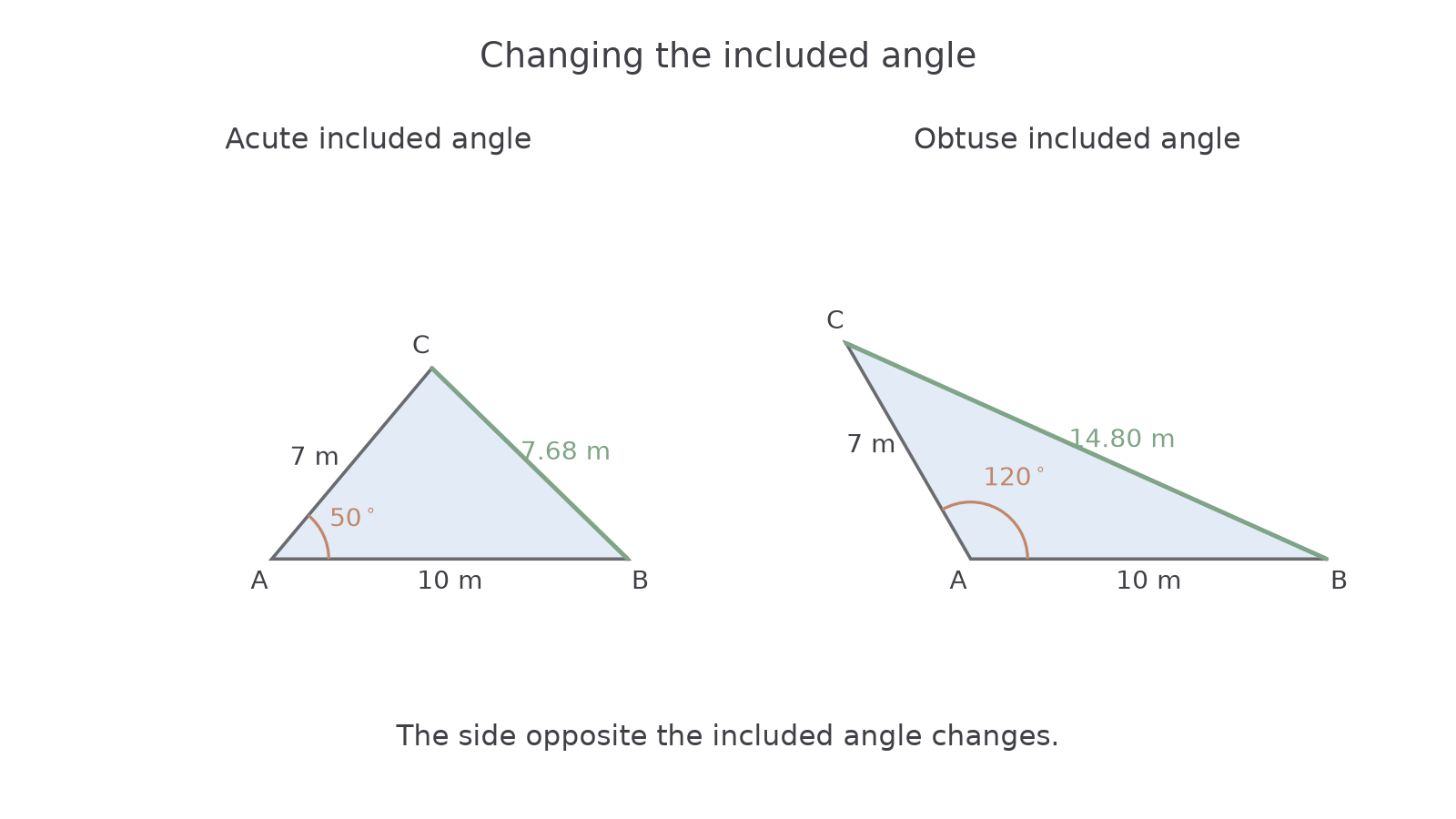
Worked example 1: an acute included angle
Question. Two straight paths from lead to and , with , and . Calculate .
Plan. Use the cosine rule because the known angle is between the known sides.
Answer. , to 3 significant figures.
Check. For a right included angle, the distance would be . An acute opening gives a smaller distance, as found. Also , so the triangle inequality is satisfied.
Keep both path lengths and widen only the included angle. The cosine term now has a different sign.
Worked example 2: an obtuse included angle
Question. The paths still have and , but . Calculate .
Plan. Use the same cosine-rule arrangement, including the negative value of .
The cosine is negative because the side projects backwards from ; subtracting that negative contribution increases the squared separation.
Answer. , to 3 significant figures.
Check. The obtuse angle is the largest angle, so its opposite side must be the longest: . It is still shorter than the combined path length 17 m.
Always take the positive square root to turn the calculated squared length into a length.
Watch out
The cosine rule gives , not . Also keep the minus sign before : for an obtuse included angle, subtracting a negative term makes larger than .
Use a new pair of sides.
Three sides
If all three sides are known, no opposite angle is available for the sine rule. Rearrange the cosine rule instead. First add and subtract on both sides, then divide by .
Cosine rule for an angle
The side is opposite the required angle . This is a rearrangement of the supplied cosine rule; the rearranged version is not separately printed in the formula list.
A triangle angle lies between and , where inverse cosine gives a single answer. A negative cosine gives an obtuse angle directly. Do not apply the sine-rule instruction to subtract from again.
Continue this lesson.
You’re previewing NovaLearn without an account. Create a free account to read the rest.
Create free account