E8.3 - Magnitude of a vector (Extended)
A journey goes 6 units right and 2 up, then 2 left and 4 up. How far is the finish from the start in a straight line? E8.3 uses Pythagoras' theorem to find a vector's magnitude. You will read modulus notation, distinguish length from direction and calculate the magnitude after combining vectors.
Vector length
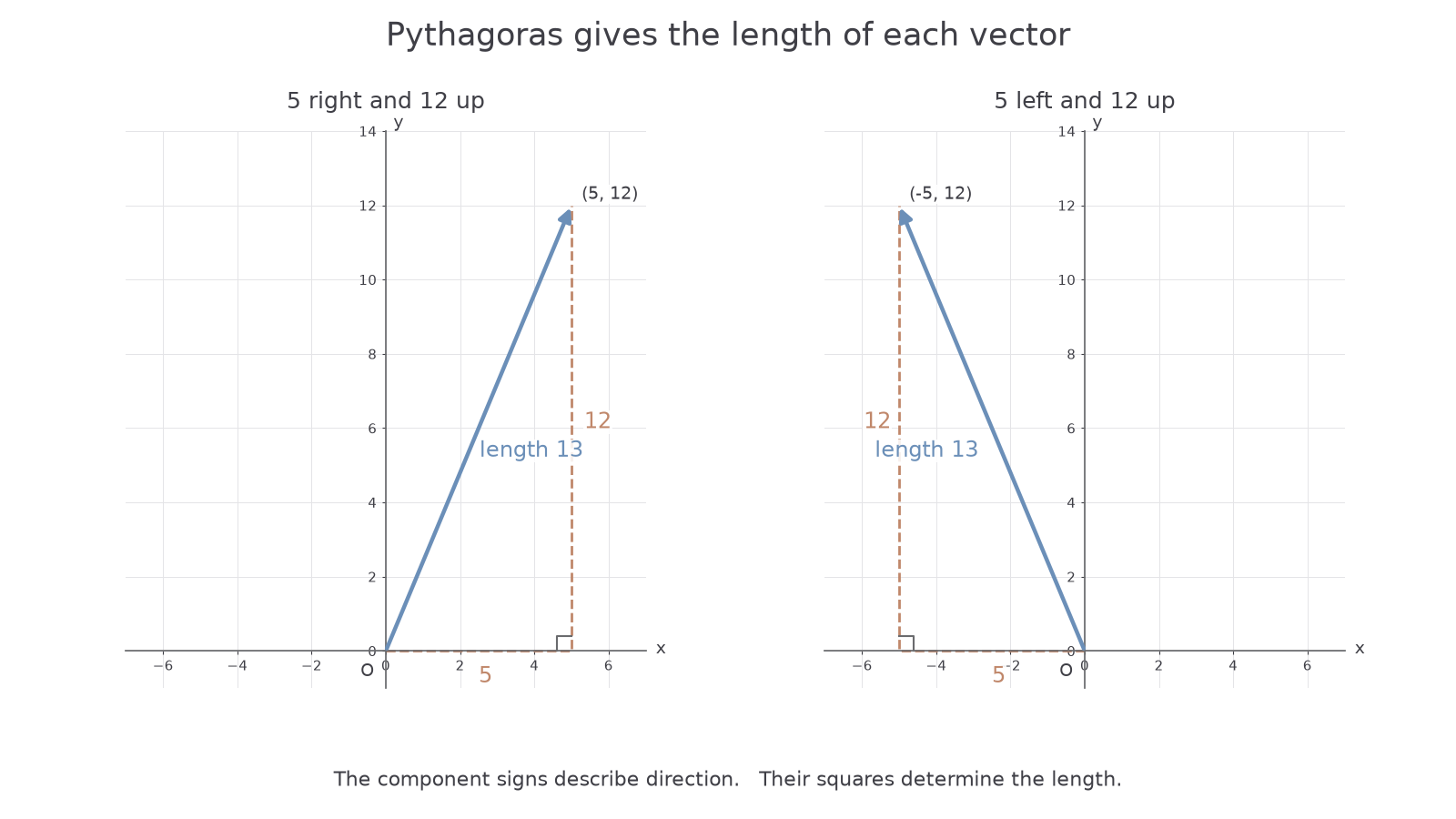
A vector's components give perpendicular horizontal and vertical displacements. Draw those two legs and the vector becomes the hypotenuse of a right-angled triangle. Its length is found from the sum of the squares, even when a component is negative.
Magnitude
The magnitude of a vector is its length. It is a single non-negative number: it does not include a direction. Only the zero vector has magnitude zero.
The legs have lengths equal to the sizes of the signed components, while the vector's magnitude is . Their squares are and , since squaring removes either sign. Pythagoras therefore gives .
Magnitude from components
For a two-dimensional vector ,
Take the non-negative square root. Both components must use the same unit. Not on the supplied formula list for Papers 1–4: learn it.
[DIAGRAM: asset_name: Vector lengths from perpendicular components; asset_slug: vector_length_triangles; caption: Reversing the horizontal sign changes the direction, but not the squares or the length.; description: Two accurate equal-scale grids show vectors from the origin to five comma twelve and minus five comma twelve. Dashed horizontal and vertical components form right triangles with leg lengths five and twelve. Each vector is labelled length thirteen, with the right angle marked where the horizontal and vertical legs meet.]
Worked example 1: a vector pointing right and up
Question. Calculate the magnitude of .
Plan. Use the two components as perpendicular legs, then take the square root of their squared sum.
Answer. 13 units.
Check. , recovering the horizontal leg. The straight-line length is greater than either component size and less than .
Change only the horizontal sign. The arrow points left instead, while the triangle's leg lengths stay 5 and 12.
Worked example 2: a negative component
Question. Calculate the magnitude of .
Plan. Square the signed components in brackets and take the positive length.
Answer. 13 units, the same magnitude as the first vector.
Check. The second right triangle is the first reflected in the vertical axis. Reflection preserves lengths, agreeing with the calculation.
For , the formula gives : a vertical vector's magnitude is just its vertical component's size. For the zero vector it gives zero. No negative magnitude is needed in either case.
Watch out
Do not add the components or take a root of their unsquared sum. Also, , whereas . Brackets preserve the negative component before squaring.
Calculate the length of a new vector with a downward component.
Modulus notation
Vertical bars around a vector mean its magnitude. They change the type of answer you give: the vector itself needs two components, while its magnitude is one length.
Modulus signs for a vector
If is a vector, is its magnitude. Similarly, is the magnitude of the directed segment from A to B, equal to the ordinary distance AB.
The bars do not mean “make each component positive”.
For example, if , then , not . The second expression would still be a vector. Reversing any vector changes both component signs, but their squares stay the same, so .
Worked example 3: a directed segment's magnitude
Question. and are points. Find .
Plan. Find the displacement from A to B, then calculate its length.
Answer. units.
Check. A to B moves 6 right and 8 up. These form a right triangle whose sides are twice 3, 4 and 5, so its diagonal is twice 5, agreeing with 10.
Reverse only the directed segment in the second example. Its arrow reverses, but the distance between the endpoints cannot change.
Worked example 4: the reversed directed segment
Question. For the same points, find .
Plan. Form the reversed vector, then interpret the modulus signs as length.
Answer. units, equal to .
Check. A journey back along the same segment has the same length. The reversed components add to the original components to give zero, confirming that only the direction has reversed.
Continue this lesson.
You’re previewing NovaLearn without an account. Create a free account to read the rest.
Create free account