C4.3; E4.3 - Midpoints and lengths
The endpoints of a segment are and . Where is its centre, and how long is it? C4.3 and E4.3 use coordinate averages for a midpoint and Pythagoras' theorem for a length, then work backwards when an endpoint is missing.
Midpoint coordinates
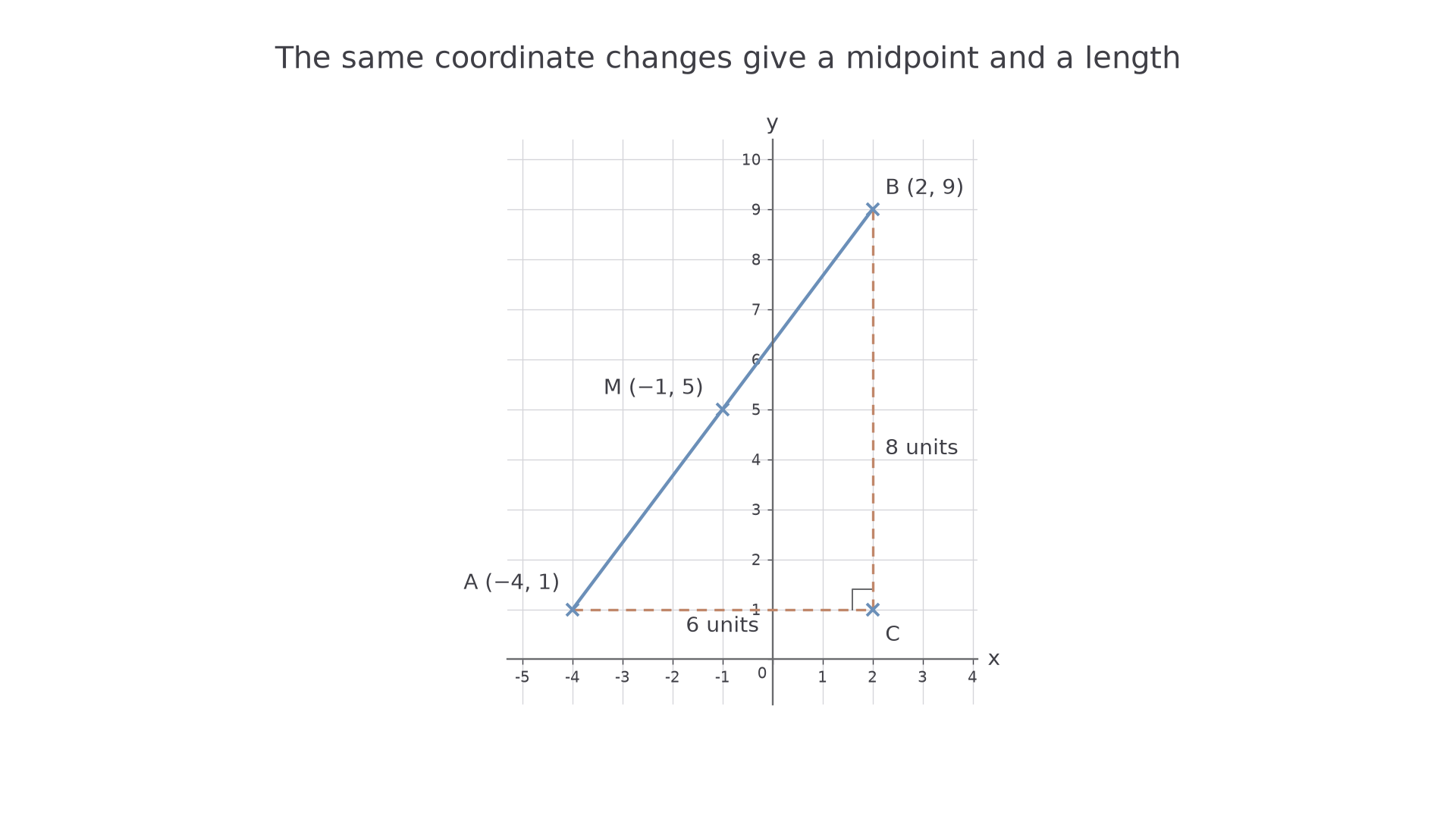
Halfway between and is : a horizontal change of 6 has been split into two changes of 3. Halfway between and is . Taking both halfway positions together gives the segment's midpoint, .
Midpoint coordinates
The midpoint of endpoints and is
Average corresponding coordinates: horizontal with horizontal, vertical with vertical. Not on the supplied formula list for Papers 1–4: learn it.
This works because half of the horizontal change and half of the vertical change make half of the same straight segment. For example, . The midpoint need not be the origin or a whole-number grid crossing.
[DIAGRAM: asset_name: A midpoint and its right-angled coordinate triangle; asset_slug: midpoint_length_triangle; caption: M is halfway along AB; the horizontal and vertical legs are 6 and 8 units.; description: An exact equal-scale Cartesian grid shows A at minus four comma one, B at two comma nine and M at minus one comma five. A right-angled dashed step passes from A to C at two comma one then to B; its horizontal leg is labelled six and vertical leg eight. The diagonal AB is highlighted and M is marked without hiding the line. Axis scales and point labels are clear.]
Worked example 1: midpoint across the y-axis
Question. Find the midpoint of and .
Plan. Average the two horizontal coordinates and the two vertical coordinates separately.
Answer. .
Check. From to , the changes are . From to , they are again , so the two halves are equal and lie in the same direction.
Change only the second endpoint's horizontal coordinate. An odd horizontal total now gives a fractional midpoint coordinate.
Worked example 2: a midpoint between grid crossings
Question. Find the midpoint of and .
Plan. Use the averages exactly, without rounding to a whole-number point.
Answer. , or .
Check. Both horizontal changes are 3.5 and both vertical changes are 4. The fractional horizontal position is necessary to split the 7-unit span equally.
Adding and dividing by 2 finds a position. Subtracting and dividing by 2 gives half a change, which must still be added to the starting coordinate if you use that route.
Watch out
The midpoint is not . For the first pair that would give , the changes from to the midpoint, rather than the midpoint's address .
Let the midpoint have non-integer coordinates when the calculation requires them.
Segment length
Join two endpoints and add a horizontal and a vertical side to make a right-angled triangle. The segment is the hypotenuse. Its perpendicular side lengths are the horizontal separation and vertical separation, so Pythagoras' theorem gives the length even if the segment slopes downwards.
Distance between two points
For points and ,
This is Pythagoras' theorem applied to the coordinate differences. A distance is non-negative. Not on the supplied formula list for Papers 1–4: learn the method.
A difference may be negative, but its square is positive or zero. Thus either subtraction order gives the same distance, provided each difference uses corresponding coordinates. For a horizontal or vertical segment, one difference is zero and the length is simply the absolute value of the other difference.
Worked example 3: an exact whole-number length
Question. Find the length from to .
Plan. Use the horizontal and vertical separations as the two shorter sides of a right-angled triangle.
Answer. 10 units, completing the opening problem.
Check. Each half of the diagram has perpendicular changes 3 and 4, giving length . Two halves make 10 units, agreeing with the whole segment.
Continue this lesson.
You’re previewing NovaLearn without an account. Create a free account to read the rest.
Create free account