E3.6 - Translating function graphs (Extended)
Why does adding 2 outside a function move its graph up, while adding 2 inside moves it left? You will track individual points to explain vertical and horizontal translations, describe their vectors, and write equations for translated graphs.
Vertical translations
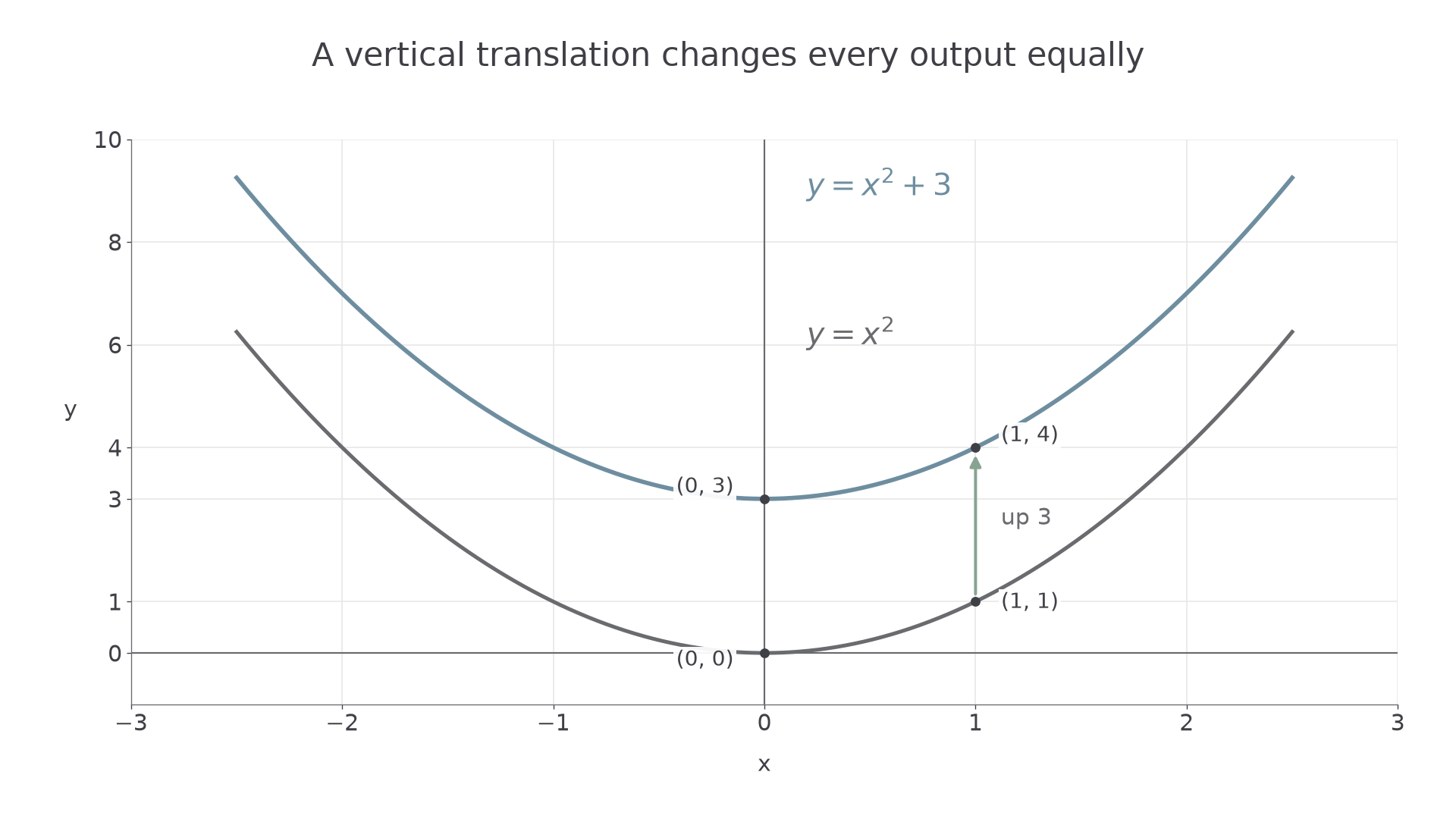
Suppose a graph contains the point . Adding 3 to every output moves this point to . The input stays fixed: every point moves straight upwards by the same distance, so the shape is unchanged.
Vertical translation
The graph is the graph of translated vertically by units. Its points move as . Positive moves the graph up; negative moves it down. Here is an integer.
The extra number acts after the function has produced its output. It adds the same amount to the maximum, minimum and every other output.
[DIAGRAM: asset_name: Moving a parabola vertically; asset_slug: graph_vertical_translation; caption: Adding 3 moves every point up 3 units; inputs stay fixed.; description: Exact coordinate plot of y equals x squared and y equals x squared plus 3. The vertices zero comma zero and zero comma three are marked, and an upward arrow connects the corresponding points 1 comma 1 and 1 comma 4. Curves are directly labelled.]
Worked example 1: adding to the output
Question. Let . Describe the translation to , give its equation in terms of , and state its vertex.
Plan. Add 3 to each output, including the original vertex's output.
The vertex moves to .
Answer. Translate 3 units up. The equation is , with vertex .
Check. The original point moves to , and . Its input has not changed.
Change only the sign of the added constant. The displacement reverses.
Worked example 2: subtracting from the output
Question. With , describe the translation to , give the new equation and state its vertex.
Plan. Subtract 3 from every output.
The vertex becomes .
Answer. Translate 3 units down. The equation is , with vertex .
Check. At , the new output is 1, exactly 3 below the original output 4. The axis of symmetry remains .
A translation moves the entire graph by the same displacement; it does not multiply its heights.
Watch out
and perform different operations. Only the first adds 3 to the output. Place brackets carefully.
Apply an output change to a different starting curve.
Horizontal translations
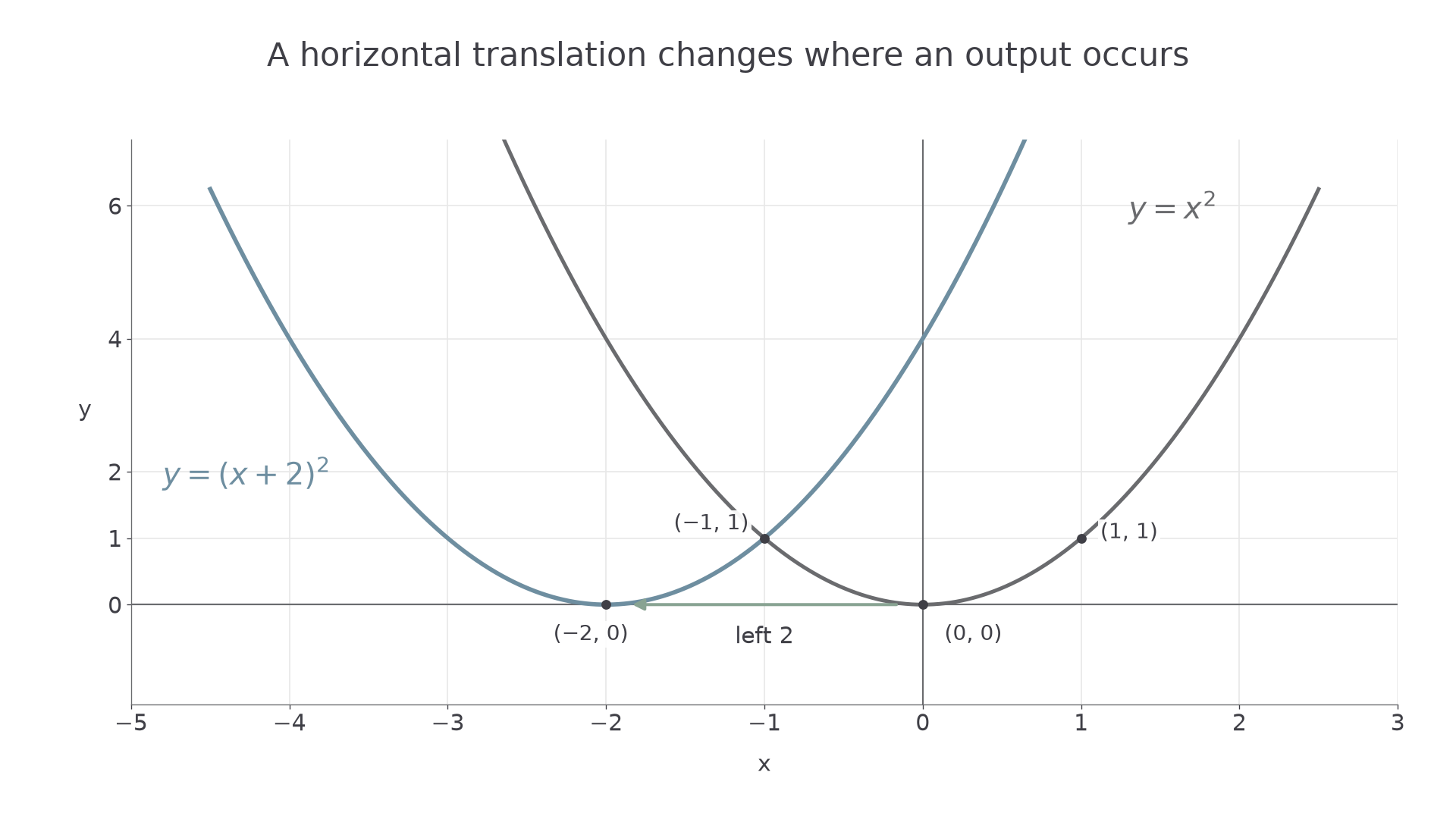
For , ask where an old input is used. If the original graph has input 5, the new graph uses that same function input when , so . Its output is unchanged, but it occurs 2 units further left.
Horizontal translation
The graph is the graph of translated horizontally by units. Its points move as . For positive , move left by ; for negative , move right by . Here is an integer.
This sign is explained by keeping the old function input fixed. To get the old output at input , solve , which gives .
[DIAGRAM: asset_name: Moving a parabola horizontally; asset_slug: graph_horizontal_translation; caption: The input x plus 2 reaches zero when x equals minus 2, so the vertex moves left.; description: Exact coordinate plot of y equals x squared and y equals x plus 2 squared, with vertices zero comma zero and minus two comma zero labelled. A leftward arrow shows the vertex translation, and corresponding points 1 comma 1 and minus one comma 1 are marked.]
Worked example 3: adding inside the function
Question. Let . Describe the translation to , give the equation in terms of , and state its vertex.
Plan. Substitute the complete new input into the square, then find where that input is zero.
Answer. Translate 2 units left. The equation is , with vertex .
Check. The original point moves to . Substitution gives , confirming the leftward movement with unchanged height.
Continue this lesson.
You’re previewing NovaLearn without an account. Create a free account to read the rest.
Create free account