E7.2 - Elevation, depression and shortest distance (Extended)
An observer is 18 m above level ground, 30 m horizontally from a tower, and sees its top at an angle of elevation of . Is the tower's height , or is something missing? E7.2 connects horizontal sight lines, perpendicular distances and linked right triangles.
Elevation and depression
Draw a horizontal line through the observer's eye. It is the reference line for both angles: looking upwards gives elevation; looking downwards gives depression. A vertical line is a different reference and produces the complementary angle.
Elevation and depression
An angle of elevation is measured upwards from the observer's horizontal to a line of sight. An angle of depression is measured downwards from that horizontal to a line of sight.
If a person looks up at a roof at , the angle between their sight line and an upward vertical is . The elevation is still , not .
[DIAGRAM: asset_name: Horizontal references for elevation and depression; asset_slug: elevation_depression_horizontal; caption: Elevation is above the observer's horizontal and depression is below it.; description: Two exact side-view panels. In the left, a sight line rises 28 degrees from an observer's dashed horizontal to a target. In the right, a sight line falls 35 degrees below a dashed horizontal to a lower target. The lower target also has a parallel horizontal line, and the equal 35 degree elevation looking back is marked. Vertical directions are shown distinctly from the horizontal references.]
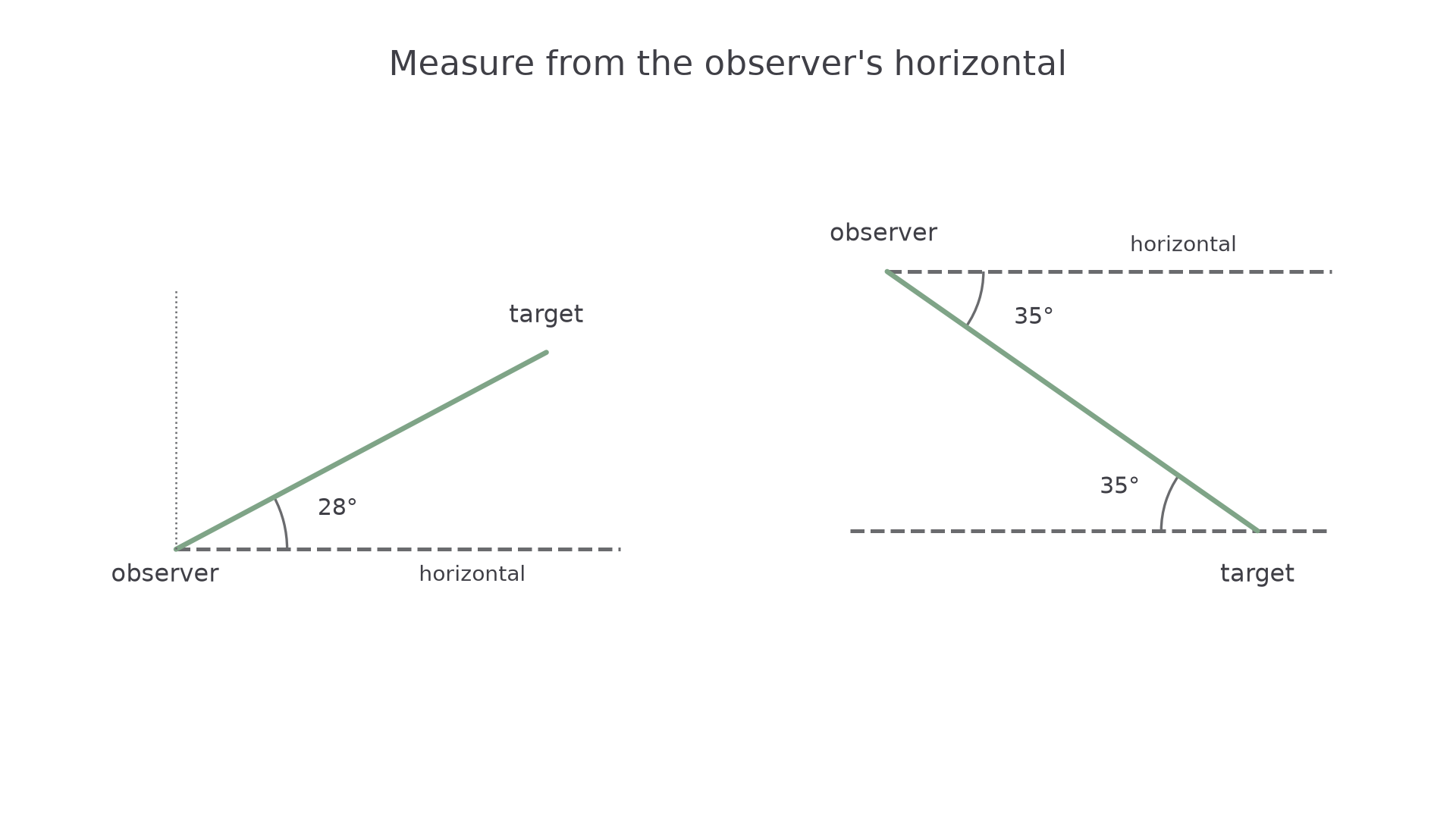
When two observers look directly at each other, their horizontal lines are parallel. A depression of from the upper observer equals an elevation of from the lower observer, by alternate angles. This equality concerns the same sight line, not a different target.
Watch out
A right triangle drawn beside a vertical wall may show the angle at the top beside the vertical. Subtract that angle from to obtain the depression from horizontal.
Identify both the reference and the angle.
Shortest distance
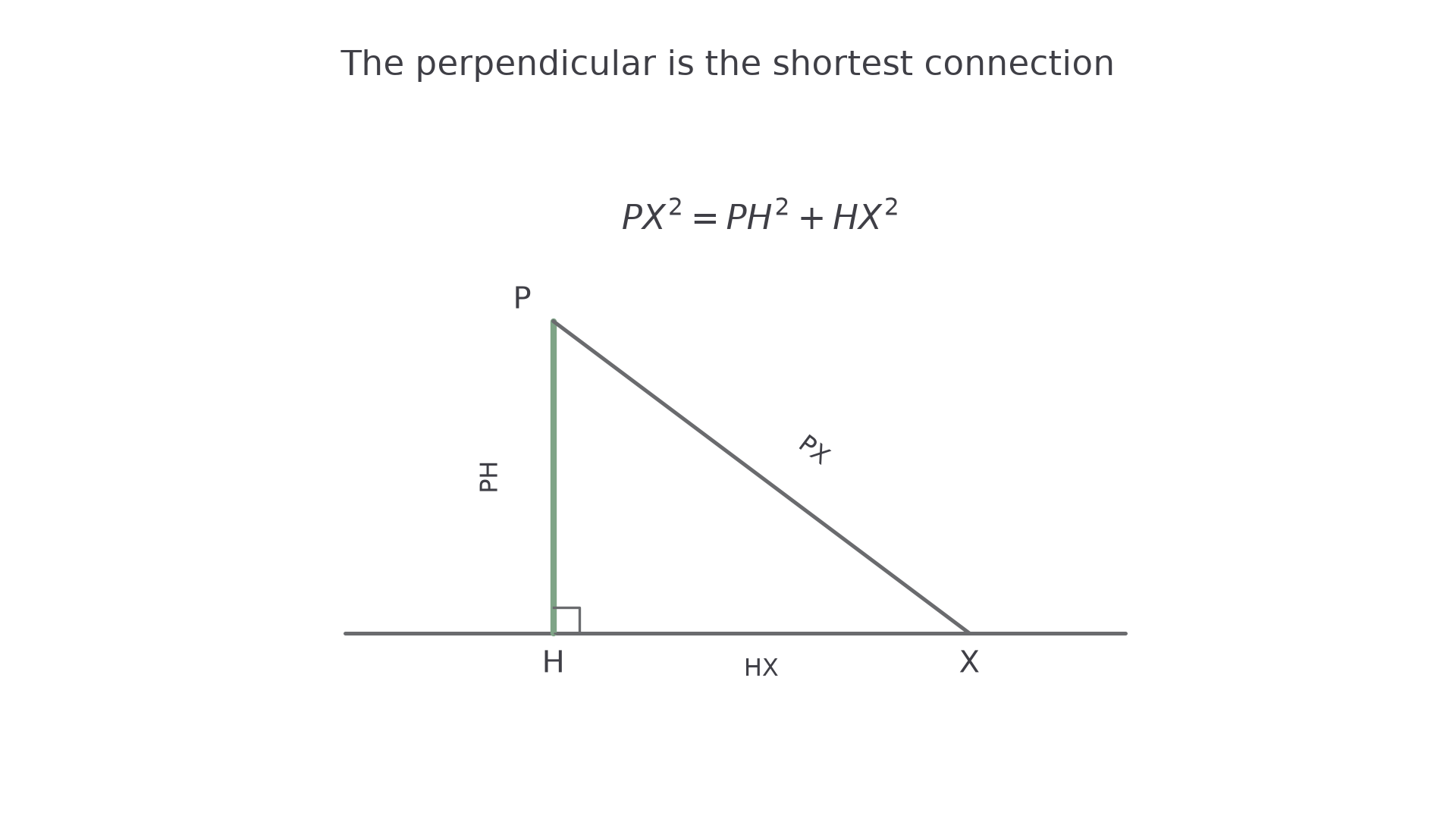
The shortest distance from a point to a straight line meets that line perpendicularly. To see why, let be the perpendicular foot from point , and choose another point on the line. Pythagoras gives . For , the added square is positive, so .
Perpendicular distance
The perpendicular distance from a point to a line is the length of the segment meeting the line at . It is the shortest distance to that line.
The foot can lie on an extension of a drawn segment. A question asking for distance to a finite segment needs its endpoints considered if the foot falls outside it; the shortest-distance-to-a-line result refers to the complete straight line.
[DIAGRAM: asset_name: Why the perpendicular is shortest; asset_slug: perpendicular_shortest_distance; caption: Every slanted route PX adds a positive horizontal square to the perpendicular distance PH.; description: Exact straight horizontal line with foot H, point X further along it, and point P vertically above H. PH is highlighted and has a right-angle square at H. PX is a slanted segment, HX is dashed, and the relationship PX squared equals PH squared plus HX squared is displayed in a separate uncluttered label.]
Worked example 1: distance to a straight road
Question. Point is 24 m from a point on a straight road. The angle between and the road is . Calculate the shortest distance from to the road.
Plan. Drop a perpendicular from to the road; use sine in the resulting right triangle.
Answer. to three significant figures.
Check. The along-road distance is . The two unrounded component squares sum to , and the perpendicular is shorter than the 24 m slanted connection.
Keep the 24 m slanted connection but increase the angle it makes with the road. The perpendicular distance should increase.
Worked example 2: a steeper connection
Question. Another point is 24 m from , and makes with the same straight road. Calculate the shortest distance from to the road.
Plan. Use the new acute angle in the same perpendicular triangle structure.
Answer. to three significant figures.
Check. This lies between the previous perpendicular distance and 24 m, as the steeper connection predicts. Since , the new perpendicular equals the previous along-road component.
Continue this lesson.
You’re previewing NovaLearn without an account. Create a free account to read the rest.
Create free account