C5.1; E5.1 - Geometrical language
A square is also a rectangle: how can one shape have two correct names? The vocabulary in C5.1 and E5.1 lets you describe lines, angles, triangles, quadrilaterals and polygons precisely, using their properties rather than their appearance.
Lines and angles
Geometrical words describe exact features: turning a diagram does not change those features. A square balanced on a corner still has four right angles, so it is still a square.
Points, lines and vertices
A point marks an exact position and has no size. A line is straight and extends indefinitely in both directions; a line segment is the finite part between two endpoints. A vertex is a corner where sides or edges meet; its plural is vertices.
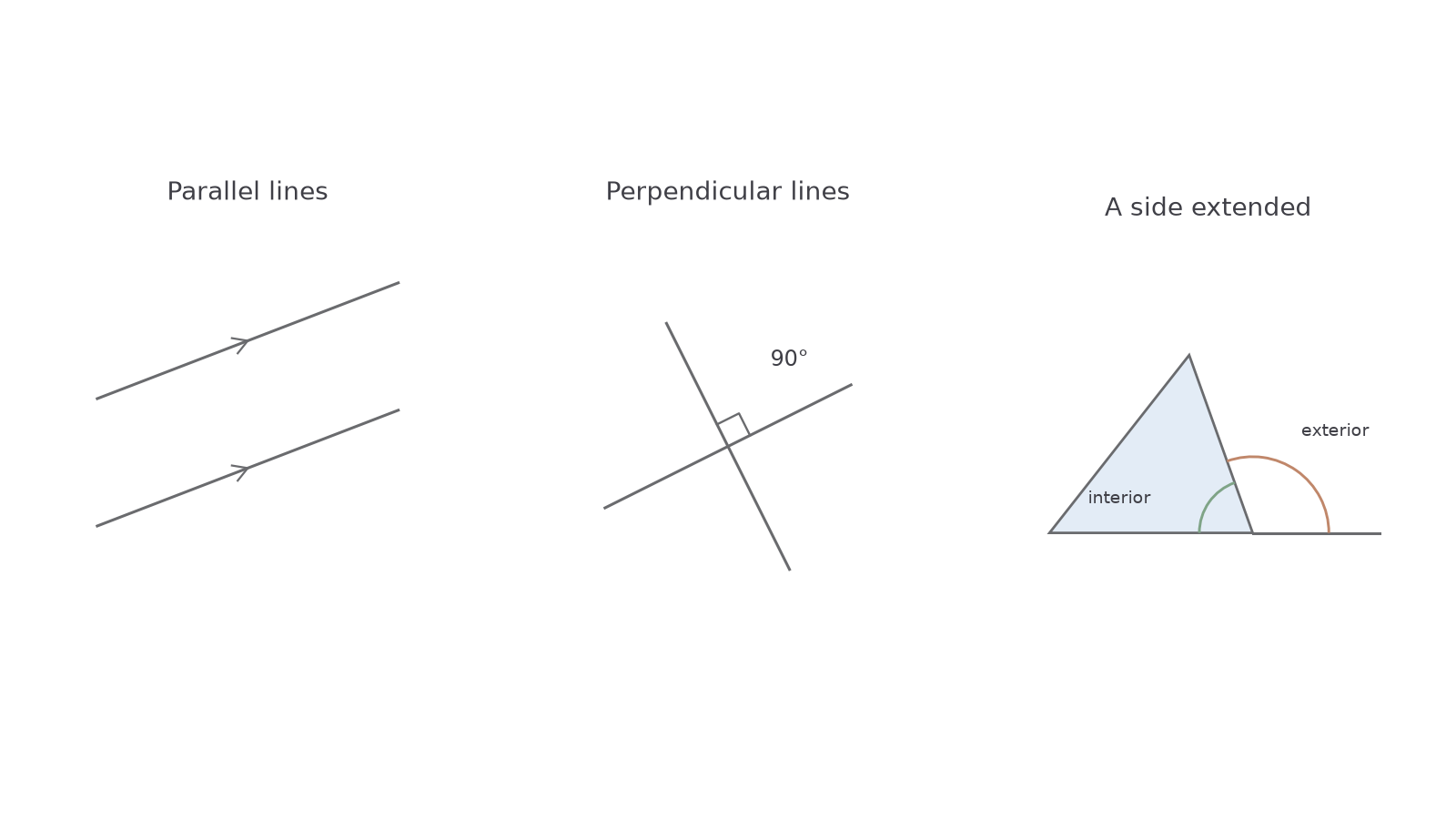
Letters identify positions. The segment joins points and . Two lines are parallel if they lie in the same flat surface and never meet, however far extended. Matching arrow marks on the lines show that they are parallel. Different parallel pairs use different arrow marks.
Two lines are perpendicular if they meet at a right angle, . A small square marks a right angle. Perpendicular lines can be sloping: “vertical” and “horizontal” describe directions on a page, whereas “perpendicular” describes the angle between two lines.
[DIAGRAM: asset_name: Line and angle vocabulary; asset_slug: lines_angle_vocabulary; caption: Matching arrows show parallel lines, a square shows a right angle, and an arc selects the angle being described.; description: Three exact panels show two sloping parallel lines with matching arrows, two perpendicular sloping lines with a right-angle square, and a polygon vertex with an interior angle and the adjacent exterior angle marked on an extended side.]
An angle measures a turn between two rays meeting at a vertex. One complete turn is . The marked arc tells you which turn is meant.
| Angle name | Size |
|---|---|
| Acute | Greater than , less than |
| Right | Exactly |
| Obtuse | Greater than , less than |
| Straight | Exactly |
| Reflex | Greater than , less than |
For example, is acute, is obtuse and is reflex. A turn of is straight, not obtuse. The same two rays can enclose a smaller angle and a reflex angle, so attend to the arc.
An interior angle is inside a polygon at a vertex. An exterior angle is formed between a side and the extension of an adjacent side. Extend the actual side; an arbitrary angle outside a shape need not be its exterior angle.
A bearing gives the direction of one point from another. It is measured clockwise from north and written with three figures: due east has bearing . North, east, south and west are the compass directions. You will use this vocabulary to measure and calculate bearings in the bearings lesson.
Watch out
Parallel arrows belong on the lines. An arrow pointing towards a line does not mark it as parallel. A sloping pair may be perpendicular; the meeting angle decides.
Use angle size and the marked turn, rather than the tilt of the picture.
Triangles and quadrilaterals
Count sides first, then use equality and angle properties to give a more precise name. Tick marks on sides mean equal lengths; matching arcs at vertices mean equal angles. A drawing's apparent lengths alone do not establish equality.
Triangle types
A triangle has three straight sides. An equilateral triangle has three equal sides and three equal angles. An isosceles triangle has two equal sides and equal angles opposite those sides. A scalene triangle has three unequal sides. A right-angled triangle has one right angle.
A triangle can have both a side description and an angle description. A right-angled triangle with two equal shorter sides is right-angled and isosceles; a right-angled triangle with all sides unequal is right-angled and scalene. “Right-angled” does not tell you whether two sides are equal.
Continue this lesson.
You’re previewing NovaLearn without an account. Create a free account to read the rest.
Create free account