C9.3; E9.3 - Combined events and sample spaces
Two coins can give no heads, one head or two heads. Are those three descriptions equally likely? C9.3 and E9.3 use systematic sample spaces to keep track of individual combined outcomes, count favourable results and understand repeated selections with replacement.
Listing outcomes
A combined outcome records both stages of an experiment. Keep the stage order: heads then tails and tails then heads are different outcomes, even though both contain one head.
Sample space
A sample space lists every possible outcome of an experiment. A systematic list or table varies one stage while holding the other fixed, so no outcome is lost or repeated.
If one stage has choices and each can be followed by the same choices, there are ordered pairs. This counts outcomes; it does not by itself make them equally likely.
Worked example 1: two ordered coin results
Question. A fair coin is tossed twice independently. List the sample space, using H for heads and T for tails, with the first toss written first.
Plan. Fix the first result as H and list both second results, then repeat with first result T.
| First toss | Second toss | Combined outcome |
|---|---|---|
| H | H | HH |
| H | T | HT |
| T | H | TH |
| T | T | TT |
Answer. HH, HT, TH, TT.
Check. Two choices at each stage give outcomes. Both possible second results occur after each first result.
Now the second stage has three outcomes instead of two. A table makes the changed number of combinations visible.
Worked example 2: different numbers of choices
Question. A fair coin is tossed and, independently, a fair spinner labelled 1, 2, 3 is spun. List all combined outcomes, writing the coin result first.
Plan. Use one row per coin result and one column per spinner result.
| Coin / spinner | 1 | 2 | 3 |
|---|---|---|---|
| H | |||
| T |
Answer. .
Check. There are pairs. Each spinner result occurs once with H and once with T.
Every pair in these examples is equally likely because the stages are independent and each device has equally likely individual outcomes. A biased coin can give the same list of possible pairs, with different probabilities.
Watch out
“Zero heads, one head, two heads” is not an equally likely sample space. “One head” collects two ordered outcomes, HT and TH, while each other description collects only one.
Keep the stage labels in your own list.
Favourable outcomes
A sample-space table gives one cell per combined outcome. When its cells are equally likely, count the cells satisfying the event and divide by the total cell count.
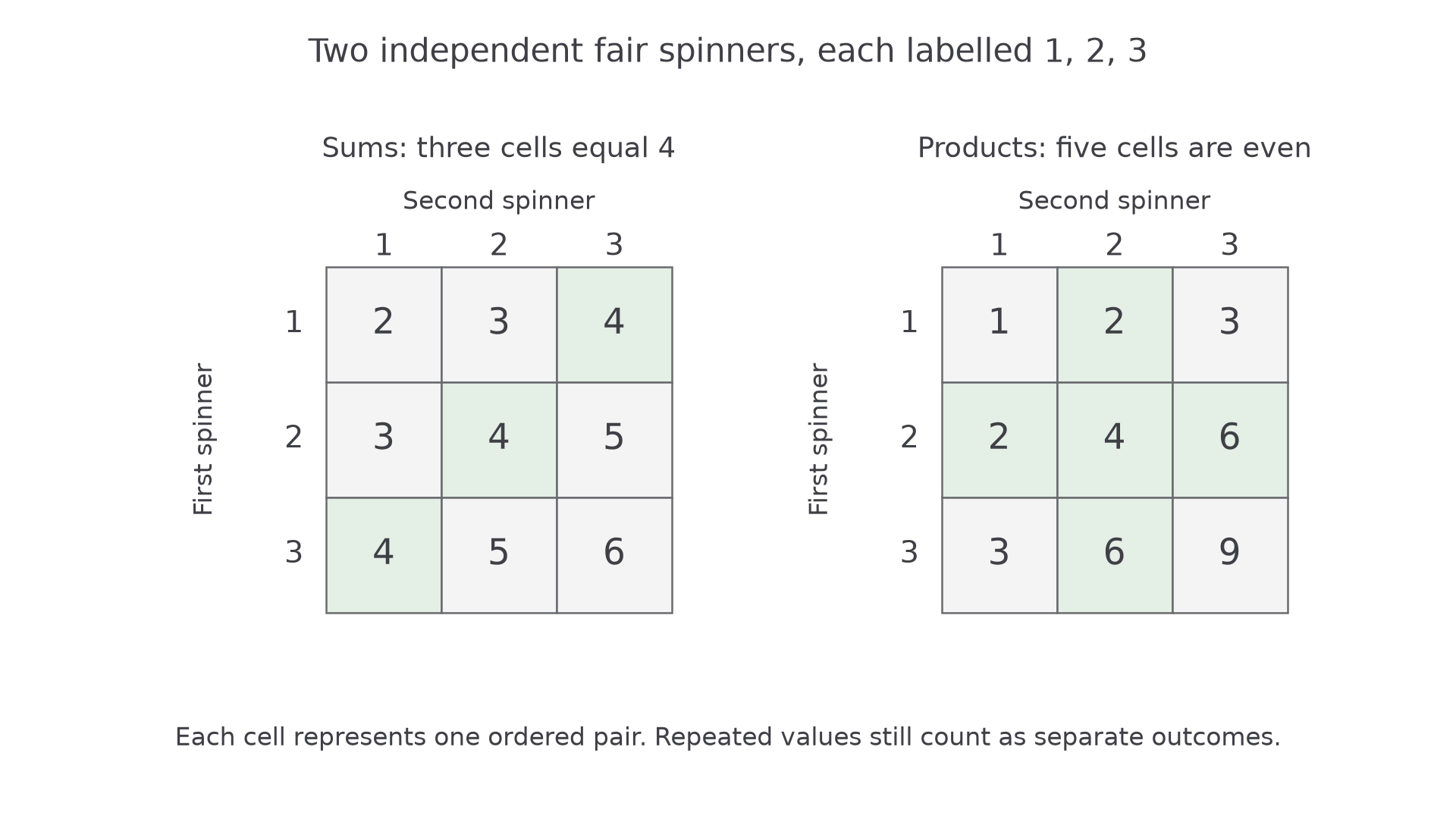
Two independent fair spinners, each labelled 1, 2, 3, give nine equally likely ordered pairs. A table can display either the pairs themselves or a calculated value, such as their sum. Repeated sums still occupy different cells.
[DIAGRAM: asset_name: Sums and products of spinner pairs; asset_slug: spinner_sample_spaces; caption: Each grid has nine equally likely pairs, even when some sums or products repeat.; description: Two three-by-three sample-space tables have first-spinner values one, two, three down the rows and second-spinner values one, two, three across the columns. The left table shows sums with rows two three four, three four five, four five six, highlighting the three cells equal to four. The right table shows products with rows one two three, two four six, three six nine, highlighting the five even cells.]
Worked example 3: a combined sum
Question. Two independent fair spinners are each labelled 1, 2, 3. Find the probability that the sum is 4.
Plan. List the ordered pairs giving 4 and count them out of all nine pairs.
Answer. .
Check. Counting row by row gives one favourable cell in each of three rows. The remaining six cells give a sum other than 4, so the probabilities total .
The devices are unchanged, but the event now depends on a product. Test the condition in each cell instead of reusing the previous shading.
Worked example 4: a combined product
Question. The same two independent fair spinners, each labelled 1, 2, 3, are spun. Find the probability that their product is even.
Plan. Select pairs with at least one 2, since the other spinner values are odd.
Answer. .
Check. An odd product needs both spinner values odd. The four pairs do this, leaving even-product pairs.
Continue this lesson.
You’re previewing NovaLearn without an account. Create a free account to read the rest.
Create free account