E3.7 - Logarithms and exponential equations (Extended)
How long does an investment take to grow by half when the same percentage is added each year? E3.7 introduces logarithms as the inverse of exponentials, then uses them to find unknown powers and interpret growth and decay times. Graphs provide a second way to see and check the solutions.
Inverse of exponentials
You know that . If the missing number is the power, the question becomes “What power of 2 gives 32?” A logarithm records that power: .
Logarithm
For , and ,
The small number is the base. The logarithm is the exponent, not the result of division by the base. A logarithm written has base 10 unless another base is stated.
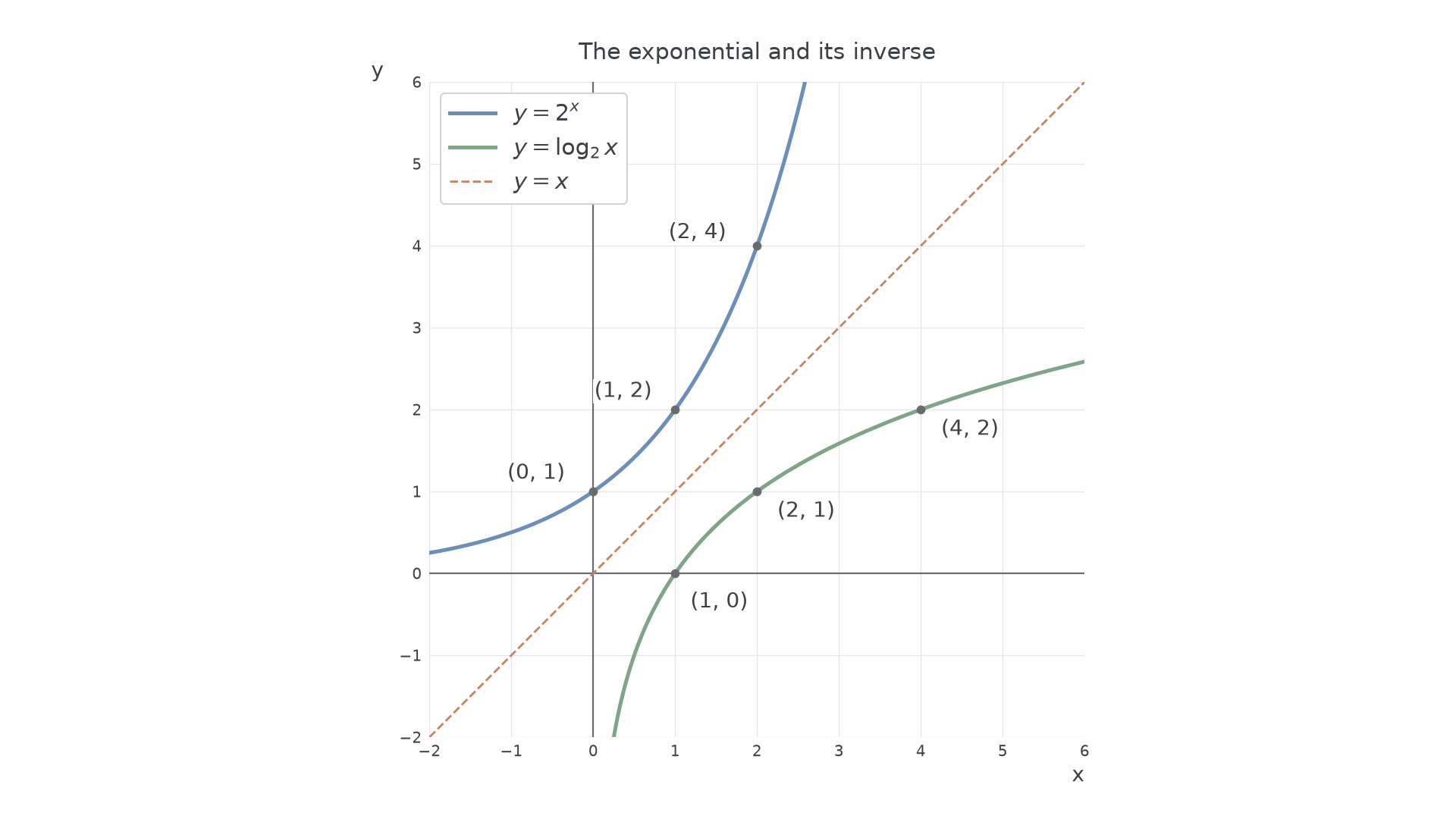
The exponential function sends an input to ; its inverse sends that positive output back to . For example, gives , and gives . A logarithm can be negative even though its argument must be positive. No real logarithm of zero or a negative number is defined here.
[DIAGRAM: asset_name: Exponential and logarithm reverse input and output; asset_slug: logarithm_inverse; caption: Corresponding points swap coordinates across the line y equals x.; description: Two accurate curves y equals two to the power x and y equals log base two of x, reflected in the dashed line y equals x. The pairs zero comma one and one comma zero, one comma two and two comma one, and two comma four and four comma two are marked. The logarithm exists only to the right of the vertical axis.]
Worked example 1: reading a power backwards
Question. Find .
Plan. Find the exponent that makes a power of 2 equal 32.
Answer. 5.
Check. Five factors of 2 multiply to 32, so the inverse returns the original exponent.
A base-ten logarithm can contain an expression. Reverse the logarithm first, then solve the resulting ordinary equation.
Worked example 2: an expression inside a logarithm
Question. Solve .
Plan. Rewrite the logarithmic equation as an exponential equation with base 10.
Answer. .
Check. , so the logarithm is defined, and . The answer is not : the argument is the whole product .
This method uses the inverse relationship directly; no logarithm laws are needed.
Watch out
means , not . The unstated base belongs to the exponential, while the logarithm's value becomes the exponent.
Reverse the function before dividing in this fresh equation.
Solving exponentials
Not every exponential equation has an integer solution. Since and , the solution of lies between 2 and 3. A calculator's base-ten logarithms give it directly.
Finding an unknown exponent
If , where , and , then
Use the same logarithm base in numerator and denominator. This relationship is not on the supplied formula list for Papers 1–4: learn it.
The quotient changes the base of the logarithm: it evaluates using the calculator's ordinary log key. Keep the whole quotient together. When an expression occupies the exponent, the quotient equals that entire expression.
Worked example 3: a non-integer exponent
Question. Solve , giving your answer to 3 significant figures.
Plan. Use the logarithm quotient, then check the answer between neighbouring powers.
Answer. to 3 significant figures.
Check. The unrounded value gives . Also , so , consistent with the answer.
Only the exponent changes in the next equation. Find the whole exponent before isolating .
Worked example 4: an expression as the exponent
Question. Solve , to 3 significant figures.
Plan. Set equal to the same logarithm quotient, then rearrange.
Answer. to 3 significant figures.
Check. Using the unrounded , , and raising 3 to that power returns 20. Substituting instead would put the wrong number in the exponent.
You can also plot the exponential and the horizontal line on a GDC, choose a window containing their crossing and use the permitted intersection feature. Record the graphs and the intersection when a graphical method is requested; an unlisted equation-solver application is not the graphical method.
Watch out
Do not reverse the quotient: is less than 1 and cannot be the power producing 20 from 3. Keep full calculator precision until the final answer.
Continue this lesson.
You’re previewing NovaLearn without an account. Create a free account to read the rest.
Create free account