E5.6 - Circle angle theorems (Extended)
The same two endpoints can define an acute angle on one side of a circle and an obtuse angle on the other. How do you choose the correct angle at the centre? E5.6 connects centre and circumference angles, angles in the same segment and opposite angles of cyclic quadrilaterals, always keeping track of the arc involved.
Centre and circumference
Choose two endpoints and on a circle. An angle , with elsewhere on the circumference, looks across the arc from to that does not contain . That is the arc subtended by the angle.
Centre and circumference theorem
The angle at the centre is twice the angle at the circumference standing on the same arc. If is the selected centre angle and is the circumference angle, then . The centre angle may be reflex.
For example, if the minor arc has central angle , a circumference vertex on the major arc gives angle . Move the vertex onto the minor arc: the angle now stands on the major arc, whose centre angle is . That circumference angle is .
[DIAGRAM: asset_name: Selecting the same circle arc; asset_slug: centre_and_same_segment; caption: The selected arc determines whether to use the smaller or reflex centre angle; vertices in the same segment see the same arc.; description: Three exact panels use a chord with minor central angle 120 degrees. In the first, a vertex on the major arc gives a 60-degree circumference angle; in the second, a vertex on the minor arc gives a 120-degree circumference angle corresponding to the reflex 240-degree centre angle. The third places two vertices on the same side of the chord and marks their equal 60-degree angles. Highlighted arcs avoid the circumference vertices.]
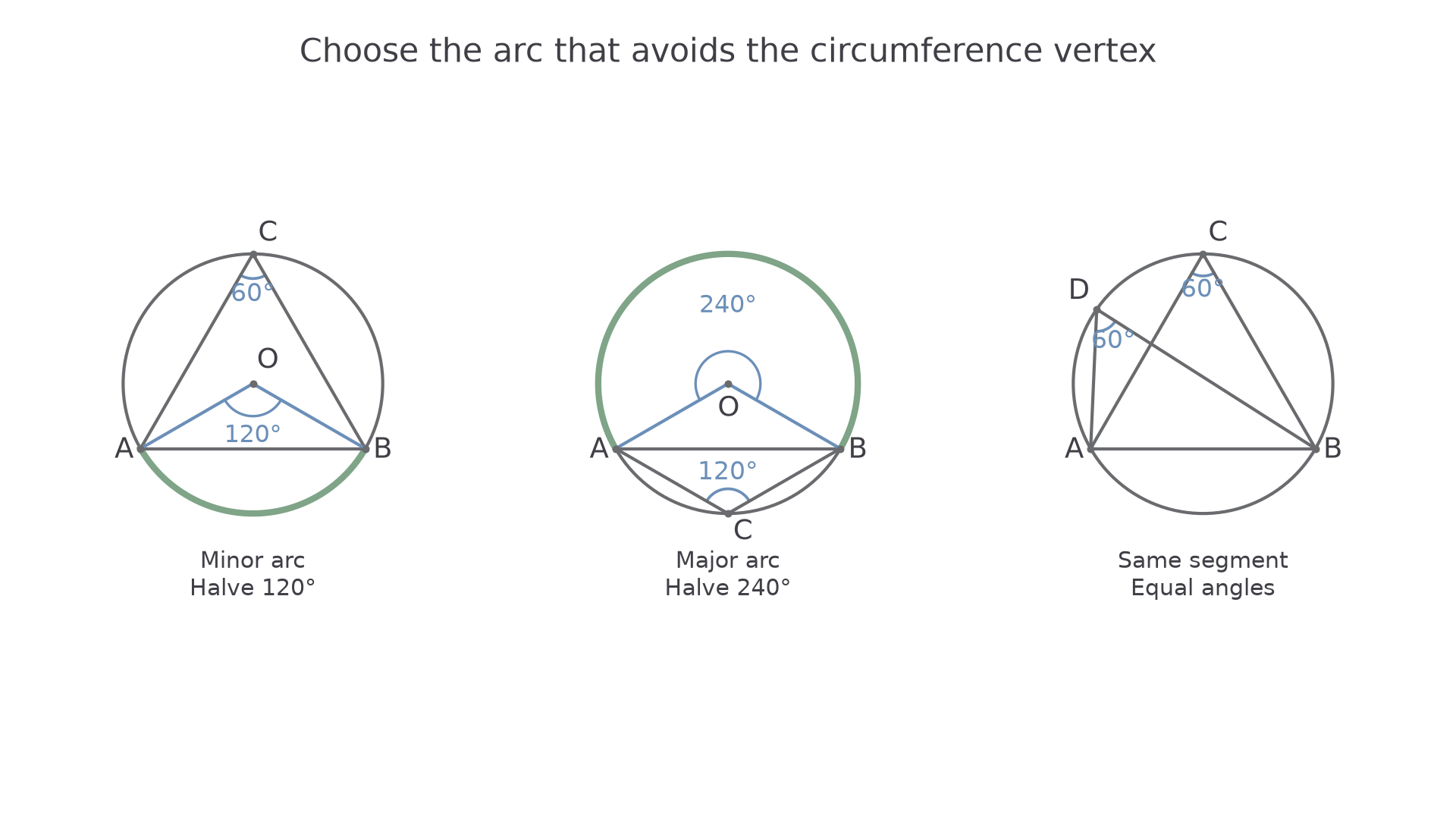
The theorem comes from equal radii. Joining the centre to the circumference vertex splits the figure into isosceles triangles. Their equal base angles, the triangle sum and the full turn at the centre give the double-angle relationship. If the joining line falls outside the angle, subtract the two isosceles-triangle angle relationships instead. Tracking the selected arc keeps the same result in each position.
Worked example 1: halving a centre angle
Question. A circle has centre . Its smaller angle is . Point lies on the major arc . Find , giving a reason.
Plan. Identify the arc not containing , then halve its centre angle.
Answer. , because the centre angle is twice the circumference angle on the same arc.
Check. Doubling returns . Since the selected arc is smaller than a semicircle, the circumference angle is acute.
Now the circumference vertex lies on the shorter arc, so doubling gives a reflex centre angle first.
Worked example 2: selecting a reflex angle
Question. , and lie on a circle with centre . Point is on the minor arc , and . Find the smaller angle , giving reasons.
Plan. Double the circumference angle to find the reflex angle on its major arc, then subtract from a full turn.
Answer. The smaller angle is .
Check. The two centre angles sum to . The angle on the major arc must be reflex, agreeing with , while the requested smaller angle is obtuse.
When the selected arc is a semicircle, the centre angle is , giving at the circumference. This includes the diameter theorem you already know.
Watch out
Do not automatically double an angle and report the result. First identify the two endpoints, then the arc, then whether the question asks for the smaller or reflex centre angle.
Use the position of the circumference vertex in the next calculation.
Same segment
The centre angle on an arc stays fixed. Any circumference angles standing on that same arc are both half the same centre angle, so they are equal.
Angles in the same segment
If and lie on the same side of chord , on the same circle and away from and , then . These are angles in the same segment.
Check both endpoints of the angles' arms. The angles may look different because their vertices are far apart, but each must join to and . If the vertices are on opposite sides of the chord, this equality does not apply.
Worked example 3: transferring an angle
Question. lie on one circle. Points and are on the same side of chord . Given , find , giving a reason.
Plan. Compare the two endpoints and the positions of their vertices.
- Both angles have arms ending at and .
- Their vertices and are in the same segment.
- Therefore .
Answer. , because angles in the same segment are equal.
Check. Both angles correspond to the same centre angle. They must therefore each be .
Continue this lesson.
You’re previewing NovaLearn without an account. Create a free account to read the rest.
Create free account