C4.2; E4.2 - Gradient from a graph
Two lines can rise by the same amount and still have different steepness. What else must you compare? C4.2 and E4.2 measure gradient by comparing vertical change with horizontal change on a grid, then use its sign and a well-chosen pair of points to describe a straight line accurately.
Rise and run
A line that rises 3 units over a horizontal distance of 6 units rises half a unit for each unit to the right. Its gradient is . A rise of 3 over only 2 horizontal units would give , a steeper line. Rise alone cannot measure steepness.
Gradient from a grid
Read both changes in the axes' units. The horizontal change must be non-zero. Not on the supplied formula list for Papers 1–4: learn it.
Draw a right-angled step between two clearly read points on the line. Move from left to right: the horizontal change is then positive, and the vertical change records a rise or a fall. The sloping length is neither change. On a straight line, larger step triangles have the same shape, so their corresponding sides scale by the same factor and the quotient stays constant.
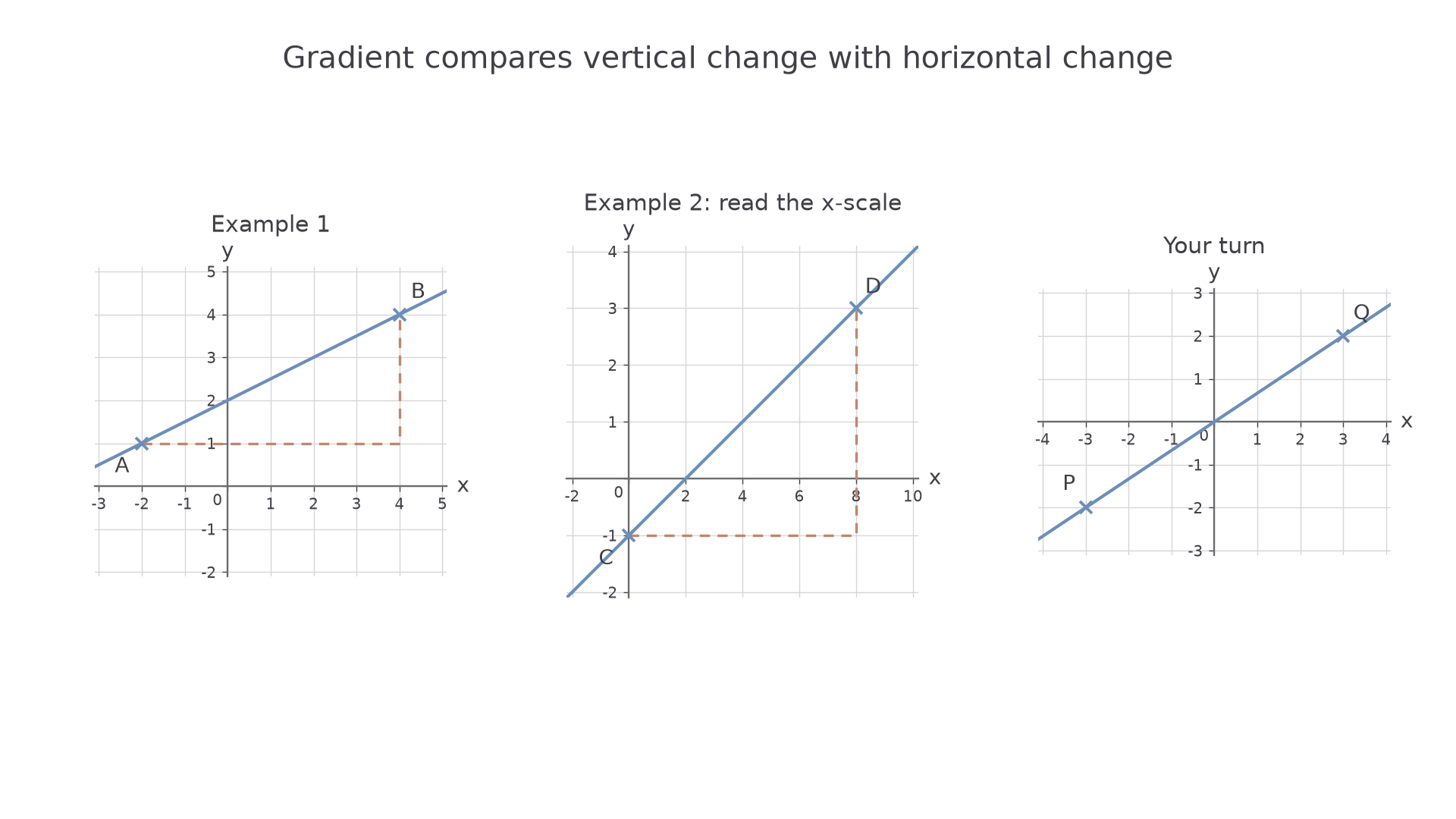
[DIAGRAM: asset_name: Gradient triangles and axis scales; asset_slug: gradient_rise_run; caption: Read changes in units: the first two lines have the same gradient even though their grids have different horizontal scales.; description: Three separate accurate grids. Example 1 shows A at minus two comma one and B at four comma four with a step triangle of run six and rise three. Example 2 shows C at zero comma minus one and D at eight comma three on a grid with horizontal intervals of two and vertical intervals of one; its step has run eight and rise four. Your turn shows P at minus three comma minus two and Q at three comma two on unit intervals, without a printed gradient.]
Worked example 1: a gradient triangle
Question. Find the gradient of in the first panel.
Plan. Read a horizontal run and the matching vertical rise from the grid.
Answer. The gradient is .
Check. The line rises 1 unit for every 2 units right; three such steps give the shown rise 3 and run 6.
The next grid has a different horizontal scale. Counting squares without reading their values would give the wrong gradient.
Worked example 2: unequal axis scales
Question. Find the gradient of in the second panel. One small horizontal interval is 2 units and one vertical interval is 1 unit.
Plan. Convert the four horizontal and four vertical intervals to coordinate units before dividing.
Answer. The gradient is , even though the line looks steeper on this differently scaled grid.
Check. A horizontal change of 2 corresponds to a vertical change of 1, again giving . The coordinate ratio agrees with the first example.
Appearance can mislead when scales differ. Compare gradients numerically, using the quantities represented by the axes.
Watch out
Do not calculate run divided by rise or use the diagonal length. A rise of 3 and run of 6 gives , not . A graph's squares are only measuring tools; their coordinate values matter.
Read the fresh line in the third panel.
Signed gradients
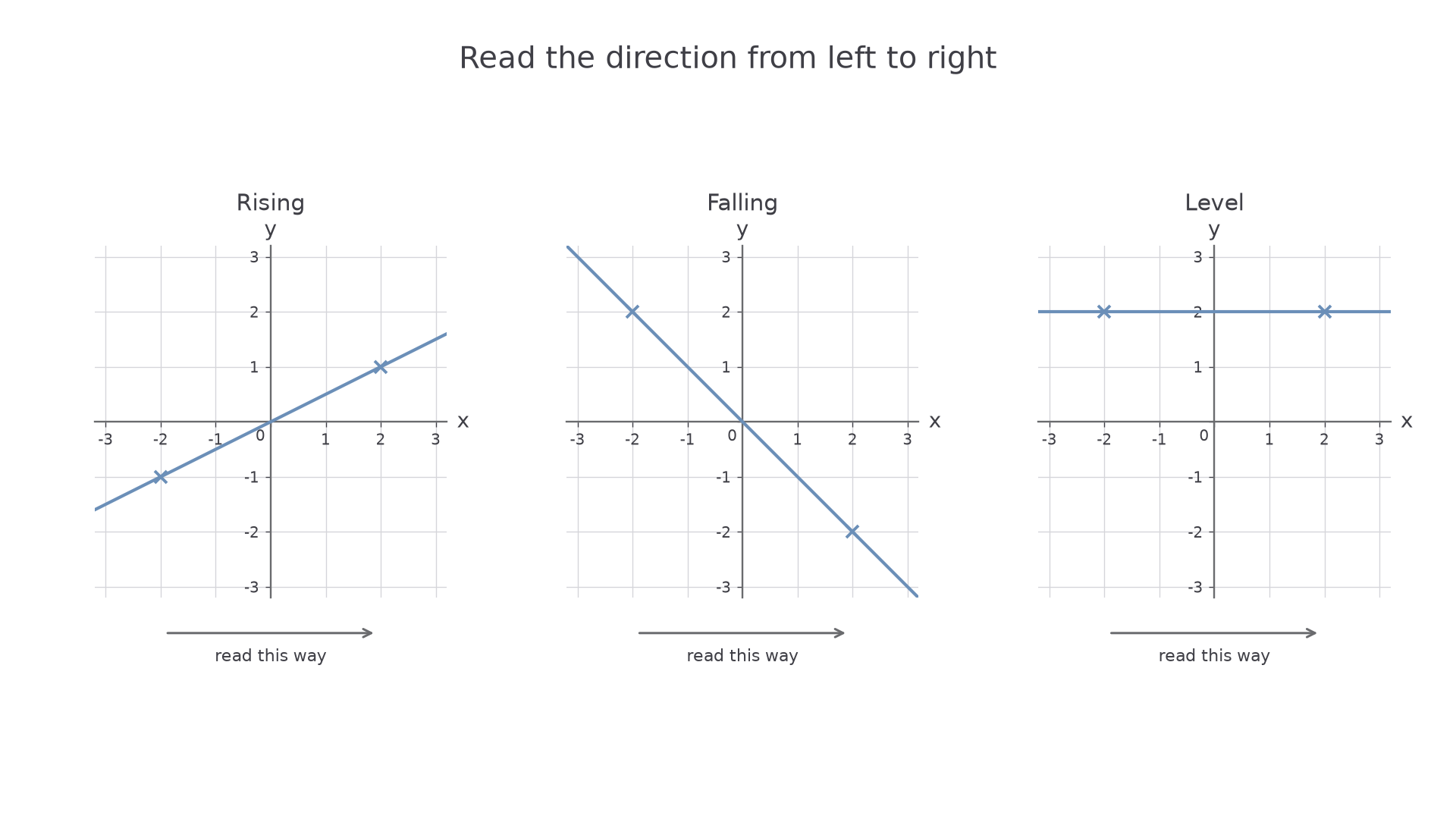
Read a line from left to right to decide the gradient's sign. A rising line has a positive vertical change and a positive gradient. A falling line has a negative vertical change and a negative gradient. The word “rise” in rise-over-run means signed vertical change; it can be negative.
[DIAGRAM: asset_name: Positive negative and zero gradients; asset_slug: gradient_signs; caption: Left to right, a rise gives a positive gradient, a fall a negative gradient and a level line zero.; description: Three accurate unit grids show a rising line through minus two comma minus one and two comma one; a falling line through minus two comma two and two comma minus two; and a horizontal line y equals two. The panels are labelled Rising, Falling and Level, with arrows indicating movement to the right.]
Worked example 3: a rising line
Question. Find the gradient of the rising line in the first panel, using the marked points.
Plan. Move 4 units right and read the signed vertical change.
Answer. , a positive gradient.
Check. Moving right 2 units reaches a point 1 unit higher on the same line, consistent with a positive half-unit rise per unit right.
Continue this lesson.
You’re previewing NovaLearn without an account. Create a free account to read the rest.
Create free account