C2.2; E2.2 - Expanding brackets
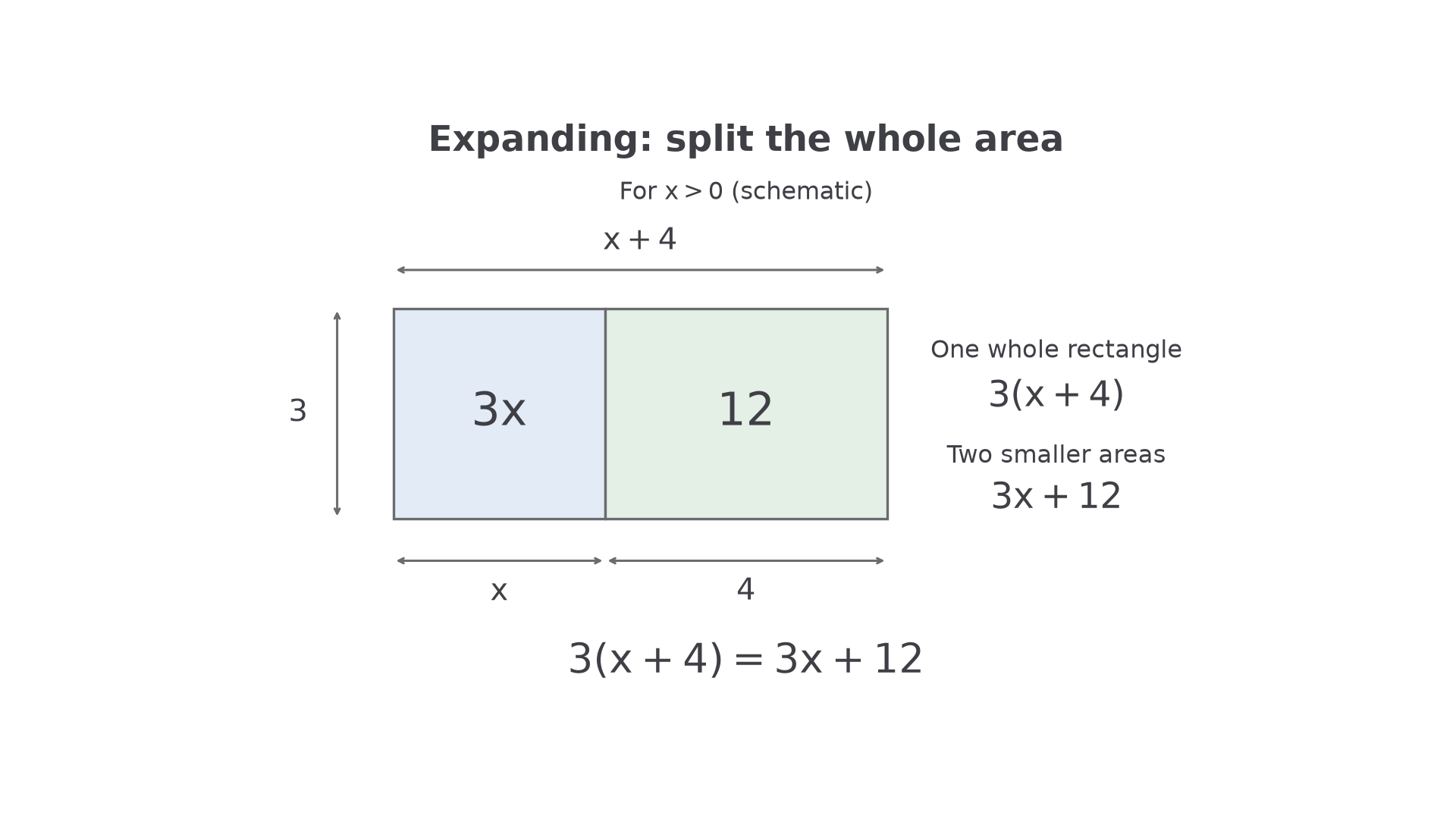
A rectangle is 3 cm high and cm wide. Why can its area be written as either or ? C2.2 and E2.2 develop expansion from this idea, then use it to multiply two brackets and simplify quadratic expressions.
One bracket
Splitting the opening rectangle into widths and 4 makes two smaller rectangles. Their areas are and 12, so the total is . The outside multiplier must reach every term inside the bracket.
[DIAGRAM: asset_name: Splitting a rectangle to expand a bracket; asset_slug: expansion_area_split; caption: The two areas add to the area of the whole rectangle.; description: A schematic rectangle for positive x has height three, split into widths x and four. The left area is labelled three x and the right area twelve. The full width is x plus four. The equality three times x plus four in brackets equals three x plus twelve appears below.]
Expanding a bracket
Expanding removes brackets by distributing multiplication over addition or subtraction. For example, : multiply by both terms, not just the first.
The picture explains positive lengths. The same distributive law applies to negative numbers and negative multipliers; their signs follow the usual multiplication rules.
Worked example 1: distributing a positive multiplier
Question. Expand .
Plan. Multiply both and 4 by 3.
Answer. .
Check. At , the bracket form gives . The expanded form gives .
Now change only the outside sign. Both terms receive the negative multiplier.
Worked example 2: distributing a negative multiplier
Question. Expand .
Plan. Multiply each term by , keeping that sign in both products.
Answer. .
Check. At , the original is ; the expansion is .
A letter can also be part of the outside multiplier. For example, , because . This still uses exactly one multiplication for each inside term.
Watch out
is not : the negative sign multiplies the 4 too. With a negative inside term, , because a negative times a negative is positive.
Show both products before tidying your answer.
Two brackets
Each term in the first bracket multiplies every term in the second. Two terms times two terms therefore produce four products before anything is collected.
For , think of copies of the second bracket: . Expand each of those single brackets, then collect like terms.
Worked example 3: four products
Question. Expand and simplify .
Plan. Form all four products, then collect the two -terms.
Answer. .
Check. At , the original gives ; the expansion gives .
Only the sign of 5 changes next. It affects every product containing that term.
Worked example 4: one negative term
Question. Expand and simplify .
Plan. Write the four signed products and collect the middle terms.
Answer. .
Check. At , the original is ; the expansion gives .
Writing the four products makes sign errors visible. The product of the first terms gives the squared term; the product of the constants gives the constant term. The two cross-products must also be included.
Watch out
. That misses and . There are four products, even if some later cancel.
Apply the same four-product method with new constants.
Quadratic expressions
A quadratic expression has highest power 2 after simplification, with a non-zero coefficient of that squared term. Its squared, linear and constant terms are collected separately. When there is more than one product, expand each product first and keep any subtraction of a whole expression clear.
Worked example 5: a coefficient on the first term
Question. Expand and simplify .
Plan. Multiply every pair of terms, remembering that .
Answer. .
Check. At , the original is ; the expansion is .
The next question keeps that product but subtracts another expression. The extra decision is to subtract every term of the second expansion.
Worked example 6: subtracting another product
Question. Expand and simplify .
Plan. Expand the two products separately, then remove the subtraction bracket and collect like terms.
Answer. .
Check. At , the original gives ; the simplified expression gives .
A substitution check can disprove an incorrect expansion: one disagreement is enough. Agreement at one value is useful evidence, but the distributive working is what shows equality for every value.
Watch out
, not . Treat the minus sign as multiplication by . A simplified answer should have only one term of each power.
Show the separate expansions so your signs can be followed.
Quick Recap
- Distribute a single multiplier to every term, including its sign.
- Two two-term brackets produce four products before collection.
- Collect squared terms, linear terms and constants separately.
- Subtracting a whole expansion changes every sign in that expansion.
The opening area has two forms because splitting the rectangle adds and , exactly the same total as .