C2.7; E2.7; AO2 - From patterns to general rules
The totals do not have a constant gap. Can a picture explain a rule that differences only suggest? C2.7 and E2.7 connect related sequences, while AO2 develops a general statement, tests it and repairs it when a counterexample appears.
Looking for structure
Differences reveal how a pattern changes; a diagram can reveal what is being counted. Compare a growing total with a familiar sequence at the same position. A constant remainder after subtracting squares suggests a fixed extra part beside a growing square.
You already know
The squares at positions are . Their first differences grow by 2, so their second differences are constant at 2. Multiplying all square terms by a number multiplies those differences by the same number.
For the opening pattern, suppose stage contains an -by- square of dots and six separate fixed dots. The diagram supplies a reason for the comparison: there really are two contributions.
[DIAGRAM: asset_name: A growing square and six fixed dots; asset_slug: investigation_square_structure; caption: The square grows with the stage number, while the six extra dots stay fixed.; description: Stage three shows a three-by-three blue square array plus a separate sage two-by-three array, total fifteen. Stage four shows a four-by-four blue array and the same six sage dots, total twenty-two. Labels identify the square contribution and the fixed contribution of six.]
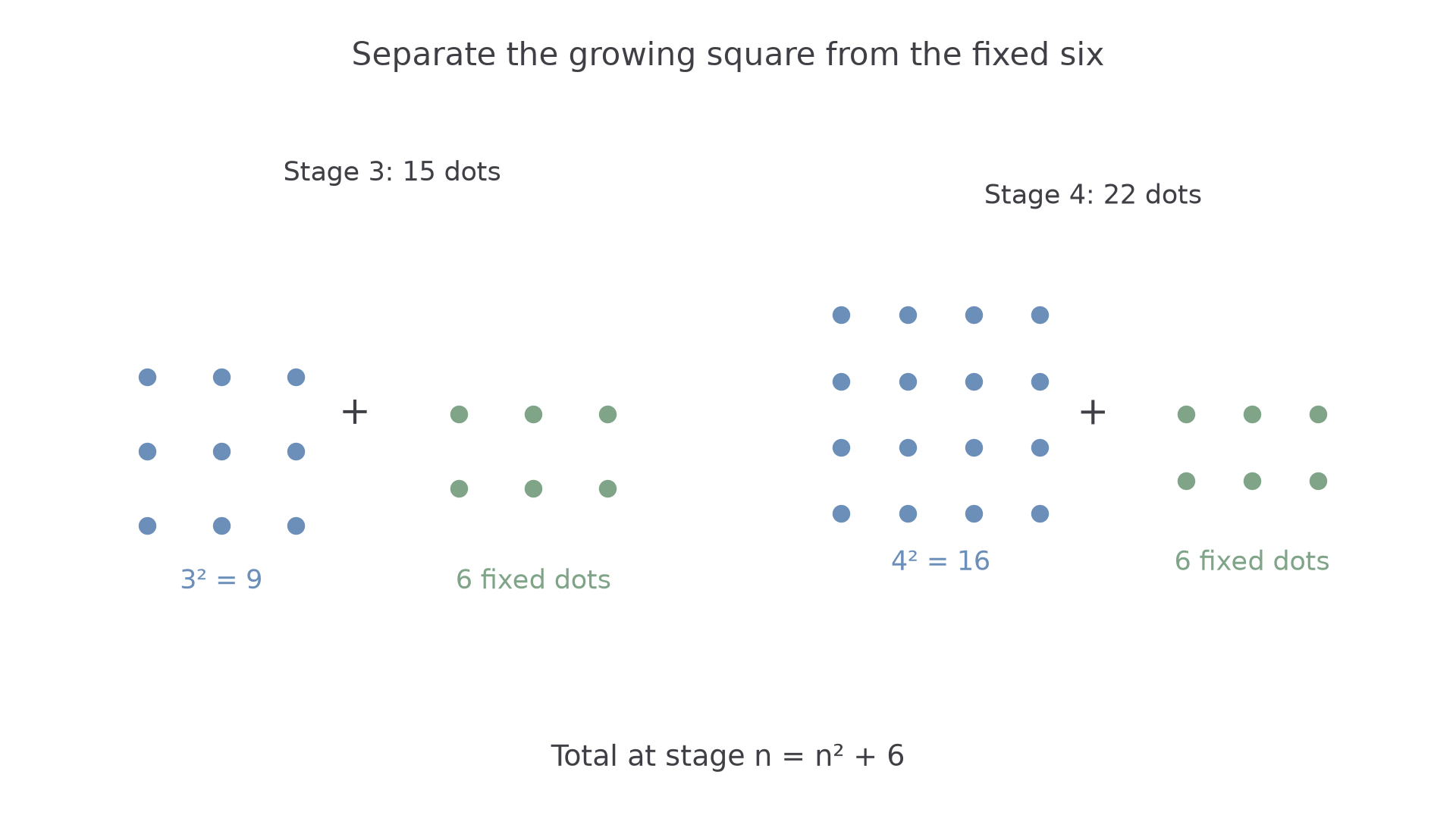
Worked example 1: subtracting a familiar sequence
Question. Find a rule for the construction with totals at stages 1 to 5. Show how the difference pattern supports the square comparison.
Plan. Calculate first and second differences, then subtract the squares at matching stages.
Answer. The total is . The differences support the square contribution; the construction explains the six extra dots for every stage.
Check. At stage 6 the construction has dots. Continuing the differences gives next gap 11 and , a second route to the same new total.
Now use two copies of the growing square but keep the same six fixed dots. This changes the square contribution and its differences, rather than doubling the entire total.
Worked example 2: relating two growing patterns
Question. A new construction has two -by- squares and six fixed dots. Its first five totals are . Find its rule and its relationship to the first construction's total .
Plan. Compare with twice the squares, then account for the fixed dots once.
Thus . Since , doubling would count the fixed six dots twice, so
Answer. , and at matching stages.
Check. Stage 4 has , giving , exactly two groups of 16 square dots plus 6 fixed dots.
Differences from finitely many numbers suggest a form; they do not force every future value if no construction or rule has been specified. Here the dot construction justifies continuing the same structure.
Watch out
“Twice the square part” and “twice the total” are different. Identify what is fixed and what grows before scaling a sequence.
Compare the new values with a suitable multiple of the squares.
Generalising
A general rule links a variable to an output for every permitted input. Define the variable and explain the operations, so that a distant stage can be calculated without drawing all earlier stages.
Generalisation
A generalisation expresses a relationship for a whole stated class of cases. A formula gives its algebraic form; a structural explanation says why it applies throughout that class.
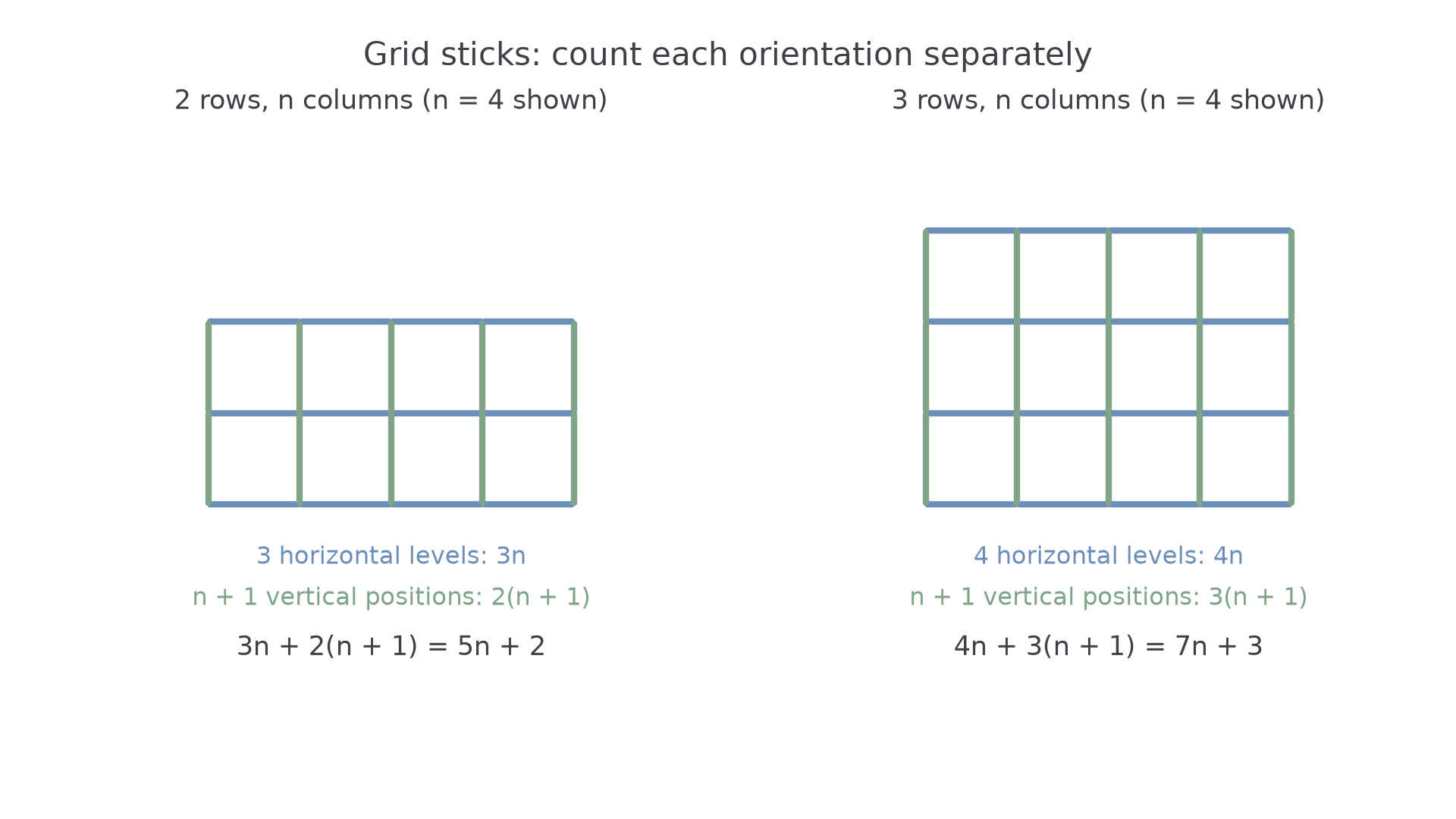
Consider a rectangular grid built from unit sticks, with columns. Count horizontal and vertical sticks separately. Every stick belongs to exactly one family, including internal shared edges only once.
[DIAGRAM: asset_name: Counting the two families of grid sticks; asset_slug: investigation_grid_sticks; caption: Count rows of horizontal sticks and columns of vertical sticks separately.; description: Two accurate unit-stick grids each have four columns. Left grid has two rows, three horizontal levels with four blue sticks at each level and five vertical positions with two sage sticks at each position. Right grid has three rows, four horizontal levels and five vertical positions. Captions show three n plus two times n plus one equals five n plus two on the left, and four n plus three times n plus one equals seven n plus three on the right.]
Continue this lesson.
You’re previewing NovaLearn without an account. Create a free account to read the rest.
Create free account