E6.3 - Major and general sectors (Extended)
Two radii bound both a short route and a long route around a circle. Which angle and fraction belong to the region you actually want? This Extended lesson develops E6.3 for unrestricted degree angles, major sectors and calculations that recover a missing angle or radius.
General angles
A sector does not need to fit a whole number of times into a circle. A sector occupies of the circle even though is not a whole number. The angle fraction still scales circumference and area correctly.
General degree-angle sectors
For radius and centre angle in degrees,
Use the angle of the selected sector. The circle formulas are supplied on the formula lists for Papers 1–4; these fraction forms are not separately listed. All required formulas are given within questions on Papers 5 and 6.
There is no rounding step when forming the angle fraction. Keep the exact fraction, or enter the complete expression into the calculator. A decimal answer comes at the end.
Worked example 1: an angle that does not divide a full turn
Question. A circle has radius . Find the arc length and area of its sector in terms of .
Plan. Simplify the angle fraction to , then apply it to circumference and area separately.
Answer. Arc length ; sector area .
Check. Both ratios to their whole-circle totals agree: .
Keep the radius fixed and change only the angle. The two answers must change by the same angle ratio.
Worked example 2: a larger unrestricted angle
Question. In the same radius-10 cm circle, find the arc length and area of a sector in terms of .
Plan. Use of each full-circle quantity.
Answer. Arc length ; sector area .
Check. The two example angles add to . Their arcs add to , half the circumference, and their areas add to , half the circle's area.
An arbitrary angle is handled by the same proportional relationship; there is no need to search for an integer number of slices.
Watch out
Do not round to a short decimal before multiplying. Retaining the fraction keeps an exact answer exact and prevents an avoidable final rounding error.
Apply the angle fraction to an area.
Major sectors
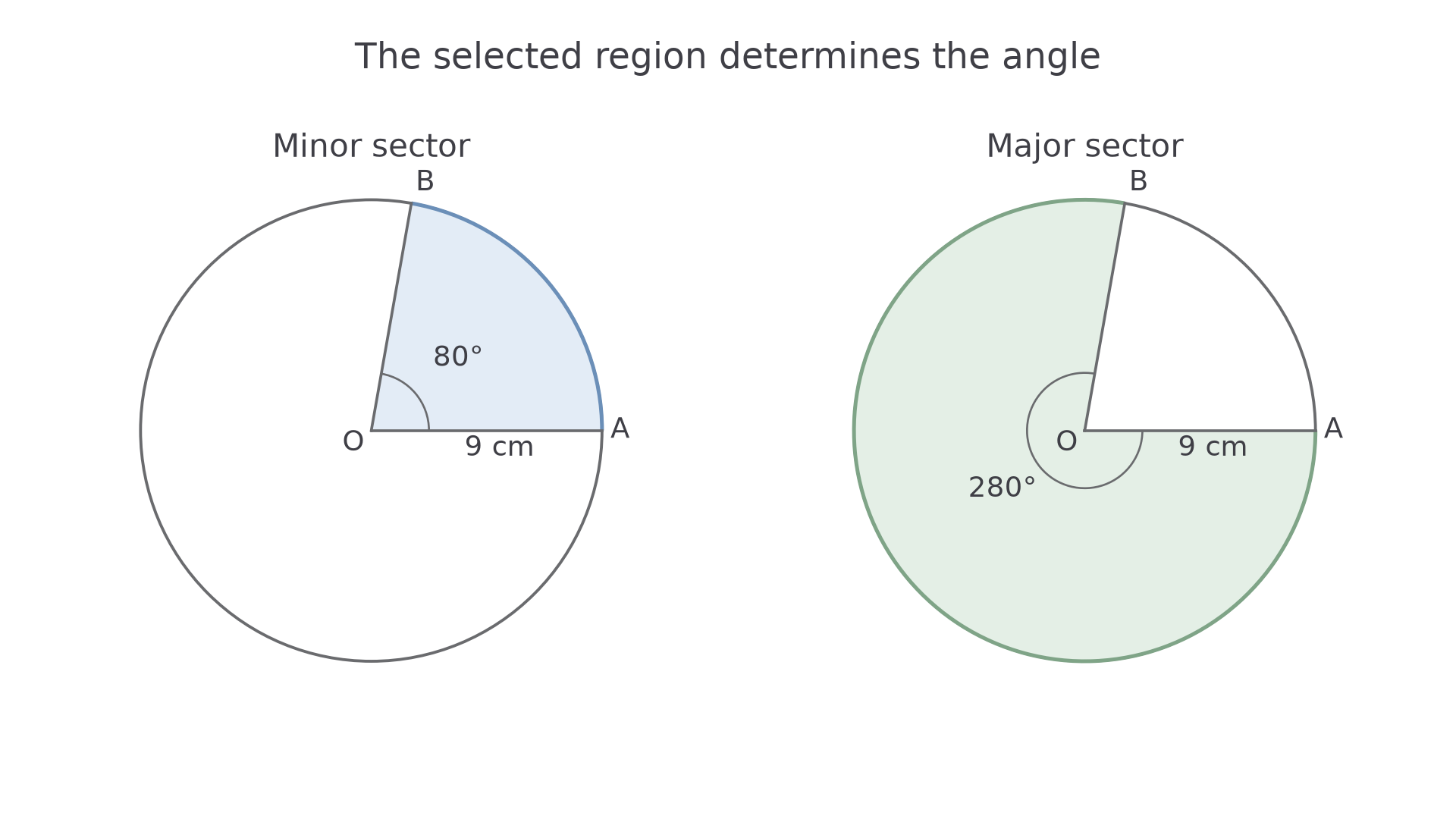
Two radii usually select two possible regions. The smaller one uses the smaller angle; the larger one uses the rest of the full turn. A labelled small angle cannot be inserted unchanged when the question asks for the larger region.
Minor and major sectors
A minor sector has centre angle less than . A major sector has centre angle greater than and less than . Their angles add to . An angle of exactly gives a semicircle.
The same distinction applies to minor and major arcs. Read the named or shaded region, then write its angle before calculating.
[DIAGRAM: asset_name: Minor and major sectors share two radii; asset_slug: minor_major_sectors; caption: An 80 degree minor sector leaves a 280 degree major sector.; description: Two equal circles each have radii at zero and eighty degrees. The left shades only the eighty degree minor sector blue. The right shades the complementary two hundred eighty degree major sector sage. The appropriate angle is marked at each centre, the same endpoints A and B identify the two alternative arcs, and each radius is nine centimetres.]
Worked example 3: selecting the minor sector
Question. Two radii of a circle of radius make a smaller angle of . Calculate the minor arc length and minor sector area in terms of .
Plan. The minor region uses the supplied angle.
Answer. Minor arc ; minor sector area .
Check. Both are of their whole-circle totals. They are smaller than half the circumference and half the area because .
Change only the selected region. The radius and endpoints stay fixed, but the remaining angle must replace the small angle.
Worked example 4: selecting the major sector
Question. For the same circle and radii, calculate the major arc length, major sector area and major sector perimeter in terms of .
Plan. Subtract the minor angle from a full turn, then use the larger fraction. Add both radii for the sector's perimeter.
Answer. Major arc , area , perimeter .
Check. The minor and major arcs add to , the full circumference; their areas add to , the full area. Their sector perimeters would count each shared radius twice, so those perimeters do not add to just the circumference.
Continue this lesson.
You’re previewing NovaLearn without an account. Create a free account to read the rest.
Create free account