AO2 - Using and revising a model (Extended)
Cutting larger corners from a card makes a deeper box but also shrinks its base. Which cut gives the greatest capacity, and does that remain the best choice when costs or restrictions change? AO2 connects practical domains to permitted graphical tools, then revises a model and interprets the new result.
Interpreting a model
A formula can return a number for an input that makes no sense in the situation. Translate every physical restriction into a condition on the variable before choosing an answer. Positive lengths, a minimum width, a budget or whole-number choices can all narrow the domain.
Feasible input
A feasible input satisfies every restriction in the problem. Solving the equation or locating a turning point gives a candidate; it becomes an answer to the practical problem only after its feasibility is checked.
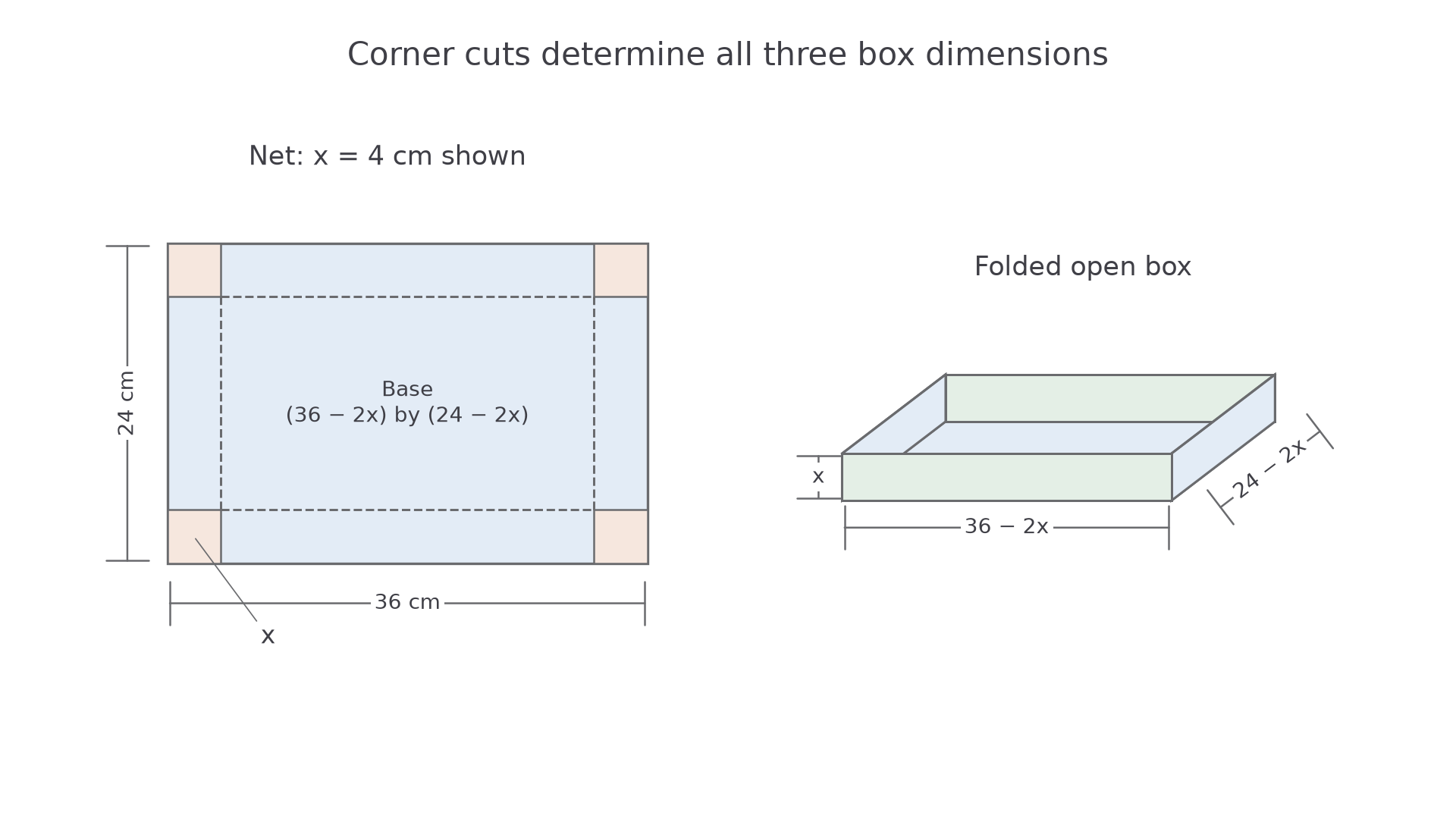
Cut equal squares of side cm from the four corners of a by card and fold up the sides. Neglect card thickness and assume no material is needed for extra joins. The box height is ; two corners are removed from each base dimension.
[DIAGRAM: asset_name: From a card to an open box; asset_slug: modelling_open_box_net; caption: Each base dimension loses two corner widths; the cut size becomes the height.; description: An exact thirty-six by twenty-four rectangle has four equal corner squares of side x shaded clay, with dashed fold lines around the central base. For the displayed drawing x is four centimetres, but dimension labels show x, thirty-six minus two x and twenty-four minus two x. A separate labelled oblique sketch of the folded open box shows the same base lengths and height x. The card thickness is neglected.]
Worked example 1: deriving the physical interval
Question. For the card construction, write its volume in terms of , using , and state the possible cut sizes for a box with positive dimensions.
Plan. Express the three lengths, then require each to be positive.
The conditions are , and . All must hold, so the tighter upper bound controls the result.
Answer. cubic centimetres for .
Check. At , dimensions are , giving . At , the width would be zero; at , the height would be zero. Neither boundary is a usable box.
Add a practical base-width requirement and restrict cuts to whole centimetres. The algebraic expression stays the same, while the feasible choices change.
Worked example 2: adding a minimum size
Question. For the same card, the shorter base dimension must be at least 10 cm and must be a whole number of centimetres. Determine the feasible cut sizes.
Plan. Combine the new width inequality with the positive-box interval.
Together with , this gives , then the integer requirement selects seven values.
Answer. cm.
Check. The last allowed cut gives base width cm. The next integer cut, 8 cm, gives only 8 cm of base width and fails the requirement.
The equality endpoint can be allowed by one condition and excluded by another. “At least 10” includes a base width of 10; “positive box width” excludes a width of zero.
Watch out
Do not round a continuous answer to an integer before checking the actual feasible choices. Nor does a positive volume alone guarantee a valid box: outside the physical interval two negative base dimensions could produce a positive product.
Use all the restrictions in this new card problem.
Solving with graphs
Use the graphical feature that matches the question. An extremum finds a local maximum or minimum; an intersection finds equal outputs; a zero solves a difference equal to zero. Inspect the whole feasible interval before zooming in, and compare any included endpoints when finding a practical optimum.
You already know
Permitted GDC methods include graphs, tables, zeros, local maxima/minima and intersections. Record the entered functions, a useful window and labelled features or read-offs. An unlisted equation-solver application is not a substitute for the required graphical method.
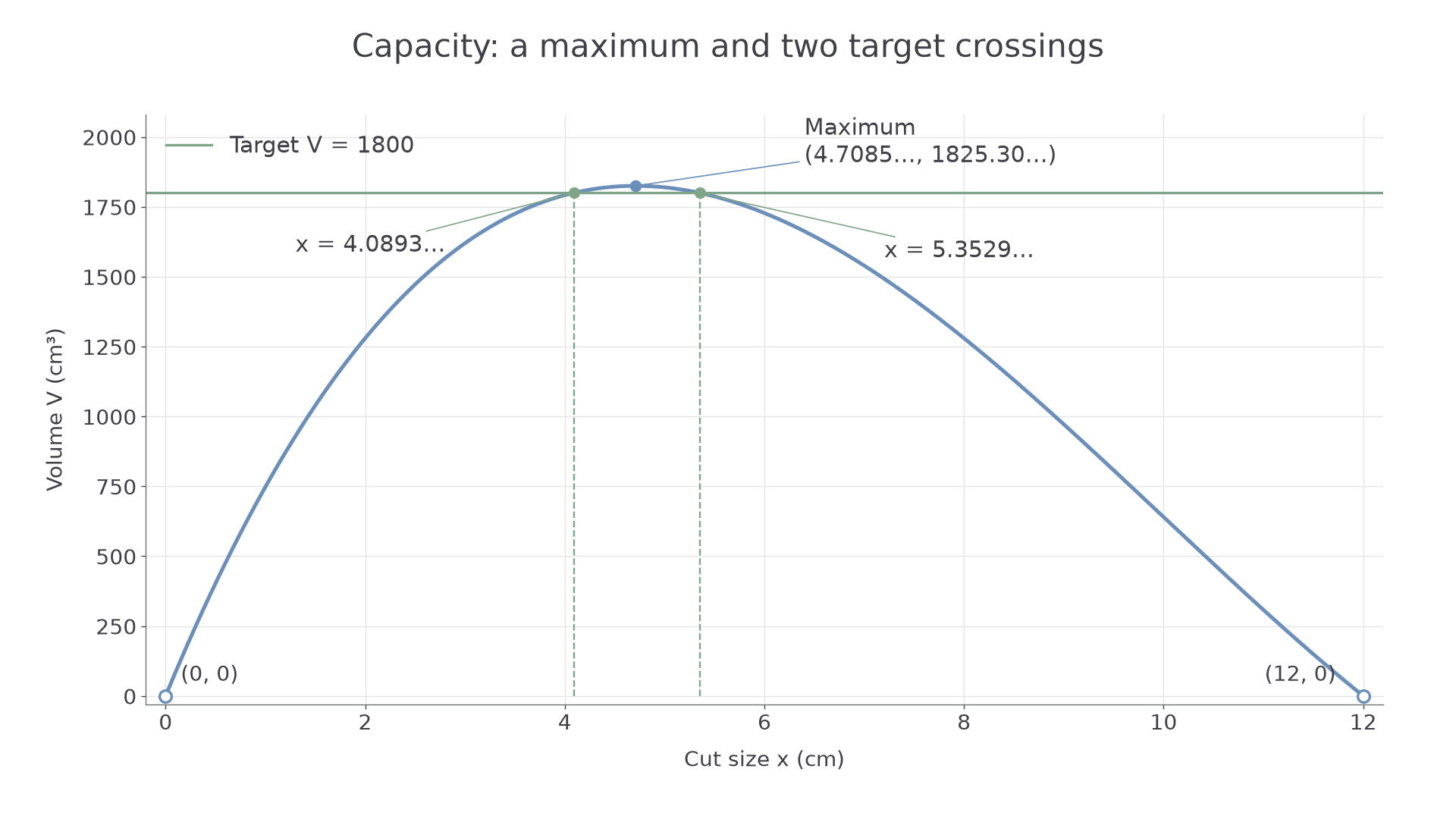
Return to , initially allowing every real cut size in . The curve rises from a limiting zero volume, reaches a maximum and falls back to zero as the base disappears.
[DIAGRAM: asset_name: Capacity and a target volume; asset_slug: modelling_box_graph; caption: The maximum is a turning point; a target capacity can occur at two different cut sizes.; description: An accurate graph of V equals x times thirty-six minus two x times twenty-four minus two x from x zero to twelve has labelled axes in centimetres and cubic centimetres. Limiting zeros at zero and twelve are hollow markers. The maximum approximately four point seven zero eight five, one thousand eight hundred and twenty-five point three is labelled. A horizontal target V equals eighteen hundred intersects at approximately four point zero eight nine three and five point three five two nine, with dashed projections.]
Worked example 3: maximum capacity
Question. Use a GDC graph to find the greatest capacity of the card box and its cut size. If only whole-centimetre cuts are allowed, which cut is best?
Plan. Locate the maximum over the full physical interval, then compare the neighbouring integer choices.
Enter . A useful window is , . The maximum feature gives approximately
The complete curve has one peak in this interval. For integer cuts, compare the integers on its two sides:
Answer. The continuous optimum is cm, giving approximately to 3 significant figures. If cuts must be whole centimetres, use 5 cm, giving exactly .
Check. Substitution of the unrounded maximum input into the original three-length product reproduces 1825.296587. The neighbouring table values at 4.70 and 4.72 cm are both slightly lower. All proposed cuts lie within .
Now ask for a target instead of an optimum. Do not stop at the first intersection: a shallow wide box and a deeper narrow box can have the same volume.
Worked example 4: two cut sizes for one capacity
Question. Use permitted graphical features to find the cut sizes giving , to 3 significant figures.
Plan. Find all intersections with a horizontal target, or all zeros of the volume minus that target, within the physical interval.
Graph and . The same full window shows two intersections; zoom to , to inspect them.
The intersection inputs are
Equivalently, graph and use the zero feature near each crossing. Subtracting 1800 changes the target height to zero, not the solution inputs.
Answer. cm or cm, both physically feasible.
Check. Substituting each unrounded input gives 1800. The difference is negative at 4, positive at 4.5 and 5, and negative at 5.5, confirming two separate crossings. The full physical-domain graph shows no further one.
Continue this lesson.
You’re previewing NovaLearn without an account. Create a free account to read the rest.
Create free account