C2.7; E2.7 - Sequences and term rules
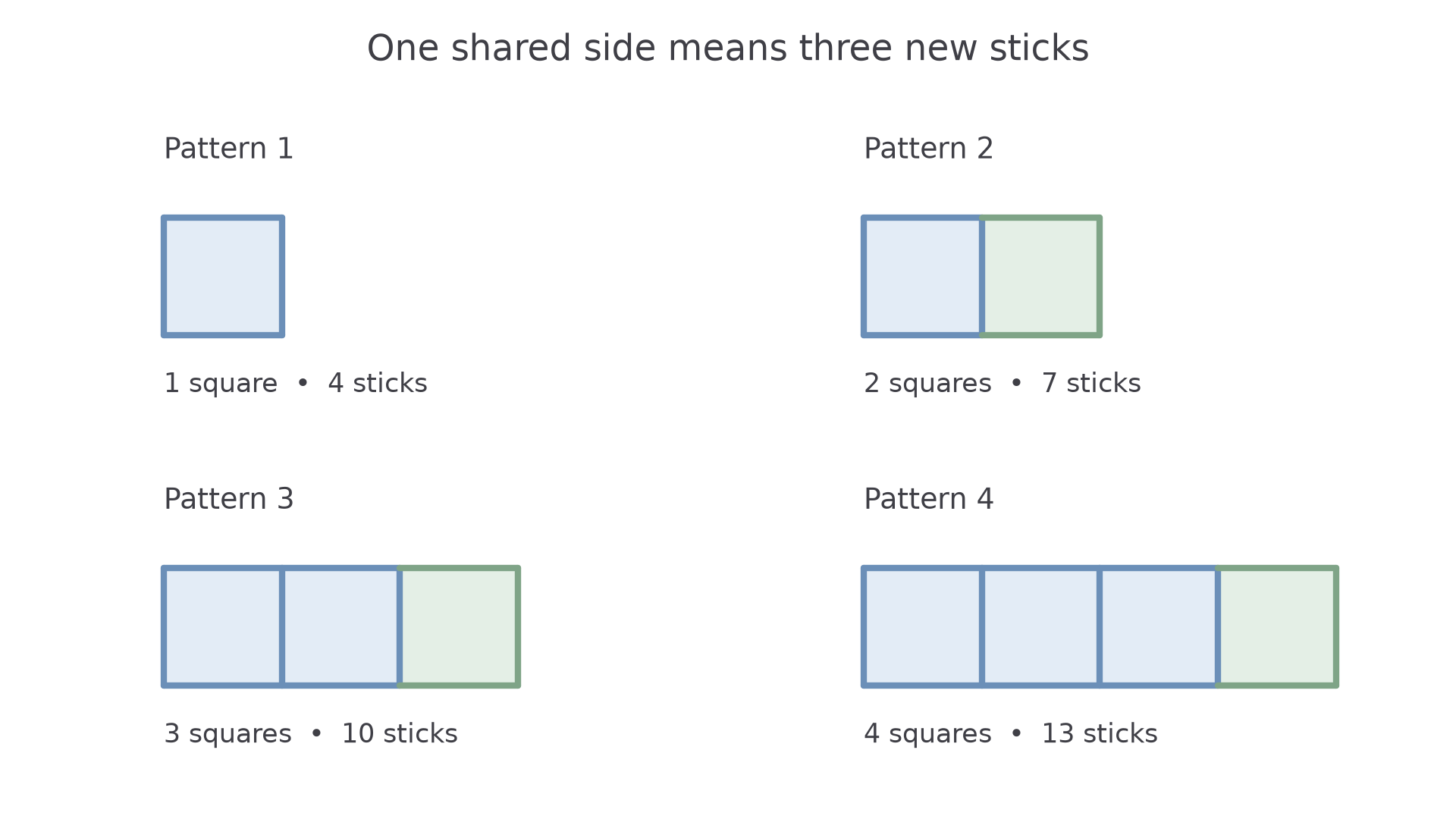
A row of one square uses 4 sticks, two adjoining squares use 7, and three use 10. Why does each new square need only three more sticks? C2.7 and E2.7 connect growing pictures, number patterns and term-to-term rules, including square, cube and triangular sequences.
Continuing patterns
A sequence is an ordered list of numbers called terms. The position matters: in , the first term is 4 and the third term is 10. The three dots mean that the pattern continues.
Look for structure before guessing a next term. A picture can explain what is added; in a number list, differences or repeated operations can suggest the intended pattern. Check a proposed rule against every supplied transition. A finite list can fit more than one rule, so use a stated construction or the simplest consistent pattern in the question.
[DIAGRAM: asset_name: Adjoining-square stick pattern; asset_slug: adjoining_square_sticks; caption: The first square uses four sticks. Each adjoining square shares one side and adds three sticks.; description: Four separate rows contain one, two, three and four equal adjoining squares, labelled pattern one to four with stick totals four, seven, ten and thirteen. The first square has four blue edges. In patterns two to four, the newest square's three unshared edges are sage and the earlier sticks are blue. Shared edges are counted once.]
Worked example 1: continuing a numerical pattern
Question. Write down the next two terms of .
Plan. Find the changes between neighbouring terms, then continue the same change.
Each step adds 3, so , followed by .
Answer. 16, 19.
Check. The extended list has gaps , matching every given gap.
The next example gives the construction instead of only its totals. Explain the extra sticks before calculating the next total.
Worked example 2: continuing a visual pattern
Question. Squares are placed in a straight row, sharing a whole side with each neighbour. One, two and three squares use 4, 7 and 10 sticks. How many sticks do four and five squares use?
Plan. Count what one additional square contributes.
One side is already present, so each new square adds its top, bottom and outer side: 3 sticks.
Answer. 13 sticks and 16 sticks.
Check. Five squares have 5 top sticks, 5 bottom sticks and 6 vertical sticks: . Four have .
The totals depend on the construction. Separate squares would use four new sticks each time, while adjoining squares share sides. A diagram's sharing rule is mathematical information.
Watch out
A term is a value; its position is its place in the list. In , 10 is the third term, not the tenth term.
Use the changes to continue this new pattern.
Term-to-term rules
A term-to-term rule tells you how to obtain a term from the preceding term. “Add 3” describes the stick totals, but the starting term 4 is also needed to identify that sequence. The same rule starting at 1 gives a different sequence.
Term-to-term rule
A term-to-term rule specifies the operation or pattern of operations taking one term to the next. Give the starting term as well when defining a sequence completely.
Test addition by subtracting consecutive terms. Test multiplication by dividing consecutive terms when the earlier term is non-zero. Sometimes the amount added changes: adds . State that changing rule precisely rather than saying only “add”.
Worked example 3: a multiplicative rule
Question. Give a term-to-term rule for , and find the next term.
Plan. Check whether one multiplier connects every consecutive pair.
Answer. Start at 3 and multiply by 2 each time. The next term is .
Check. Working backwards from 48 by dividing by 2 gives , recovering the entire list.
Continue this lesson.
You’re previewing NovaLearn without an account. Create a free account to read the rest.
Create free account