C3.3; E3.3 - Function notation
A rule squares its input. Both 3 and produce 9: can it still be a function? C3.3 and E3.3 introduce functions, mapping diagrams and notation so you can read a rule and evaluate its output accurately.
Inputs and outputs
A machine that squares a number gives and . Different inputs have reached the same output, but each individual input still has one definite result.
Function
A function assigns exactly one output to each allowed input. Different inputs may share an output. An input that is not allowed does not need an output.
For example, “add 4” gives one output for every number you put in. “Choose either the positive or negative square root of 9” does not give a single definite output for the input 9, so that instruction alone is not a function rule. The rule “take the non-negative square root” does give a single output for each non-negative input.
[DIAGRAM: asset_name: One output for each input; asset_slug: functions_mapping_square; caption: Two arrows may end at the same output; one input must not branch to different outputs.; description: The left mapping diagram for squaring shows inputs minus three, zero and three with arrows to nine, zero and nine respectively, merging the arrows from minus three and three at a single output nine. It is labelled function. The right diagram has one input four with arrows to outputs two and minus two and is labelled not a function. Input and output sets are clearly separated.]
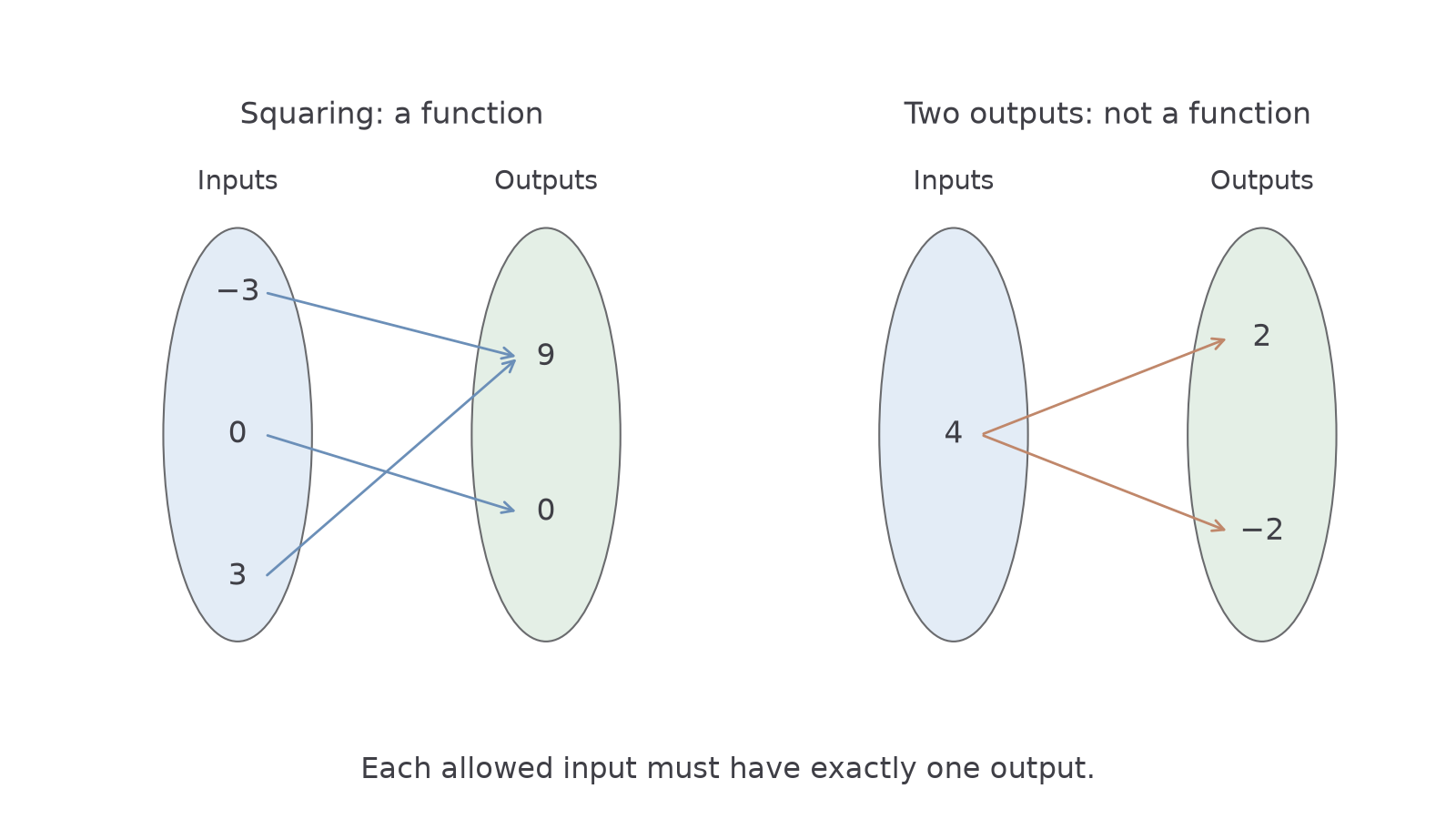
A mapping diagram lists allowed inputs on one side and draws an arrow from each input to its output. Count arrows leaving each allowed input. More than one incoming arrow at an output is fine; more than one outgoing arrow to different outputs is not.
Key idea
A function promises one result per allowed input. It does not promise a different result for every input.
Use that precise promise in this diagnostic.
Function notation
The name identifies a rule. The notation , read “ of ”, means its output when the input is . Thus says: double the input, then add 1.
Function notation
In , the value inside the brackets is the input and the whole expression is the output. For the rule , . The mapping notation expresses the same rule.
The letter is a name, not a number being multiplied by the bracket. A second rule can be named , or another stated letter. Its definition determines what happens to the input.
Worked example 1: from a rule to arrows
Question. The function is , with allowed inputs 1, 2 and 4. Give all three input-output mappings.
Plan. Replace by each input in the same rule.
Answer. .
Check. Subtracting 1 from each output and halving recovers 1, 2 and 4. Each allowed input has exactly one arrow.
Only the name changes next. A different function name does not change a rule that has been defined identically.
Continue this lesson.
You’re previewing NovaLearn without an account. Create a free account to read the rest.
Create free account