C7.1; E7.1 - Pythagoras in circles and coordinates
A chord lies 5 cm from the centre of a circle of radius 13 cm. Can you find its full length from one right triangle? C7.1 and E7.1 use Pythagoras' theorem inside circles and on grids, where the useful perpendicular sides first need identifying.
Chord lengths
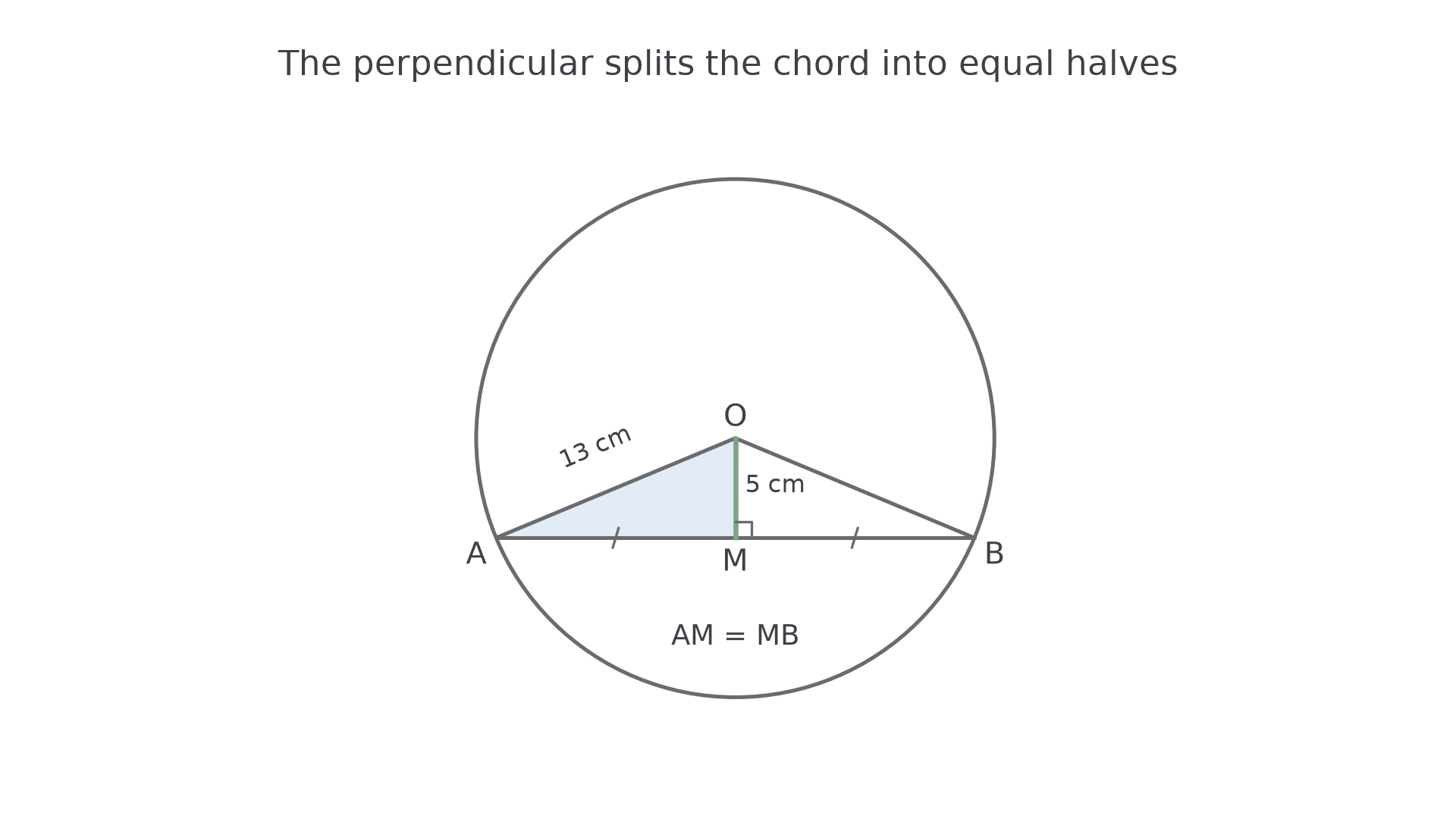
For a chord that is not a diameter, join the centre to both ends . The two radii are equal, so triangle is isosceles. Its line of symmetry goes from to the midpoint of , meeting the chord at a right angle. Thus a perpendicular from the centre bisects the chord: .
Centre-to-chord triangle
With , the right triangle has hypotenuse , one leg , and the other leg , half the chord. Hence .
The hypotenuse is a radius, not the whole chord. After finding , double it to obtain .
[DIAGRAM: asset_name: A chord split into two equal halves; asset_slug: chord_right_triangle; caption: The perpendicular OM bisects chord AB, giving a right triangle with a radius as hypotenuse.; description: Circle centred at O with radius 13 units and horizontal chord AB 5 units below O. M is the midpoint of AB. OA and OB are radii, OM meets AB at a right angle, and equal tick marks identify AM and MB. Labels show OA equals 13 cm and OM equals 5 cm.]
Worked example 1: finding the whole chord
Question. A circle has radius 13 cm. The perpendicular from its centre to chord has length 5 cm. Calculate .
Plan. Find half the chord using Pythagoras, then double it.
Answer. .
Check. Each half gives . The full chord 24 cm is shorter than the diameter 26 cm, as expected for a chord away from the centre.
Move the chord nearer the centre while retaining the same radius. Its length should increase.
Worked example 2: a chord nearer the centre
Question. In a circle of radius 13 cm, a chord is 3 cm from the centre. Calculate its length to three significant figures.
Plan. Retain the square root for half the chord, then double before rounding.
Answer. to three significant figures.
Check. . The chord is longer than the previous 24 cm but still shorter than the 26 cm diameter.
The opening chord is therefore 24 cm long; its two halves each belong to a 5–12–13 right triangle.
Watch out
The centre-to-chord distance means the perpendicular distance. A slanted segment from the centre to an arbitrary chord point does not generally bisect it.
Use the same half-chord structure with new lengths.
Distance from centre
When the full chord is known, halve it before setting up the triangle. The distance from the centre is the other shorter side; subtract the half-chord's square from the radius's square.
Worked example 3: finding the perpendicular distance
Question. A chord of a circle of radius 17 cm has length 30 cm. Find the perpendicular distance from the centre to the chord.
Plan. Use half the chord, 15 cm, as one leg of the right triangle.
Answer. .
Check. . The perpendicular distance is less than the radius, as the chord lies inside the circle.
Keep the radius fixed and shorten the chord. It must then lie further from the centre.
Continue this lesson.
You’re previewing NovaLearn without an account. Create a free account to read the rest.
Create free account