C1.12; E1.12 - Simple and compound interest
Two accounts both advertise 5% interest per year. One adds 1000 investment; the other adds a little more each year. C1.12 and E1.12 distinguish simple from compound interest, calculate interest and balances, and compare offers over the same period.
Simple interest
With simple interest, every interest calculation uses the original investment. If 0.03\times1200=36$ dollars, regardless of interest already earned.
Principal and simple interest
The principal is the original amount invested or borrowed. Simple interest is calculated on this unchanged principal. At a fixed annual rate, equal time periods earn equal amounts of interest.
Multiplying the yearly interest by the number of years gives the total interest. Add the principal only when a total balance is required.
Simple interest
Here is the principal, is the annual percentage rate, is the time in years, is the interest and is the final amount. The rate and time units must correspond.
Not in the supplied formula list: learn it.
The formula simply counts copies of of the principal. When time is given in months, convert to years before using an annual rate.
Worked example 1: interest and total balance
Question. $1200 is invested at 3% per year simple interest for 3 years. Calculate the interest and total amount.
Plan. Find three years of interest on $1200, then add the original investment.
Answer. Interest 1308.
Check. Three years at 3% simple interest earns 9% of the principal: .
Now change the duration to a fractional number of years. The yearly interest remains $36.
Worked example 2: time given in months
Question. $1200 is invested at 3% per year simple interest for 18 months. Calculate the interest and total amount.
Plan. Convert 18 months to years, then use the same unchanged principal.
Answer. Interest 1254.
Check. One year earns 18, so the total interest is $54.
Under simple interest, half as much time earns half as much interest because the principal stays unchanged. The final amount includes that principal as well as the earned interest.
Watch out
Using 3 rather than as the decimal rate makes the interest 100 times too large. Also, an interest answer alone does not answer a request for the total amount: add the principal.
Read both requested amounts in the next question.
Compound interest
With compound interest, earned interest stays in the account and becomes part of the next interest calculation. At 3% per year, 1236 after one year; the next 3% applies to $1236.
Compound interest
Compound interest is calculated on the updated balance after each interest period. At a fixed rate, each period multiplies the balance by the same growth factor.
For two periods, the balance is . Repeating this argument gives a power for any whole number of interest periods.
Compound amount
Here is the percentage rate per interest period and is the number of those periods. The formula assumes the rate is unchanged and there are no additional deposits or withdrawals.
Not in the supplied formula list: learn it.
Keep the full calculator value until the final money answer. Annual interest over two years uses two periods; half-yearly interest over two years uses four periods.
Worked example 3: annual compounding
Question. $1200 is invested at 3% compound interest per year for 2 years. Calculate the final amount and the interest earned, to the nearest cent.
Plan. Multiply by twice and subtract the principal for the interest.
Answer. Final amount 73.08.
Check. The second year's interest is . Adding 37.08 gives $73.08.
The next offer changes the interest period. Its stated 1.5% applies to every half-year, so both the multiplier and the number of applications must reflect that period.
Worked example 4: half-yearly compounding
Question. $1200 is invested at 1.5% compound interest every six months for 2 years. Calculate the final amount and interest, to the nearest cent.
Plan. Use four half-year periods, each with multiplier .
Answer. Final amount 73.64.
Check. After the first year the amount is . Multiplying this by for the second year gives the same unrounded final amount.
The half-yearly offer gives a slightly larger return than 3% compounded annually: the first half-year's interest starts earning interest before the year ends. The rate period is part of the offer's meaning.
Watch out
Do not use four periods with an annual 3% rate unless 3% is actually paid each half-year. Here the question explicitly gives the rate for each six-month period. Also, is the balance; subtract if asked for interest alone.
Match the rate period and the duration before calculating.
Comparing interest models
Compare investments using the same principal, the same elapsed time and the stated rates. With the same positive rate, simple and compound interest agree after one period. Later, compound interest earns interest on earlier interest.
Key idea
Simple interest adds a fixed amount each period. Compound interest multiplies the current balance each period. A higher simple-interest rate can still beat a lower compound-interest rate over a short duration.
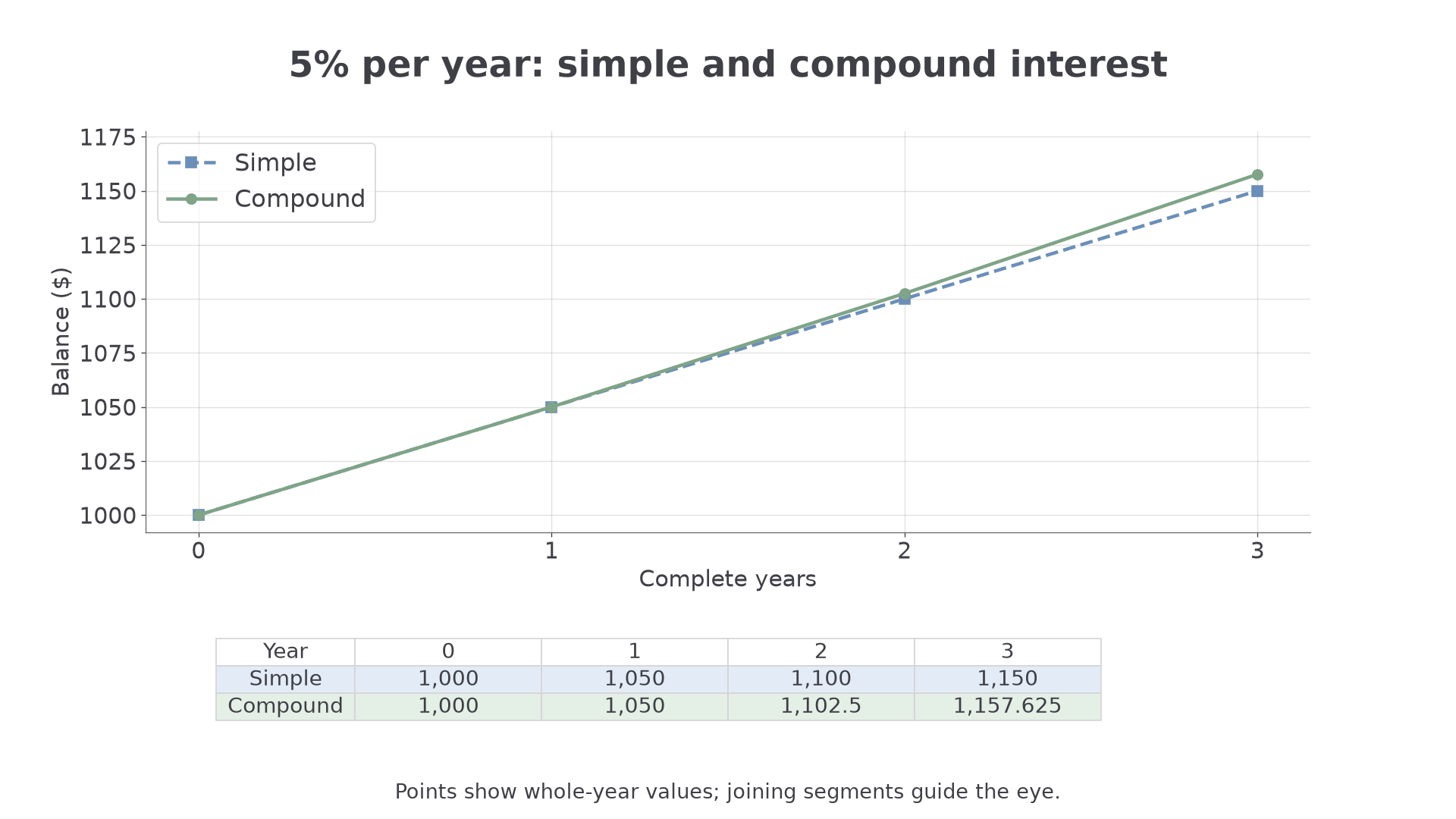
The first comparison answers the opening puzzle: both accounts may say 5%, while using different bases after the first year.
[DIAGRAM: asset_name: Comparing interest over three years; asset_slug: simple_compound_balances; caption: At the same five percent annual rate, simple interest has equal yearly additions and compound interest has growing additions.; description: A table and paired line plots compare one thousand dollars invested at five percent simple and compound interest. At years zero, one, two and three, simple balances are one thousand, one thousand and fifty, one thousand one hundred and one thousand one hundred and fifty. Compound balances are one thousand, one thousand and fifty, one thousand one hundred and two point five and one thousand one hundred and fifty-seven point six two five. Points are annual balances; connecting segments guide the eye.]
Worked example 5: comparing equal rates
Question. $1000 is invested for 3 years. Account S pays 5% per year simple interest. Account C pays 5% per year compound interest. Calculate each final amount and determine the better return.
Plan. Calculate both balances over exactly three years.
Answer. S gives 1157.63 to the nearest cent. C gives $7.63 more, to the nearest cent.
Check. Compound yearly interest is 52.50 and 157.625. Simple interest is three lots of 150.
Now change only the simple-interest rate. The word “compound” alone no longer settles the comparison.
Worked example 6: comparing unequal rates
Question. $1000 is invested for 3 years. Account S pays 6% per year simple interest. Account C pays 5% per year compound interest. Calculate each final amount and determine the better return.
Plan. Recalculate S using 6%, and compare it with C over the same duration.
Answer. S gives 1157.63 to the nearest cent. S gives $22.38 more, to the nearest cent.
Check. S earns three lots of 180. This exceeds C's $157.625 interest. Subtract unrounded balances before rounding the difference.
The duration matters as well as the rates. These calculations establish which offer wins after three years; another duration requires a new comparison.
Exam tip
State which account is better and support the decision with comparable amounts. Check whether the question asks for a balance, interest or a difference; these are three different quantities.
Use the unrounded values to make the next comparison.
Quick Recap
- Simple interest always uses the original principal.
- Compound interest uses the updated balance each period.
- Match the rate period with the number of periods.
- Distinguish interest from total amount, and compare offers over the same duration.
The two 5% accounts agree for one year; afterwards, only the compound account earns interest on earlier interest.