C5.5; E5.5 - Angles in parallel lines
A straight line crosses two parallel lines: which angles must match, and which must add to ? C5.5 and E5.5 connect corresponding, alternate and co-interior angles to the angle facts you already know, so you can calculate and give precise reasons.
Corresponding angles
A line crossing two other lines is called a transversal. When those two lines are parallel, the transversal makes the same pattern of angles at both intersections.
Corresponding angles
Corresponding angles occupy the same relative position at the two intersections of a transversal with parallel lines. They are equal.
“Same position” means, for example, above each parallel line and to the right of the transversal at each intersection. The parallel lines may slope or be drawn vertically; the relationship does not depend on an upright picture.
[DIAGRAM: asset_name: Eight angles made by a transversal; asset_slug: parallel_angle_positions; caption: Corresponding angles share a position, alternate angles cross the transversal, and co-interior angles lie inside on the same side.; description: Two exact horizontal parallel lines marked with matching arrows are crossed by a sloping transversal. At the upper intersection, angles 1, 2, 3 and 4 run clockwise from upper left. At the lower intersection, 5, 6, 7 and 8 occupy the same respective positions. A key identifies corresponding pairs 1 and 5, 2 and 6, 3 and 7, 4 and 8; alternate interior pairs 4 and 6, 3 and 5; and co-interior pairs 4 and 5, 3 and 6.]
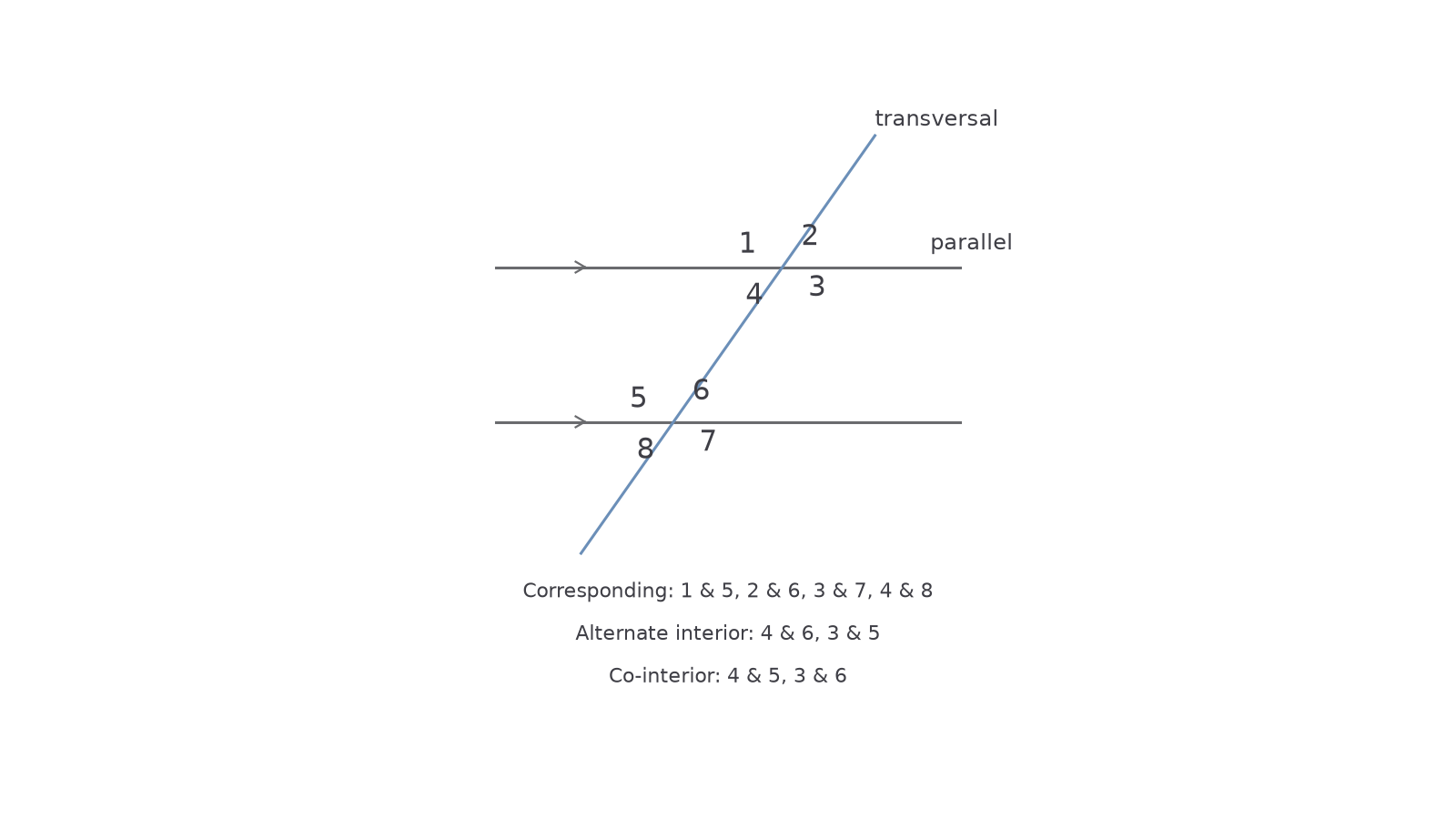
In the picture, angles 2 and 6 correspond. Sliding the upper intersection along the transversal to the lower intersection makes the parallel-line direction match, so the angle stays unchanged. The matching arrow marks are the evidence for parallel lines.
Worked example 1: the same upper-right position
Question. A transversal crosses two parallel horizontal lines. At the upper intersection, the angle above the horizontal line and to the right of the transversal is . Find the angle in the same position at the lower intersection.
Plan. Match the two relative positions.
Both angles are above their horizontal line and on the same side of the transversal, so they are corresponding.
Answer. , because corresponding angles in parallel lines are equal.
Check. Both angles are acute. The neighbouring obtuse angles would each be , giving the same pattern at both intersections.
The next target is adjacent to the corresponding angle. Transfer an angle first, then use the straight line.
Worked example 2: transfer, then subtract
Question. A transversal crosses two parallel horizontal lines. At the upper intersection, the upper-left angle is . Find the lower-left angle at the lower intersection.
Plan. Find the upper-left angle at the lower intersection, then its adjacent lower-left angle.
Answer. .
Check. at the lower intersection. The requested angle is adjacent to the corresponding one, so it should not also be .
The same method works after rotating the entire diagram. Follow the lines through each intersection rather than choosing a pair because they look close together.
Watch out
Corresponding equality needs parallel lines. If the lines are not stated or marked parallel, the same-looking positions alone do not prove equal angles.
The next pair has exactly the same relative position.
Alternate angles
Alternate angles lie on opposite sides of the transversal. The usual interior pair sits between the parallel lines, one at each intersection.
Alternate angles
Alternate interior angles are between the parallel lines and on opposite sides of the transversal. They are equal. Alternate exterior angles, outside the parallel lines and on opposite sides of the transversal, are equal too.
In the numbered diagram, 4 and 6 are an alternate interior pair, as are 3 and 5. Angles 1 and 7 form an alternate exterior pair, as do 2 and 8.
You can explain the interior equality using facts already taught. Angle 4 equals angle 2 because they are vertically opposite; angle 2 equals angle 6 because they correspond. Therefore angle 4 equals angle 6.
Continue this lesson.
You’re previewing NovaLearn without an account. Create a free account to read the rest.
Create free account