C6.2; E6.2 - Perimeter and area
A rectangular garden needs edging around its boundary and turf over its surface. Why do those jobs require different calculations and different units? This lesson develops perimeter and the areas of rectangles, triangles, parallelograms and trapeziums in C6.2 and E6.2, including the choice of perpendicular height.
Perimeter
The edging follows the whole outside boundary. Its length is the perimeter, so you add lengths rather than multiply them. Convert all measurements to the same unit before adding.
Perimeter
The perimeter of a plane shape is the total length of its boundary. A rectangle has two equal lengths and two equal widths, so its perimeter is . A triangle's perimeter is the sum of its three side lengths.
Perimeter has length units such as centimetres or metres. It does not use square units: the boundary is a line, rather than a surface.
Worked example 1: a rectangular boundary
Question. A rectangular garden is long and wide. Find its perimeter.
Plan. Count each of the two lengths and each of the two widths.
Answer. .
Check. One length plus one width is . Doubling this gives , agreeing with the four-side sum.
Changing the shape changes which sides must be counted. There is no extra doubling rule for an ordinary triangle.
Worked example 2: a triangular boundary with mixed units
Question. A triangular panel has sides , and . Calculate its perimeter in centimetres.
Plan. Convert the metre measurement to centimetres, then add the three sides.
Answer. .
Check. In metres, , which is .
For any polygon, follow the boundary once and count every side once. Equal-side markings can supply repeated lengths. A parallelogram with side lengths and has perimeter ; for a trapezium, add its four boundary sides. A perpendicular height drawn inside a shape is not a boundary side.
Watch out
For the garden, calculates area, not perimeter. The edging needs ; turf would need . Rectangle perimeter and area formulas are not supplied on the formula lists: learn them.
Keep the boundary and the requested unit in view.
Rectangle and triangle area
Turf covers the surface rather than following its edge. Area counts unit squares: a rectangle with 8 rows of 5 unit squares has area 40 square units.
Rectangle and triangle area
For a rectangle of length and width , and a triangle with base and corresponding perpendicular height ,
Triangle area is supplied on page 2 of Papers 1–4. Rectangle area is not supplied: learn it. All required formulas are provided within questions on Papers 5 and 6.
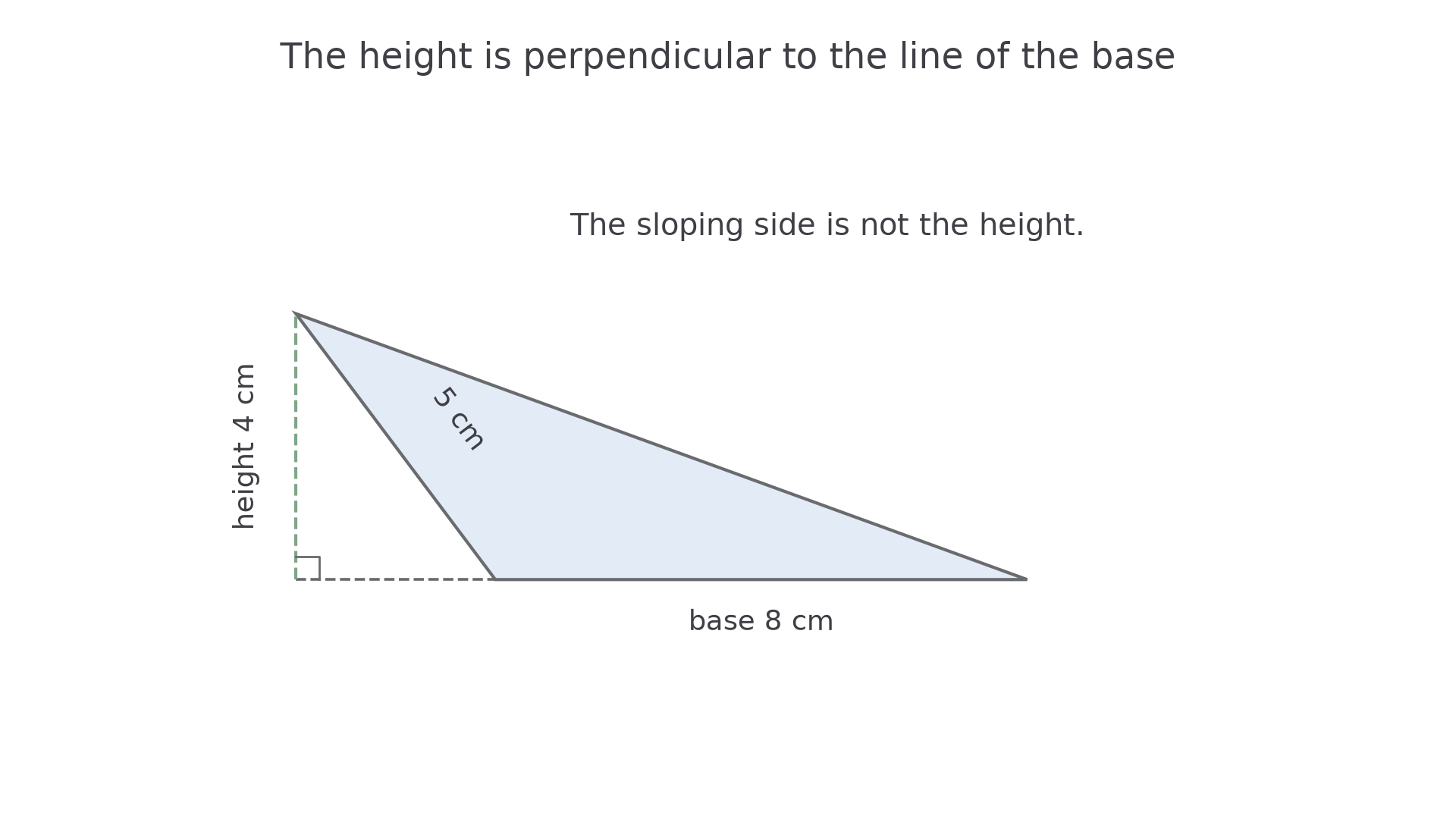
Two copies of a triangle can form a parallelogram of base and height ; cutting and moving its end makes a rectangle of area . One triangle occupies half that area. The height measures the distance from the opposite vertex to the line of the base at a right angle. It may lie outside an obtuse triangle.
[DIAGRAM: asset_name: A triangle's height is perpendicular; asset_slug: triangle_perpendicular_height; caption: The height meets the line of the base at a right angle, even when the foot lies outside the triangle.; description: Exact obtuse triangle with horizontal base eight centimetres and opposite vertex four centimetres above a point three centimetres beyond the left endpoint. The perpendicular height is dashed with a right-angle marker at its foot and label four centimetres. The left sloping side is labelled five centimetres. The base is extended to the foot.]
Worked example 3: rectangular surface
Question. A rectangular board is by . Calculate its area.
Plan. Multiply the perpendicular length and width to count square centimetres.
Answer. .
Check. Split the length into 7 cm and 0.5 cm: the areas are and , totalling .
A triangle needs half the base-times-height product. The diagram deliberately offers a sloping side as well as the height, so that the choice matters.
Worked example 4: height outside a triangle
Question. A triangle has base , perpendicular height , and one sloping side of , as shown above. Calculate its area.
Plan. Use the perpendicular height 4, rather than the sloping side 5.
Answer. .
Check. Two copies form a parallelogram of base 8 cm and height 4 cm, with area . One copy has half that area. Moving the top vertex sideways without changing its height would preserve the area.
Continue this lesson.
You’re previewing NovaLearn without an account. Create a free account to read the rest.
Create free account