E3.1, E3.5 - Cubic and reciprocal graphs (Extended)
A cubic curve can flatten or turn; a reciprocal graph has separate branches. Recognise these E3.1 families, use labelled points to determine unknown values, and identify the simple axis-parallel asymptotes in E3.5 directly from graphs. The shape helps you decide whether a calculator display makes mathematical sense.
Cubic shape
Can a smooth curve have two turning points and still be one function? A cubic such as does: every input still has just one output.
Cubic function
A cubic function has the form , where . Its highest input power is 3. Its two ends go in opposite vertical directions; its graph can have two turning points or no turning points.
For positive , the far-left end goes down and the far-right end goes up. Negative reverses these directions. The basic has rotational symmetry of order 2 about the origin: a half-turn sends to on the same curve. Do not assume every cubic is symmetric about the origin; other terms can move its centre of symmetry.
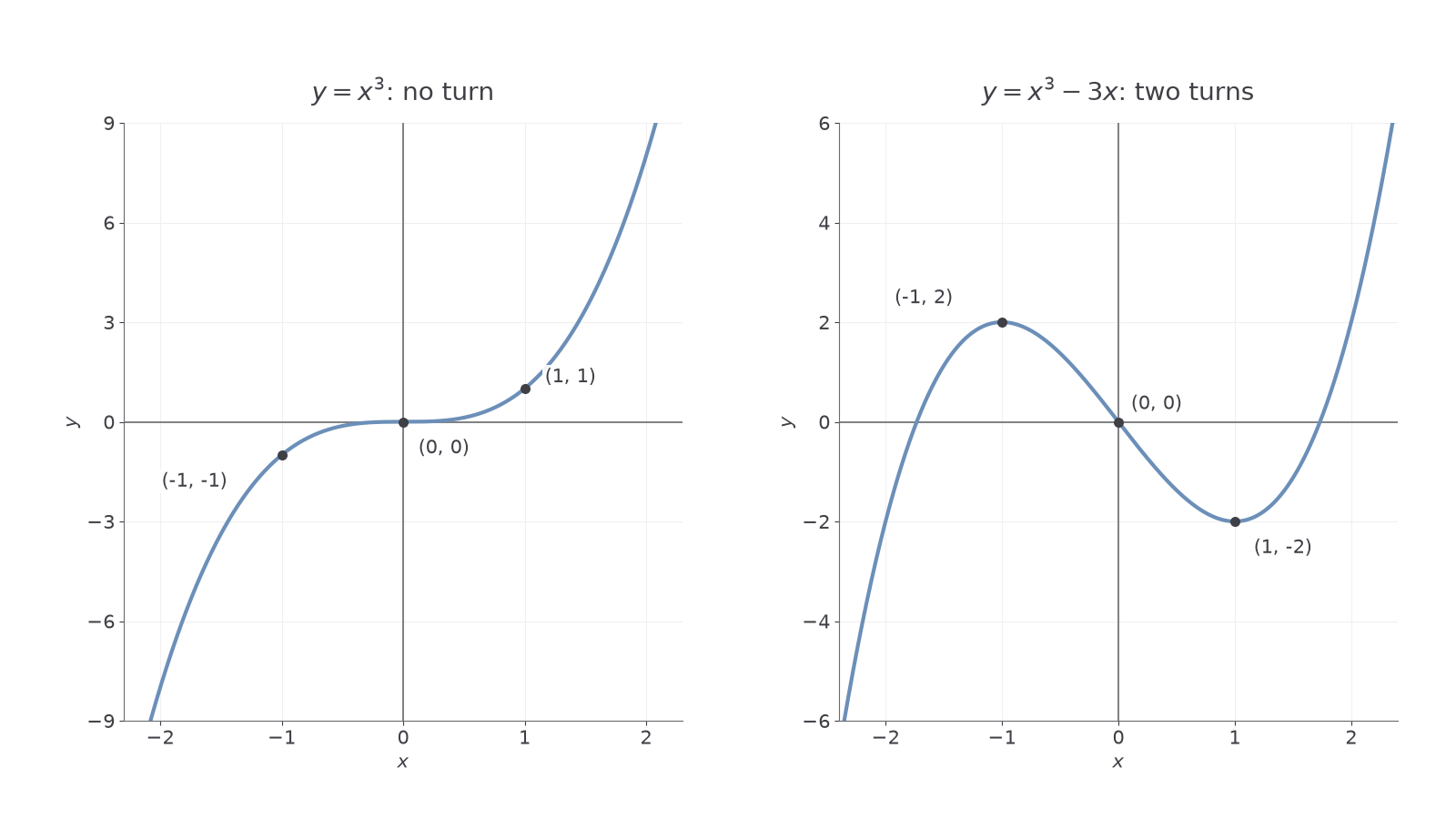
[DIAGRAM: asset_name: Cubics with and without turning points; asset_slug: cubic_shapes; caption: Both are cubic curves, but the right-hand curve has two turning points.; description: Two exact numbered-axis panels show y equals x cubed and y equals x cubed minus three x. The first labels minus one minus one, zero zero and one one. The second labels local maximum minus one two, local minimum one minus two and zero zero. Curves are smooth and show opposite end directions.]
Worked example 1: a cubic that keeps increasing
Question. Describe the shape and symmetry of .
Plan. Use a few exact points, then examine the complete curve.
The smooth curve rises from bottom left to top right, flattening at and then continuing upwards. It does not reverse direction there.
Answer. An increasing cubic with no local maximum or minimum, and half-turn symmetry about .
Check. Opposite inputs give opposite outputs, for example and . The origin is a flat point, not a turning point, because outputs increase through it.
Adding a linear term can create two turns while leaving the highest power unchanged.
Worked example 2: a cubic with two turns
Question. Describe , using its GDC graph.
Plan. Graph the curve and locate its extrema rather than deciding from one point.
- Enter , with , .
- The maximum feature near gives ; the minimum near 1 gives .
- The curve rises, falls between the turns, then rises again. Its far ends still go down on the left and up on the right.
Answer. A cubic with a local maximum at , a local minimum at , and half-turn symmetry about the origin.
Check. and . Replacing by reverses the output sign, confirming the symmetry. Nearby values on the graph confirm each turn's type.
This answers the opening question: two turns do not give multiple outputs for a single input.
Watch out
Do not confuse a cubic's flat point with a quadratic vertex. The graph of keeps increasing through zero; the graph of changes from decreasing to increasing there.
Use end direction and symmetry together.
Reciprocal shape
A reciprocal , with , has no value at zero. Its graph therefore has two separate branches rather than one curve joined through the origin.
Asymptote
An asymptote is a straight line that a graph approaches. Here identify simple vertical or horizontal asymptotes from the graph. State their equations, such as or , rather than a single number or a point.
For the basic reciprocal family, positive puts the branches in the first and third quadrants; negative puts them in the second and fourth. The axes are the asymptotes of these basic graphs. Each branch approaches the axes without meeting them. They have half-turn symmetry about the origin. An asymptote is not an instruction to connect separated branches, and the general concept does not mean that every graph is forbidden from crossing every asymptote.
Continue this lesson.
You’re previewing NovaLearn without an account. Create a free account to read the rest.
Create free account