E8.1 - Reflections in oblique lines (Extended)
A sloping mirror still puts each image directly across a perpendicular, rather than directly left, right, up or down. E8.1 extends reflection to any straight mirror line. You will construct images, join their vertices accurately and use midpoint and right-angle checks to distinguish a reflection from a plausible-looking mistake.
Oblique mirrors
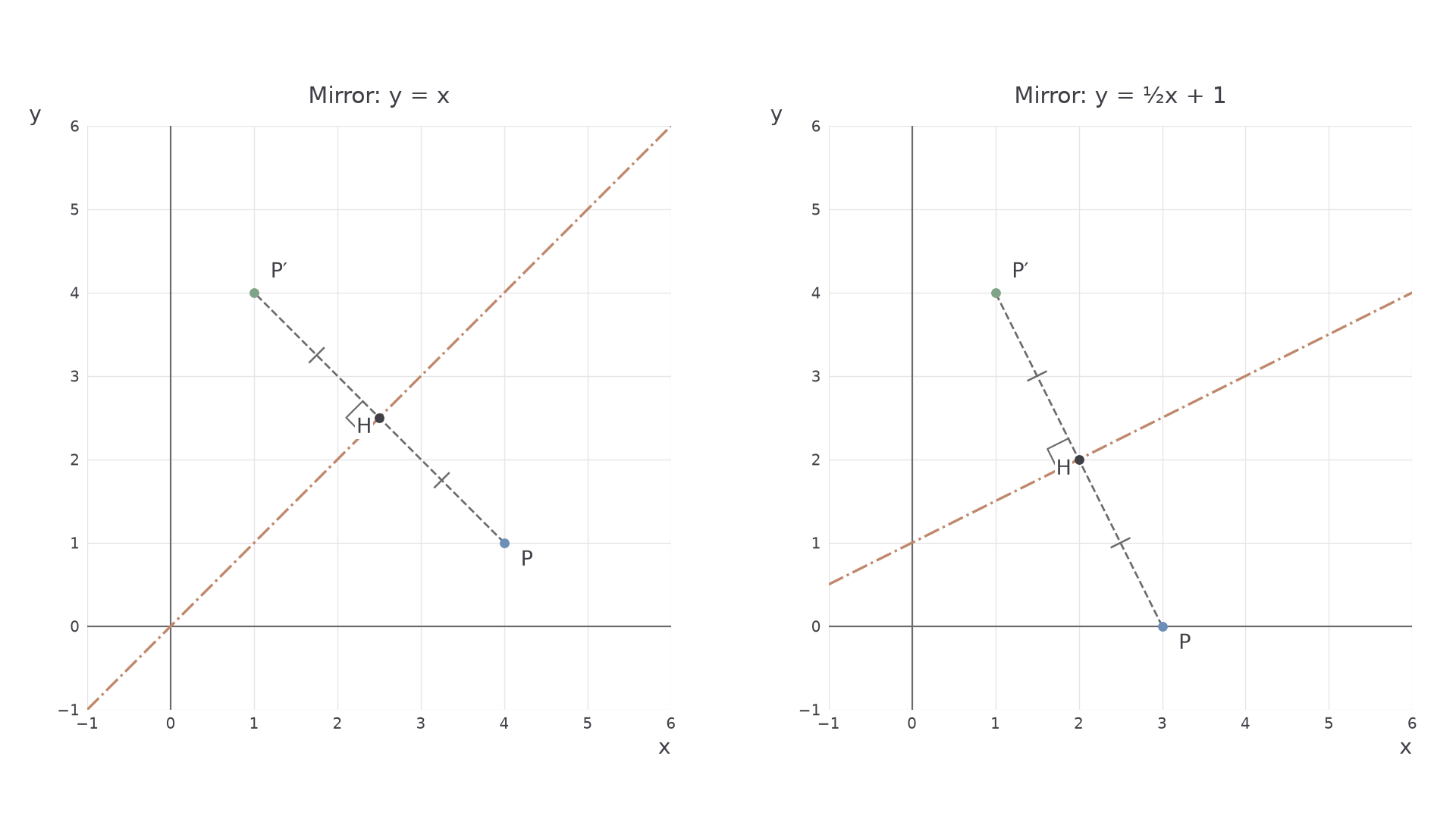
How can you reflect in without guessing? The mirror passes through and . The reflected point is : its joining segment with P crosses the mirror at right angles and halfway.
Oblique mirror line
An oblique mirror line is sloping rather than horizontal or vertical. The same reflection rule applies: the mirror perpendicularly bisects each point-to-image segment. A point on the mirror stays fixed.
On a squared grid, swaps horizontal and vertical positions, so maps to . The line maps to . These are useful special cases, not rules for every sloping line.
For any straight mirror, draw a perpendicular from P to the mirror using a set square or protractor, meeting it at H. Extend PH beyond H. Measure , then mark P'. Use the grid's scale, and ensure the axes use the same physical scale when constructing right angles on paper.
[DIAGRAM: asset_name: Perpendicular constructions in sloping mirrors; asset_slug: oblique_point_construction; caption: H is on the mirror and halfway along the perpendicular joining segment.; description: Two accurate equal-scale grids. Left shows P four comma one reflected in y equals x to P prime one comma four, with H at two point five comma two point five. Right shows P three comma zero reflected in y equals one half x plus one to P prime one comma four, with H at two comma two. Right-angle symbols and matching distance marks establish the construction in both panels.]
Worked example 1: reflection in y equals x
Question. Reflect in .
Plan. Swap coordinates, then check the perpendicular-bisector condition.
H lies on . From P to P', the move is 3 left and 3 up, perpendicular to a line moving equally right and up.
Answer. .
Check. Repeating the swap returns . The two points lie on opposite sides of the mirror and H is halfway between them.
The next mirror has a different gradient. A coordinate swap would reflect in the wrong line, so use the perpendicular construction.
Worked example 2: a different oblique line
Question. Reflect in , using the right-hand grid.
Plan. Draw PH perpendicular to the mirror and extend the same distance through H.
The perpendicular meets the mirror at , as constructed on the grid. From P to H is 1 left and 2 up. Repeat that move from H:
Answer. .
Check. H satisfies the mirror equation: . The mirror runs 2 right and 1 up; PH runs 1 left and 2 up, forming a right angle as marked. The identical P-to-H and H-to-P' moves establish equal distances.
To construct a reflection in , the same perpendicular-distance method works; the coordinate shortcut merely saves drawing time.
Watch out
Swapping coordinates is valid for , not for every oblique mirror. For example, the swap of is , which is not its reflection in .
Use the stated mirror in the next task.
Drawing an image
Reflect every vertex separately, label the images and join them with a ruler in the original vertex order. A vertex on an oblique mirror is fixed just as it is on a horizontal mirror. The reflected shape remains congruent to the object.
Problem-solving
For each vertex: draw its perpendicular to the mirror, find the meeting point, then continue by the same distance. Check the vertex labels before joining: joining the right points in the wrong order can make the wrong shape.
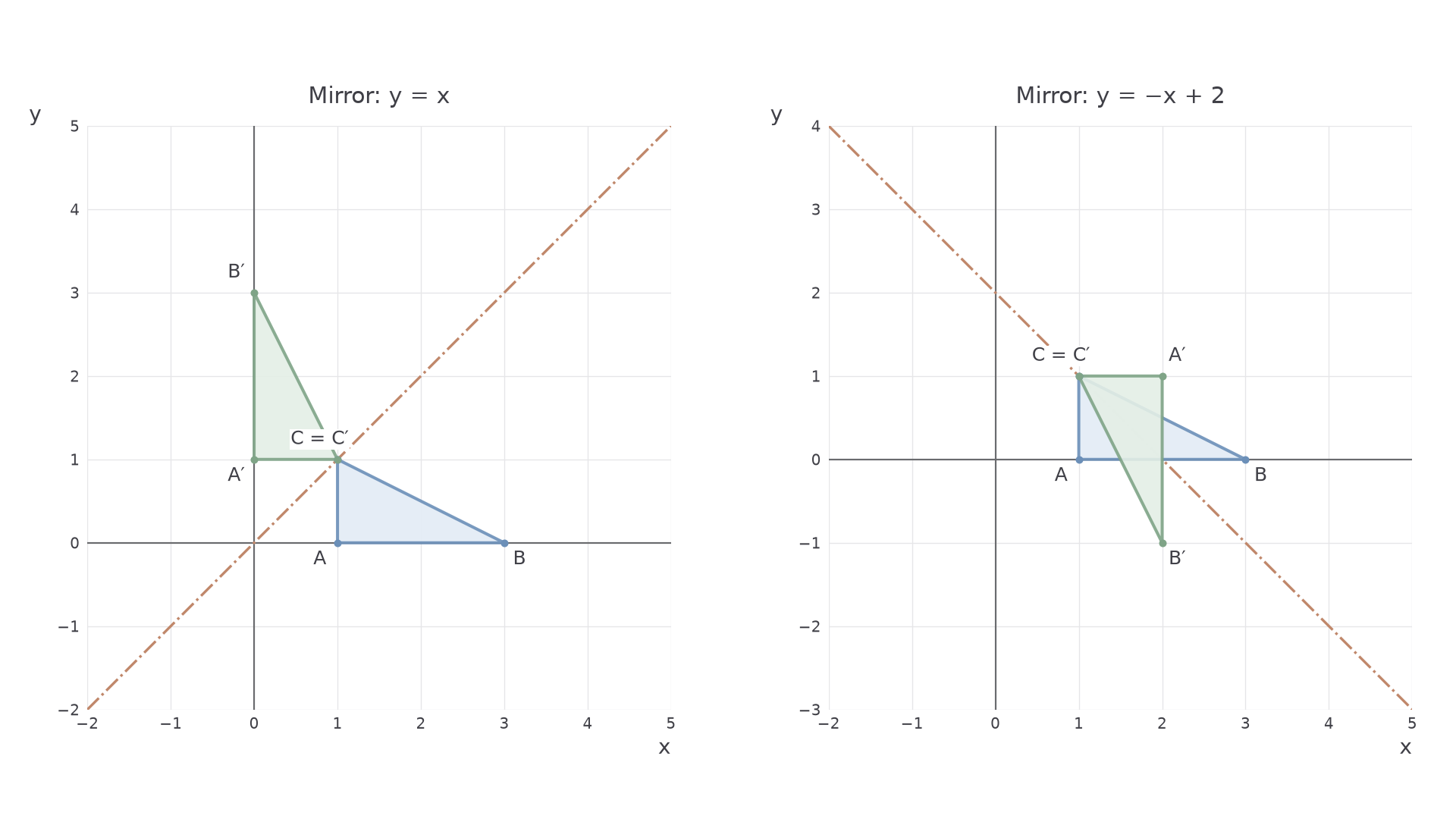
The examples below keep the object fixed but change the mirror. A sloping mirror need not pass through the origin.
[DIAGRAM: asset_name: Triangles reflected in two diagonal mirrors; asset_slug: oblique_triangle_images; caption: C lies on each mirror and remains fixed, while A and B move to their corresponding images.; description: Two accurate equal-scale grids show A one comma zero, B three comma zero and C one comma one. The first mirror is y equals x and images are zero comma one, zero comma three and one comma one. The second mirror is y equals minus x plus two and images are two comma one, two comma minus one and one comma one. Object and image edges are ruled, with primes distinguishing corresponding vertices.]
Worked example 3: a triangle in a diagonal through the origin
Question. Reflect triangle , , in .
Plan. Swap the coordinates of every vertex and join the images in order.
Answer. The image is the triangle joining , labelled A', B', C' as on the left grid.
Check. C lies on , so stays fixed. AB is horizontal with length 2; A'B' is vertical with length 2. Every midpoint of a moved pair lies on .
Continue this lesson.
You’re previewing NovaLearn without an account. Create a free account to read the rest.
Create free account