C6.4; E6.4 - Prisms and cylinders
A block and a round column look different, but both can be built by repeating the same cross-section. C6.4 and E6.4 use that shared structure to calculate prism and cylinder volumes. You will identify the area that repeats, choose the correct length and keep radius separate from diameter.
Uniform cross-sections
Why does multiplying one flat area by a length give the volume of a solid? Imagine stacking identical triangular cards without gaps: each layer has the same area, so every equal thickness adds the same volume.
Prism and uniform cross-section
A cross-section is the flat shape exposed by a cut through a solid. A prism has a uniform cross-section: parallel cuts perpendicular to its length have the same shape and size all the way along.
A cuboid has a rectangular cross-section; a triangular prism has a triangular one. A cylinder has a circular cross-section. Here the word prism includes any uniform cross-section, even one with a curved boundary: a solid made by extending a circular sector is a cylindrical sector.
[DIAGRAM: asset_name: Repeating cross-sections; asset_slug: repeating_cross_sections; caption: A triangular face or a quarter-circle can repeat unchanged along a solid.; description: A triangular prism and a quarter-cylinder are shown side by side. Each has an end cross-section and a parallel interior cross-section highlighted in the same pale blue. Their length directions are marked. The quarter-cylinder has two straight radial sides and a curved side, all extending unchanged along its length.]
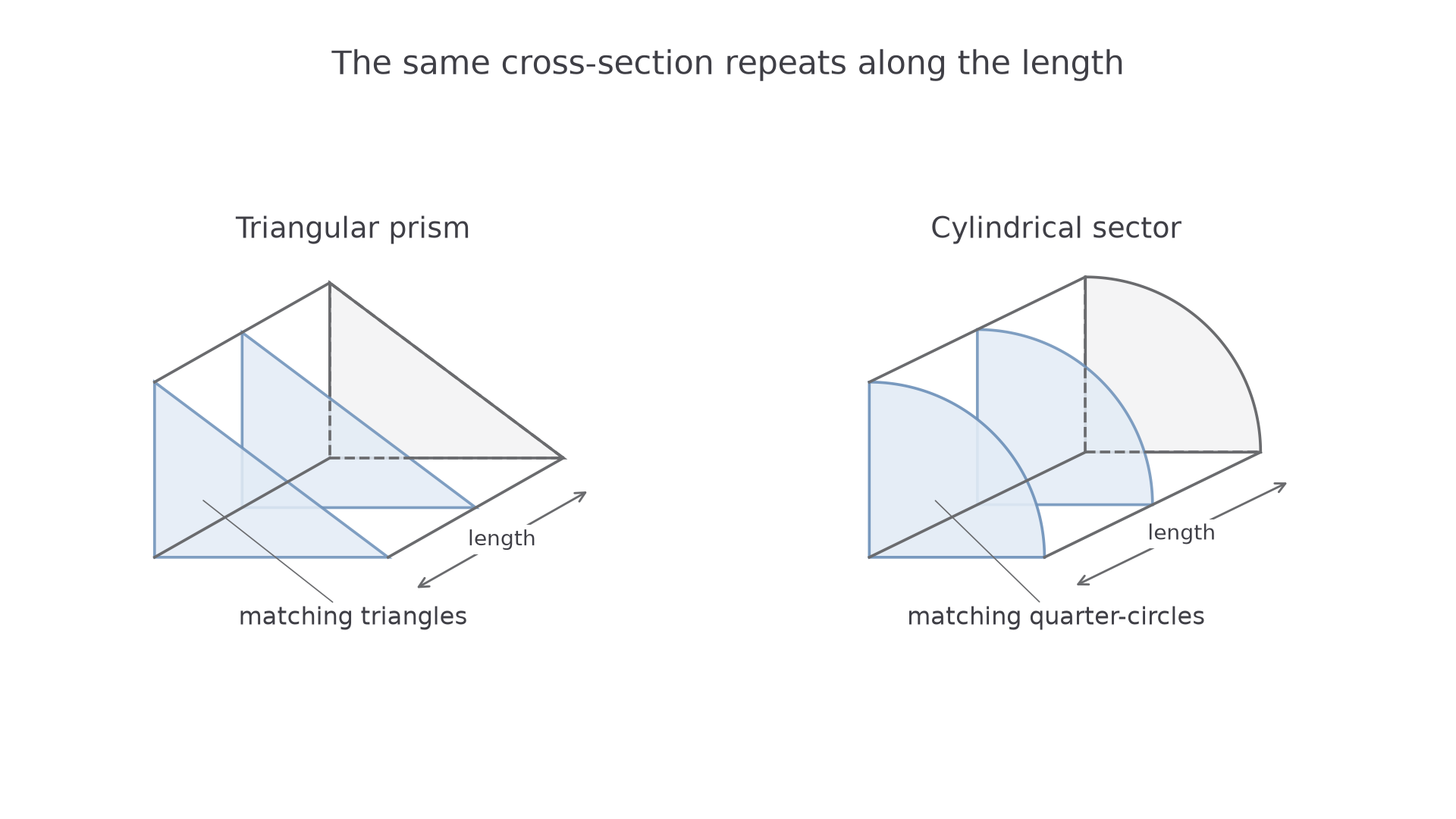
The direction of the cut matters. Cutting a triangular prism along its length does not usually produce the cross-section used to calculate its volume. Look for the shape that repeats from one end to the other. A cone fails this test: cuts parallel to its circular base become smaller towards its tip. A pyramid also narrows, so neither has a uniform cross-section.
Key idea
The cross-section must keep both its shape and its size. Circular slices alone do not make a cone a prism: the circles shrink.
Use the unchanged slices, rather than whether the solid has a curved surface.
Prism volume
For a prism, each unit of length contributes one cross-sectional area of volume. A cross-section of area repeated through a length of 5 cm gives .
Volume of a prism
is the uniform cross-sectional area and is the perpendicular distance between the two matching ends. Use matching length units throughout. This formula is on the supplied lists for Papers 1–4; required formulas are supplied within questions on Papers 5 and 6.
For a cuboid, , so this gives the familiar product of three dimensions. For another prism, first calculate its end area. Do not multiply all the labelled lengths indiscriminately.
Worked example 1: a rectangular cross-section
Question. A cuboid is 8 cm long. Its rectangular end is 5 cm wide and 3 cm high. Calculate its volume.
Plan. Find the rectangular cross-sectional area, then multiply by the length.
Answer. .
Check. Eight layers each containing unit cubes contain unit cubes.
Only the end shape changes next. Halving a rectangle to make a triangle halves the volume too.
Continue this lesson.
You’re previewing NovaLearn without an account. Create a free account to read the rest.
Create free account