C4.4; E4.4 - Equations of straight lines
A line crosses the -axis at 1 and rises 2 units for every unit to the right. How can one equation describe every point on it? C4.4 and E4.4 connect a straight-line graph's gradient and intercept to its equation, including horizontal and vertical lines.
Slope-intercept form
Start on the -axis at height 1. After moving units horizontally along a line with gradient 2, the height changes by . Its height is therefore . This describes every point, rather than only the starting point.
Gradient and y-intercept
For the non-vertical straight line , is its gradient and is its -intercept, the value of where . The intercept point is . This equation form is not on the supplied formula list for Papers 1–4: learn it.
The expression “slope-intercept form” names the same form: slope is another word for gradient. Multiplying by accounts for the change from the starting height . When , the term vanishes, leaving . When increases by 1, changes by .
Worked example 1: identifying a positive gradient
Question. Write down the gradient and -intercept of .
Plan. Compare the coefficient of and the constant term with .
Answer. Gradient 3 and -intercept , at the point .
Check. gives ; gives . A unit increase in produces a rise of .
Keep the intercept but change the coefficient of . The new negative fractional gradient changes both direction and steepness.
Worked example 2: identifying a negative fractional gradient
Question. Write down the gradient and -intercept of .
Plan. Include the minus sign in the coefficient and in the constant term.
Answer. Gradient and -intercept , at .
Check. At , ; at , . The change is over a run of 2, giving .
An omitted coefficient of means 1: has gradient 1. In , the coefficient is . A line through the origin has , so is already simplified.
Watch out
The -intercept of is , not 2 and not 3. The point is on the -axis; would be on the -axis.
Compare a fresh equation with the same form.
Equation from a graph
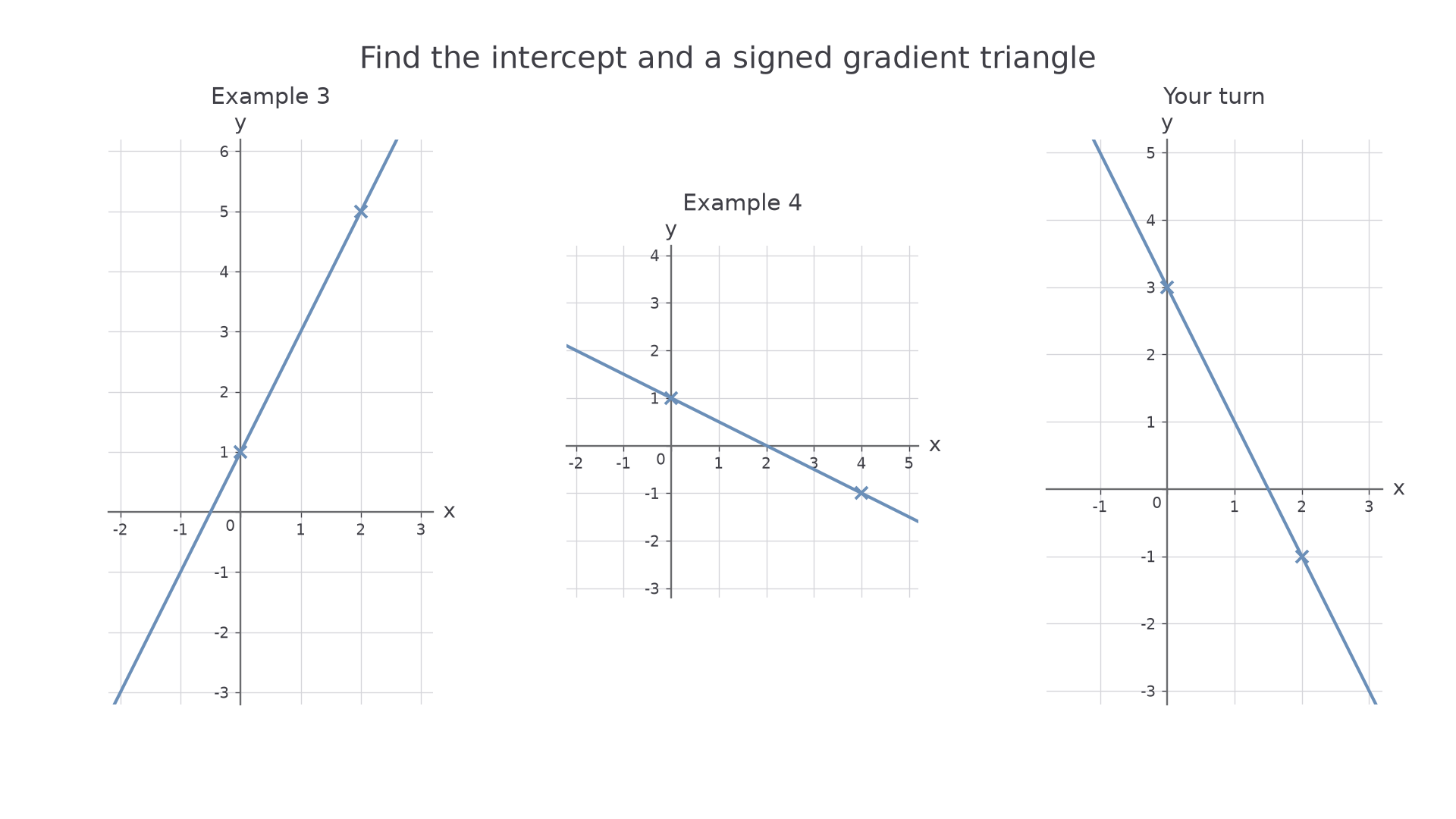
To obtain an equation from a grid, read where the line crosses the -axis and calculate its gradient using a clear triangle. Put these two values into , then simplify. At Core, the grid supplies the gradient information; you do not need a coordinate-only gradient formula.
[DIAGRAM: asset_name: Equations from three straight-line grids; asset_slug: line_equation_grids; caption: Read the intercept at x equals zero and the gradient from a matching rise and run.; description: Three accurate Cartesian unit grids. Example 1 shows a line through zero comma one and two comma five, with those clear points marked. Example 2 shows a falling line through zero comma one and four comma minus one. Your turn shows a separate line through zero comma three and two comma minus one. The lines are not labelled with their equations or gradients.]
Worked example 3: a positive gradient from the grid
Question. Find the equation of the line in the first panel.
Plan. Read the -intercept, then use the marked points to find the gradient.
Answer. , answering the opening question.
Check. The marked point satisfies . The intercept also satisfies the equation.
The second grid keeps the same intercept but changes the gradient to a falling fraction. Simplify the ratio before writing the equation.
Worked example 4: a negative gradient from the grid
Question. Find the equation of the line in the second panel.
Plan. Use its intercept and the signed change from the left marked point to the right one.
Answer. .
Check. At , the equation gives , agreeing with the right-hand marked point. At , it gives 1.
Continue this lesson.
You’re previewing NovaLearn without an account. Create a free account to read the rest.
Create free account