E3.1 - Exponential graphs (Extended)
Equal input steps give equal output factors on an exponential graph. Recognise growth and decay, recover a base or coefficient from labelled points, and describe the graph's long-term behaviour. Reciprocal bases also reveal a useful reflection symmetry.
Growth and decay shapes
A positive quantity halves at every unit step. Will its graph eventually reach zero? The outputs become small, but the exponential rule never makes a positive starting value exactly zero.
Exponential function
In the exponential function , the input is the power and the base satisfies , . If , the graph increases: exponential growth. If , it decreases: exponential decay. In both cases and all outputs are positive.
Increasing the input by one multiplies the output by . This is a constant factor, not a constant difference. Join calculated points with a smooth curve rather than ruled segments. The curve continues between integer inputs; for example .
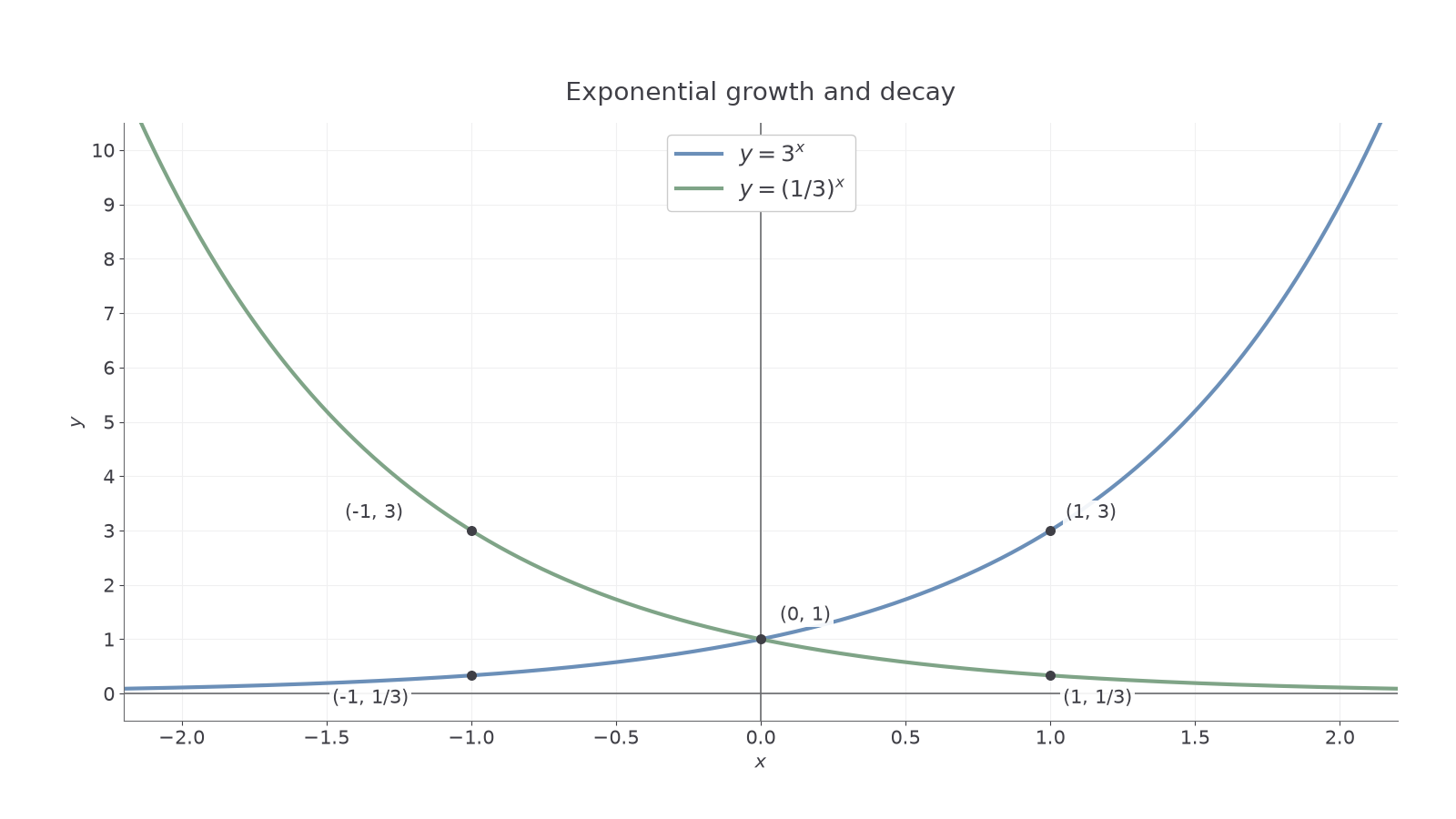
[DIAGRAM: asset_name: Exponential growth and decay; asset_slug: exponential_growth_decay; caption: Reciprocal bases give curves reflected in the vertical axis, both passing through zero one.; description: Exact graph of y equals three to the power x in blue and y equals one third to the power x in sage, on numbered axes from minus two point two to two point two. The point zero one and the pairs one three, minus one three, one one third and minus one one third are marked. Both curves stay above the horizontal axis.]
Worked example 1: recognising growth
Question. Use values to describe .
Plan. Evaluate successive integer inputs and compare the outputs.
Each output is three times the preceding one. The smooth curve rises from left to right and passes through .
Answer. An increasing exponential growth graph, with multiplication factor 3 per unit input step.
Check. The ratios are , and . The differences are not constant, so it is not a straight-line graph.
Replacing the base by its reciprocal reverses growth into decay.
Worked example 2: recognising decay
Question. Use values to describe .
Plan. Use the same inputs so the change in shape is clear.
The multiplier is , so the positive outputs decrease at each unit step. Negative inputs give larger outputs, not negative outputs.
Answer. A decreasing exponential decay graph, passing through .
Check. , and multiplying 9 by four times gives , matching the table.
The sign of the input is different from the sign of the output.
Watch out
A negative input does not make negative. For positive , . Decay means the outputs decrease, not that they are below the horizontal axis.
Use both the values and the base to classify the curve.
Reading parameters
A labelled graph point supplies an exact input-output equation. For , input 1 is especially useful because its output is the base itself.
For a supplied growth or decay model , the coefficient is the output at zero, because . With equally spaced inputs, divide outputs to find the multiplier per step. A ratio over two input units is , not . Here take positive bases, as the exponential family requires.
Worked example 3: a base from a labelled point
Question. The graph of , with , passes through the labelled point . Find , then find the output at .
Plan. Substitute the point, take the positive square root, then evaluate the rule.
Answer. ; the required output is .
Check. . A base of 9 would instead give output 81 at input 2, so confusing the two-unit multiplier with the base would fail the given point.
Continue this lesson.
You’re previewing NovaLearn without an account. Create a free account to read the rest.
Create free account