C5.1; E5.1 - Solid shapes and circle vocabulary
A cylinder and a cone both have a circular base, but their shapes behave differently as you move upwards. C5.1 and E5.1 give you the language to recognise solids and describe circles, so you can tell a radius from a chord and a sector from a segment.
Simple solids
Imagine cutting a cylinder and a cone into thin slices parallel to their bases. A cylinder's slices keep the same size; a cone's slices become smaller towards its tip. This is a useful way to distinguish solid shapes.
Faces, surfaces and edges
A solid is three-dimensional. Its surface is its outer boundary, which can contain flat and curved parts. A face is a flat part of that surface. An edge is a boundary where surface parts meet; it may be straight or curved.
A vertex is a corner where edges meet. A cube has straight edges and vertices. A sphere has a continuous curved surface with no edges or vertices. The circular boundary of a cone's flat base is a curved edge; its pointed tip is its apex.
[DIAGRAM: asset_name: Familiar solid shapes; asset_slug: simple_solid_shapes; caption: Prisms keep a uniform cross-section; pyramids and cones taper towards an apex.; description: Exact mathematical projections show a cube, a non-cubic cuboid, a triangular prism, a cylinder, a square-based pyramid, a cone and a sphere. Selected flat faces are pale blue, hidden edges dashed, and the cone and pyramid have labelled apexes.]
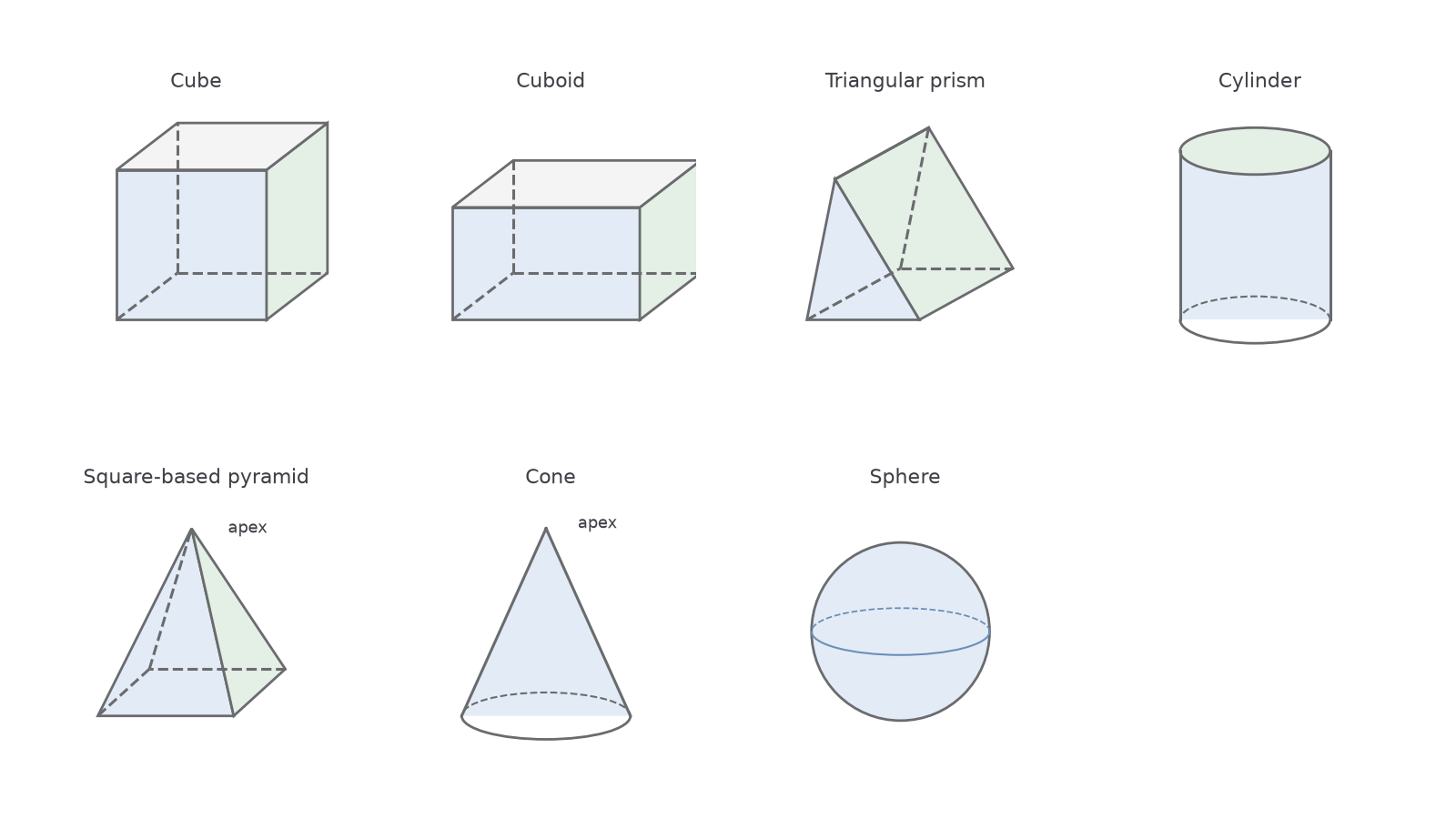
| Solid | How to recognise it |
|---|---|
| Cube | Six equal square faces |
| Cuboid | Six rectangular faces; a cube is the special case with all edges equal |
| Prism | A uniform cross-section all along its length |
| Cylinder | Two equal parallel circular flat ends joined by a curved surface |
| Pyramid | A polygon base with triangular side faces meeting at one apex |
| Cone | A circular flat base and curved surface tapering to one apex |
| Sphere | All points of its surface the same distance from its centre |
A cross-section is the flat shape revealed by a slice. For a prism, slices perpendicular to its length have the same shape and size. A triangular prism has triangular ends and rectangular side faces; it does not come to a point. A square-based pyramid has one square base and four triangular side faces meeting at the apex.
The uniform-cross-section description also includes curved examples: a cylinder has a circular cross-section, and a solid whose cross-section is a circular sector can be a prism. Do not decide that a solid is a pyramid merely because a triangle appears somewhere in its drawing.
A perspective drawing can make a rectangular face look like a parallelogram on the page. The cube's back edges remain equal in reality even when the picture makes them appear shorter. Dashed lines show hidden edges.
Watch out
A circle is a flat shape; a sphere is a solid. A triangular prism has two triangular ends; a triangular face alone does not make a solid a prism.
Use the behaviour of the whole solid, including hidden parts.
Circle vocabulary
The boundary of a circle curves, but many of its named parts are straight line segments. Ask where a segment's endpoints lie and whether it passes through the centre.
Centre, radius and diameter
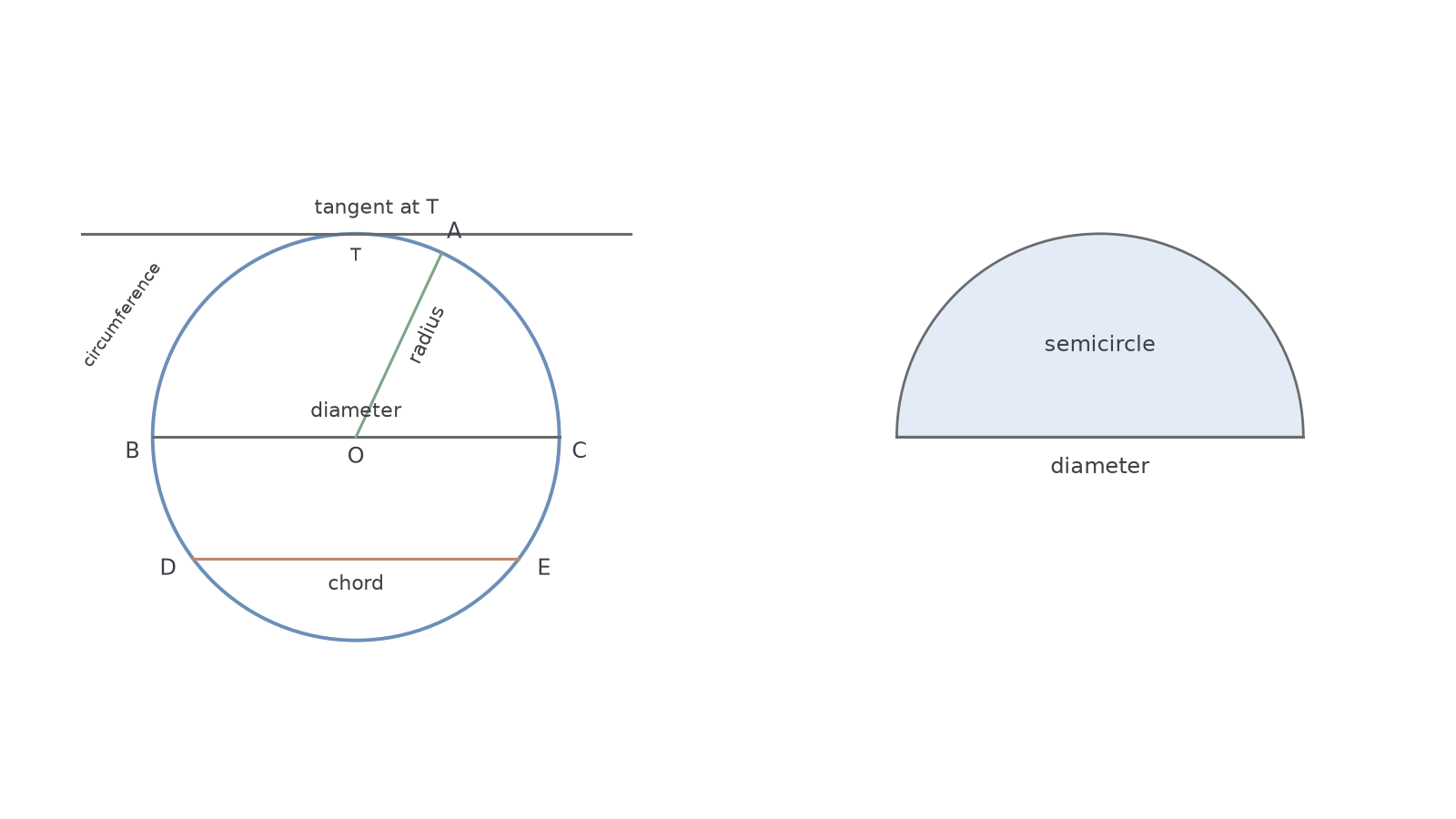
A circle consists of points in a flat surface at a fixed distance from its centre. A radius joins the centre to a point on the circle; the plural is radii. A diameter joins two points on the circle through the centre.
Every radius of the same circle has the same length. A diameter contains two radii in a straight line, so its length is twice the radius. For example, if the radius is , the diameter is . The diameter is a straight distance across the circle; it is not the distance around it.
[DIAGRAM: asset_name: Circle line vocabulary; asset_slug: circle_line_vocabulary; caption: A diameter passes through the centre; a chord need not, and a tangent touches the circle once.; description: Two exact circle panels show labelled centre O, radius OA, diameter BC through O, a non-diameter chord DE, a tangent at T, the circumference highlighted, and a semicircle bounded by a diameter and a half-circle arc. The tangent is outside the circle except at its contact point.]
Continue this lesson.
You’re previewing NovaLearn without an account. Create a free account to read the rest.
Create free account