E7.6 - Pythagoras and trigonometry in 3D (Extended)
An 8 cm by 6 cm by 5 cm box has a 10 cm diagonal across its base. How long is the diagonal through its interior, and how steeply does it rise above the base? You will find useful plane triangles inside solids, link Pythagoras calculations and measure the angle between a line and a plane using a perpendicular projection.
Selecting a plane
A solid drawing is a flat view of a three-dimensional object. An angle that looks square on the page need not be a right angle in the solid; use the stated perpendicular edges and faces instead.
Plane section and perpendicular height
A plane is a flat surface extending in every direction. A triangle whose three vertices lie in one plane can be treated as an ordinary two-dimensional triangle. A line perpendicular to a plane meets every line in that plane through its foot at a right angle.
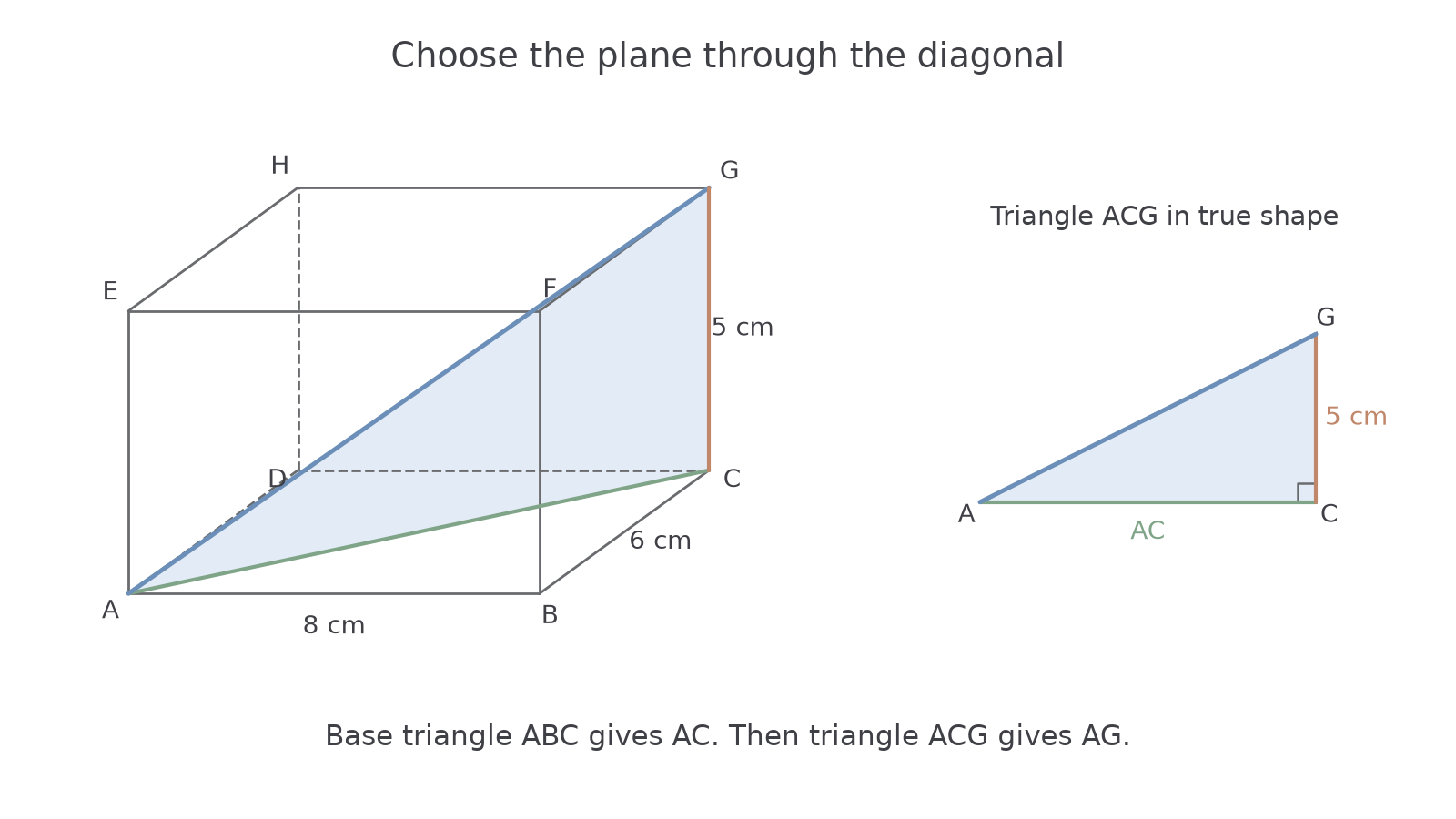
For a cuboid labelled around the base, with directly above , the diagonal lies in triangle . The base diagonal is horizontal and is perpendicular to the base, so is right-angled at . Sketch that triangle separately before calculating.
[DIAGRAM: asset_name: A diagonal plane inside a cuboid; asset_slug: cuboid_diagonal_plane; caption: Find the base diagonal first, then work in the right triangle ACG.; description: An exact oblique projection of cuboid ABCD EFGH has AB 8 cm, BC 6 cm and CG 5 cm. Base diagonal AC and interior diagonal AG form the shaded plane triangle ACG, right-angled at C. A separate true-shape triangle ACG shows horizontal AC, vertical CG 5 cm and sloping AG, with its right-angle mark at C.]
Worked example 1: choosing two connected triangles
Question. A cuboid has , and , labelled as above. To find , which base length should you find first, and which right triangle should you then use?
Plan. Join the lower endpoint to the foot directly below the upper endpoint .
First use base triangle , right-angled at , to find . Then use triangle , right-angled at , because is perpendicular to the base plane containing .
Answer. Find first; then use right triangle .
Check. and meet at , and the side joining their other endpoints is exactly the required . This gives one connected triangle rather than mixing edges from different faces.
A pyramid changes the solid, but the same strategy works: join the target's base endpoint to the foot of the perpendicular height.
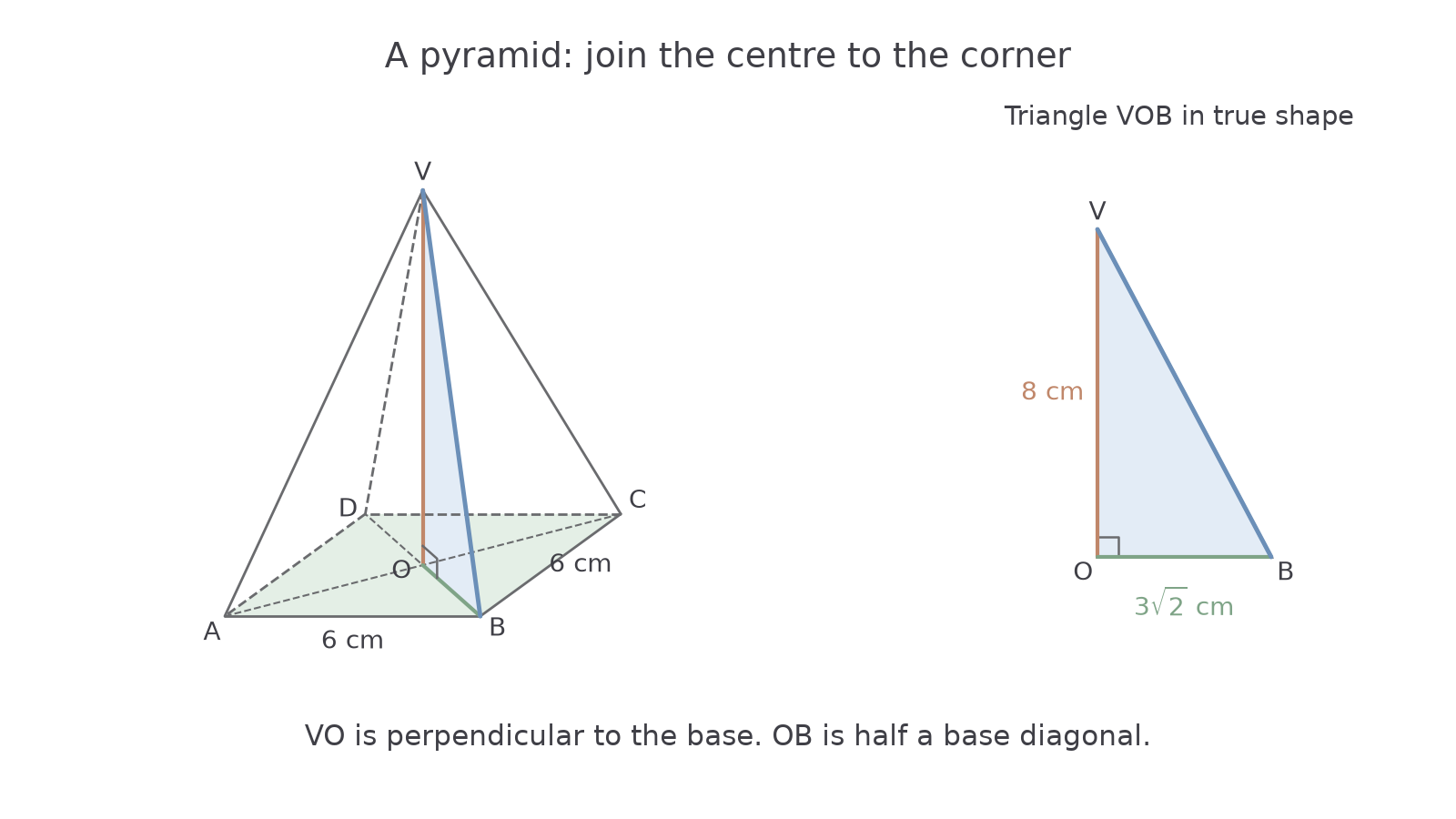
[DIAGRAM: asset_name: A right triangle inside a square-based pyramid; asset_slug: pyramid_centre_triangle; caption: The horizontal leg to a corner is half the base diagonal, not half a base edge.; description: A square ABCD of side 6 cm has centre O at the intersection of its diagonals. Apex V is vertically 8 cm above O. The exact projected solid highlights right triangle VOB, with VO perpendicular to the base, OB half the square diagonal, and VB the sloping edge. The right angle is at O, and a separate true-shape triangle VOB shows legs 8 cm and 3 square root 2 cm.]
Worked example 2: a pyramid's sloping edge
Question. A square-based pyramid has base of side . The apex is directly above the centre , and . Which right triangle would you use to find sloping edge , and how would you obtain its horizontal leg?
Plan. Use the perpendicular height and join its foot to .
Triangle is right-angled at . Its horizontal leg is half the base diagonal . Find from a right triangle with legs 6 and 6, then halve it. Thus .
Answer. Use triangle , with legs and , and hypotenuse .
Check. Every corner is the same distance from the square's centre, so this triangle would give the same sloping-edge length for all four corners. Using half an edge, 3 cm, would instead reach a side midpoint, not .
A separate triangle sketch should retain the original vertex letters, lengths and justified right angle.
Watch out
The perpendicular height of a pyramid is not its sloping edge. Also, centre-to-corner distance is half a diagonal; centre-to-side-midpoint distance is half an edge. Choose the one that reaches your target endpoint.
Identify the connected triangles in a new box.
Lengths in 3D
Once the plane triangle is selected, the calculation uses familiar two-dimensional rules. A first Pythagoras calculation often supplies a length needed in a second one. Keep that intermediate length exact, or carry its square forward without rounding.
You already know
Pythagoras gives for a right triangle with hypotenuse . To find a leg, subtract the other leg's square from the hypotenuse's square. Pythagoras is not separately printed in the supplied formula list: learn it.
An interior diagonal of a cuboid can be found by two successive right triangles. This works because its edges meet perpendicularly; do not transfer the method to a sloping box without checking those right angles.
Worked example 3: an interior diagonal
Question. A cuboid has base sides , and height . Calculate its interior diagonal .
Plan. Find base diagonal in , then use and in right triangle .
Answer. , to 3 significant figures.
Check. Use a different pair of faces: , then . Both routes give the same squared diagonal.
Continue this lesson.
You’re previewing NovaLearn without an account. Create a free account to read the rest.
Create free account