C4.5; E4.5 - Parallel straight lines
Two straight tracks have equations and . Can they ever meet? C4.5 and E4.5 connect parallel lines with equal gradients, then use a point to locate the particular parallel line you need.
Equal gradients
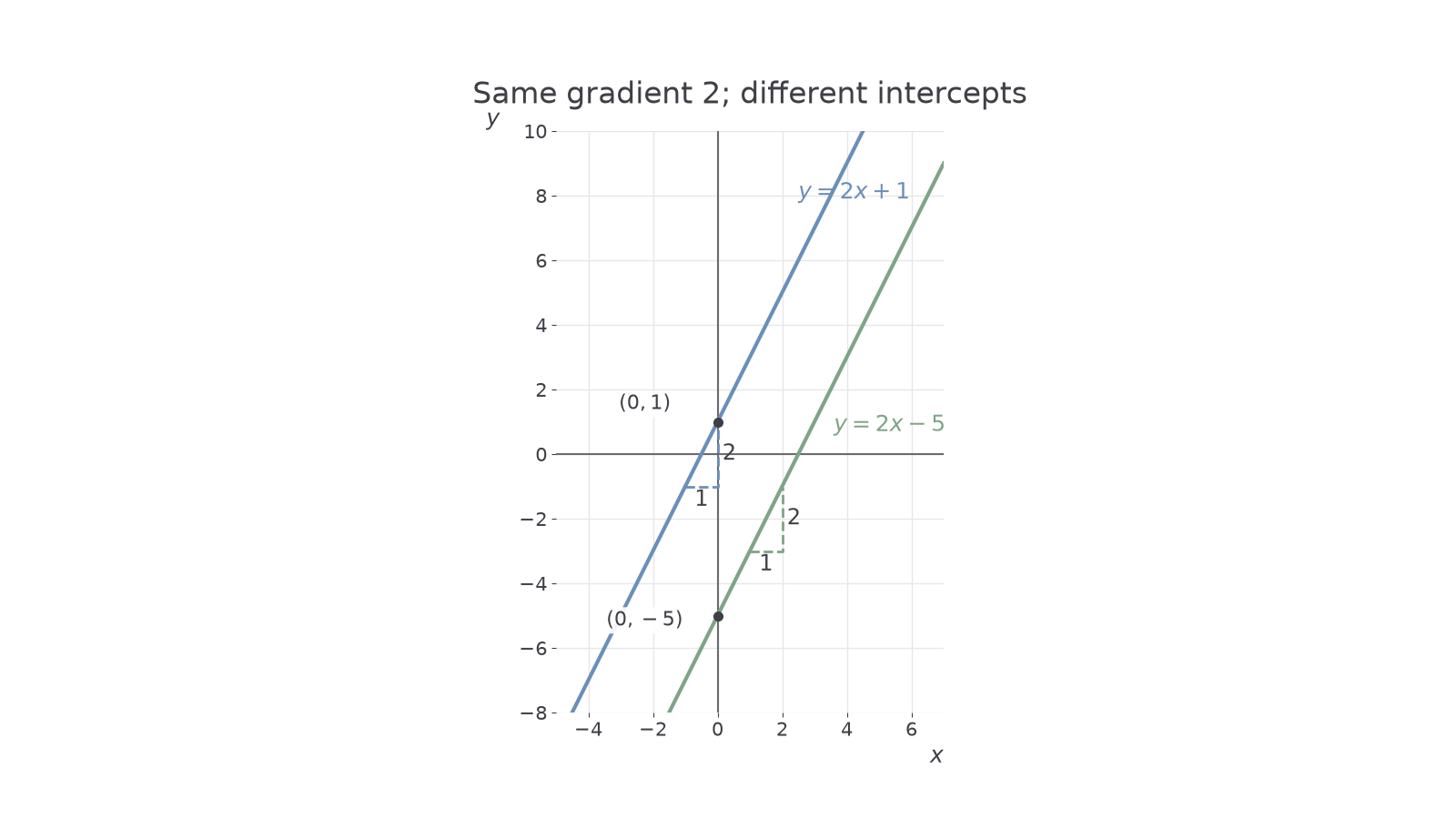
Increasing by 1 increases by 2 on both opening tracks. Their separation stays the same because neither line gains on the other.
Parallel straight lines
Distinct straight lines in the same plane are parallel if they never meet. Non-vertical parallel lines have the same gradient. Distinct vertical lines, such as and , are also parallel, although their gradients are undefined.
For , compare the coefficients of , including their signs. Changing moves a line up or down without changing its gradient. Equal gradients with equal intercepts describe the same line, rather than two distinct parallel lines.
[DIAGRAM: asset_name: Equal gradients and different intercepts; asset_slug: parallel_equal_gradients; caption: Each line rises 2 units for a run of 1, while their vertical separation stays 6 units.; description: A coordinate grid shows the exact lines y equals 2x plus 1 and y equals 2x minus 5. Each has a labelled gradient triangle with run one and rise two. Their intercepts at one and minus five are marked on the y-axis and the equations label their corresponding lines.]
Worked example 1: comparing gradients
Question. Are and parallel? Give a reason.
Plan. Read the two gradients and check that the equations describe different lines.
Answer. Yes. They are distinct lines with the same gradient, 3.
Check. At their outputs differ by 6. At the outputs are 8 and 2, still differing by 6.
Only the sign of the second gradient changes next. Equal steepness alone does not give the same direction.
Worked example 2: a sign changes the decision
Question. Are and parallel? Give a reason.
Plan. Compare the signed gradients, rather than their sizes alone.
The first line rises as increases; the second falls.
Answer. No. Their gradients are different.
Check. At , both equations give . The lines actually meet at .
Horizontal lines have gradient zero: and are distinct parallel lines. Do not call a vertical line's gradient zero; its horizontal change is zero, so the gradient quotient is undefined.
Watch out
The intercept is not the gradient. The lines and share an intercept, so they meet at ; they are not parallel.
Use both gradient and distinctness in your explanation.
Parallel through a point
A gradient gives a family of parallel lines. A specified point selects one member of that family: copy the gradient into , then substitute both coordinates to find .
You already know
The point lies on exactly when . The first coordinate replaces , and the second replaces .
Keeping the gradient preserves direction. Finding the intercept makes the new line pass through the required point.
Worked example 3: a positive gradient
Question. Find the equation of the line parallel to through .
Plan. Use gradient 2, then substitute the point to find the new intercept.
Answer. .
Check. At , , so the point lies on the line. Its gradient is 2 and its intercept differs from 7.
Continue this lesson.
You’re previewing NovaLearn without an account. Create a free account to read the rest.
Create free account