C2.6; E2.6 - Inequalities on a number line
A lift allows a load of at most 500 kg. Is a load of exactly 500 kg allowed, and how can one picture show every permitted load? C2.6 and E2.6 use inequalities, endpoints and number lines to describe whole ranges of values precisely.
Strict and inclusive bounds
An inequality can describe many possible values rather than one fixed answer. In the opening lift, “at most 500” includes 500 itself: a load kilograms satisfies . Its physical meaning also requires .
Strict and inclusive inequalities
A strict inequality, or , excludes equality with the boundary . An inclusive inequality, or , allows equality. A value satisfies an inequality when substituting it makes the statement true.
Read the words carefully: “at least” means , “at most” or “no more than” means . “Greater than” means ; “less than” means . Inclusive means equality is allowed, not that equality is compulsory.
Worked example 1: testing a strict bound
Question. A temperature satisfies . Which of are permitted?
Plan. Substitute each value and compare it with the boundary 4.
Answer. Only .
Check. On a number line, lies left of 4; 4 is the boundary and 4.1 lies right of it.
Change only the symbol: allowing equality changes the decision for the boundary, while the other two decisions stay the same.
Worked example 2: testing an inclusive bound
Question. Which of satisfy ?
Plan. Allow numbers below 4 and the boundary itself.
Answer. and 4.
Check. The added bar in permits equality. It does not permit 4.1, which is still too large.
A double inequality such as means both and . Each boundary has its own inclusion rule. For example, 2 passes both tests; fails the first.
Key idea
Test a boundary by substituting it. A statement such as is false, while is true.
Apply both conditions in this interval.
Number-line intervals
A number line makes a range visible. Its highlighted line includes all values along it, including fractions and decimals between labelled integers.
Number-line endpoints
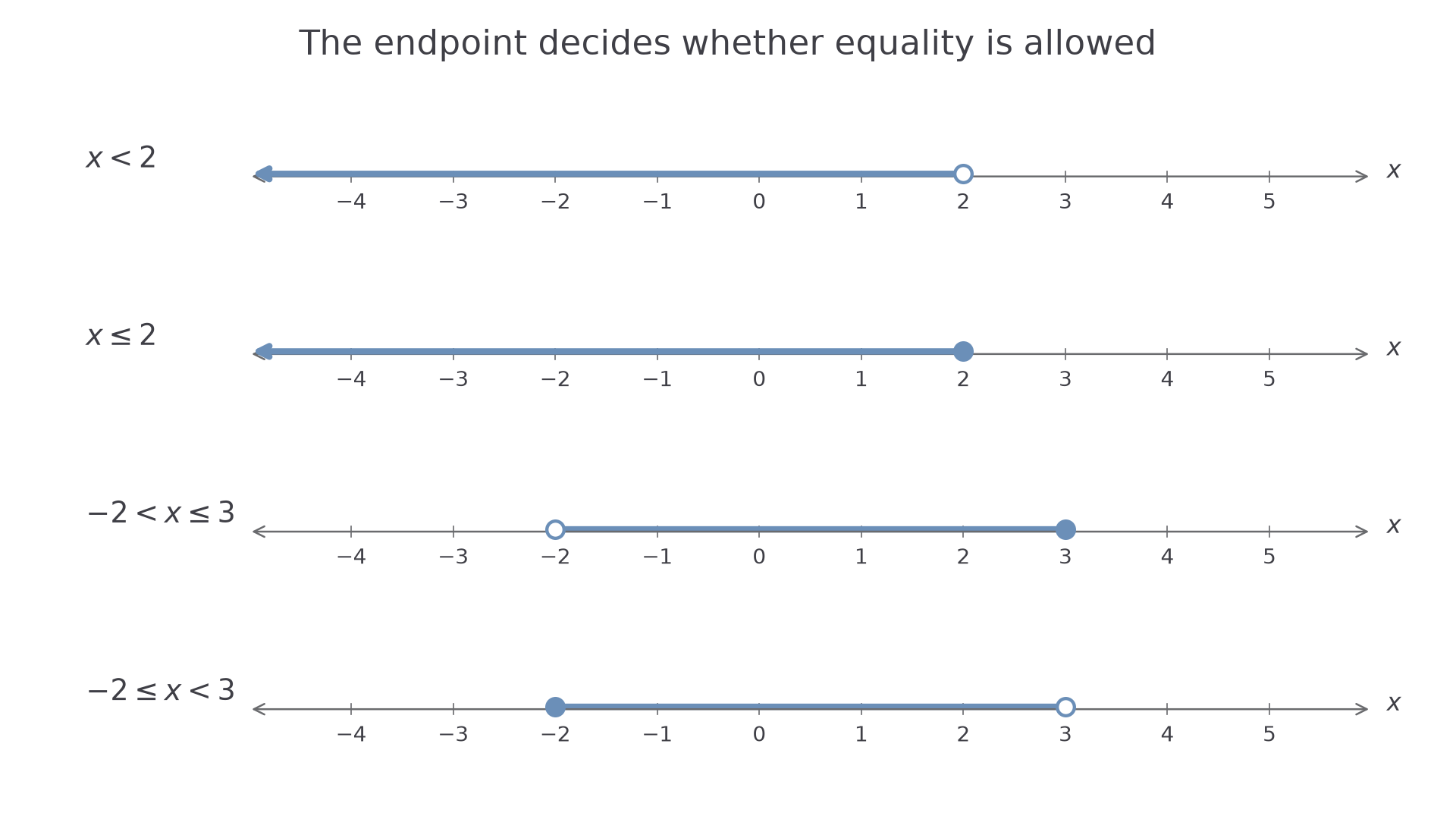
An open circle marks an excluded endpoint for or . A closed circle marks an included endpoint for or . A line between endpoints shows the allowed interval; an arrow shows that the allowed values continue indefinitely in that direction.
The position of the circle gives the boundary value; whether it is open or filled gives the equality decision. The line's direction gives the values on the permitted side.
[DIAGRAM: asset_name: Strict and inclusive number-line intervals; asset_slug: inequality_endpoint_intervals; caption: Open circles exclude endpoints; closed circles include them. Arrows continue the allowed range.; description: Four horizontal number lines with integer ticks. The top pair show x less than two and x less than or equal to two, with blue leftward rays and respectively open and closed circles at two. The lower pair show negative two less than x less than or equal to three, then negative two less than or equal to x less than three, with the correct contrasting endpoint circles.]
Worked example 3: describing a ray
Question. Describe how to represent on a number line.
Plan. Decide whether 2 is included, then which side contains greater values.
- Mark 2 and draw a closed circle, because equality is allowed.
- Draw a line to the right, because values greater than 2 lie there.
- Add a rightward arrow, because there is no upper boundary.
Answer. A closed circle at 2 with a rightward ray.
Check. The picture includes 2 and 3, which satisfy the condition, but excludes 1, which does not.
Continue this lesson.
You’re previewing NovaLearn without an account. Create a free account to read the rest.
Create free account