C1.5; E1.5 - Comparing quantities
Which is greatest: , or ? Their appearances make the comparison harder than it needs to be. C1.5 and E1.5 ask you to order quantities by size, use precise comparison symbols and extend the same reasoning to negative numbers.
Common forms
Use a common form before comparing numbers written in different ways. The opening quantities become , and , so is greatest. Writing equivalent trailing zeros helps line up the decimal places without changing any values.
Ascending and descending order
Ascending order runs from smallest to largest. Descending order runs from largest to smallest. On a number line, greater numbers are farther to the right.
For positive decimals, compare units first, then tenths, then hundredths, until a different digit settles the order. , because : the tenths match, but zero hundredths is less than seven hundredths. More digits does not mean a greater number.
Worked example 1: ordering different forms
Question. Write , and in ascending order.
Plan. Convert all three to decimals, keeping exact values.
The tenths are all 8. Comparing hundredths gives 6, 7 and 9, which settles the order.
Answer. .
Check. As percentages these are , , , in the same order.
The next list straddles one whole and asks for descending order. Convert the mixed number as a complete amount, then reverse the direction of the list.
Worked example 2: quantities above one
Question. Write , and in descending order.
Plan. Compare their exact decimal forms, greatest first.
The first two values and agree through the hundredths. The thousandths decide which is greater.
Answer. .
Check. Subtract 1 from every value to compare the excesses: . Adding 1 back preserves that order.
Retain the original forms in your final ordered list when the question gives them that way. Avoid rounding before comparing: two different numbers may round to the same short decimal.
Watch out
A percentage is not its printed number alone. , so it is smaller than , even though 12 is larger than 0.2.
Keep exact equivalents until the comparison is settled.
Inequality notation
Comparison symbols state a relationship precisely. The open, wider end of an inequality faces the greater number; the pointed end faces the smaller one. Read the complete statement from left to right.
Comparison symbols
means equal to; means not equal to. The strict symbols and mean less than and greater than. The inclusive symbols and mean less than or equal to and greater than or equal to.
Thus and describe the same comparison. Equality is allowed in , but is false. Saying only says the values differ; it does not state which is greater.
Worked example 3: choosing a comparison symbol
Question. Insert , or to make each statement correct: (a) ; (b) .
Plan. Use exact common forms before choosing a symbol.
Answer. (a) ; (b) .
Check. The second pair differs by exactly , so the first number is greater. No rounded decimal was needed.
The next example describes an allowed interval. Each boundary has its own condition, so an inclusive lower bound need not mean an inclusive upper bound.
Worked example 4: inclusive and strict boundaries
Question. A parcel's mass kilograms must be at least but less than . Write this using inequalities. Decide whether and are allowed.
Plan. Translate “at least” as an inclusive lower bound and “less than” as a strict upper bound.
The statement means both and .
Answer. . A mass of is allowed; is not.
Check. Substitution gives , both true. At the other boundary, is false.
“No more than 2” would instead allow equality and use . “Not equal to 2” uses and could describe values on either side of 2.
Key idea
Strict comparisons exclude equality. Inclusive comparisons allow equality; they do not insist on it.
Translate each boundary separately.
Negative comparisons
A negative number farther from zero lies farther left on the number line, so it is smaller. For example, , even though . A temperature of is colder than .
[DIAGRAM: asset_name: Ordering negative decimals; asset_slug: negative_decimal_order; caption: Negative values increase as you move right towards zero.; description: A horizontal number line from negative one to zero, with equally spaced quarter ticks and two labelled points at negative zero point seven five and negative zero point six. The first lies left of the second, which lies left of zero. A rightward arrow is labelled increasing.]
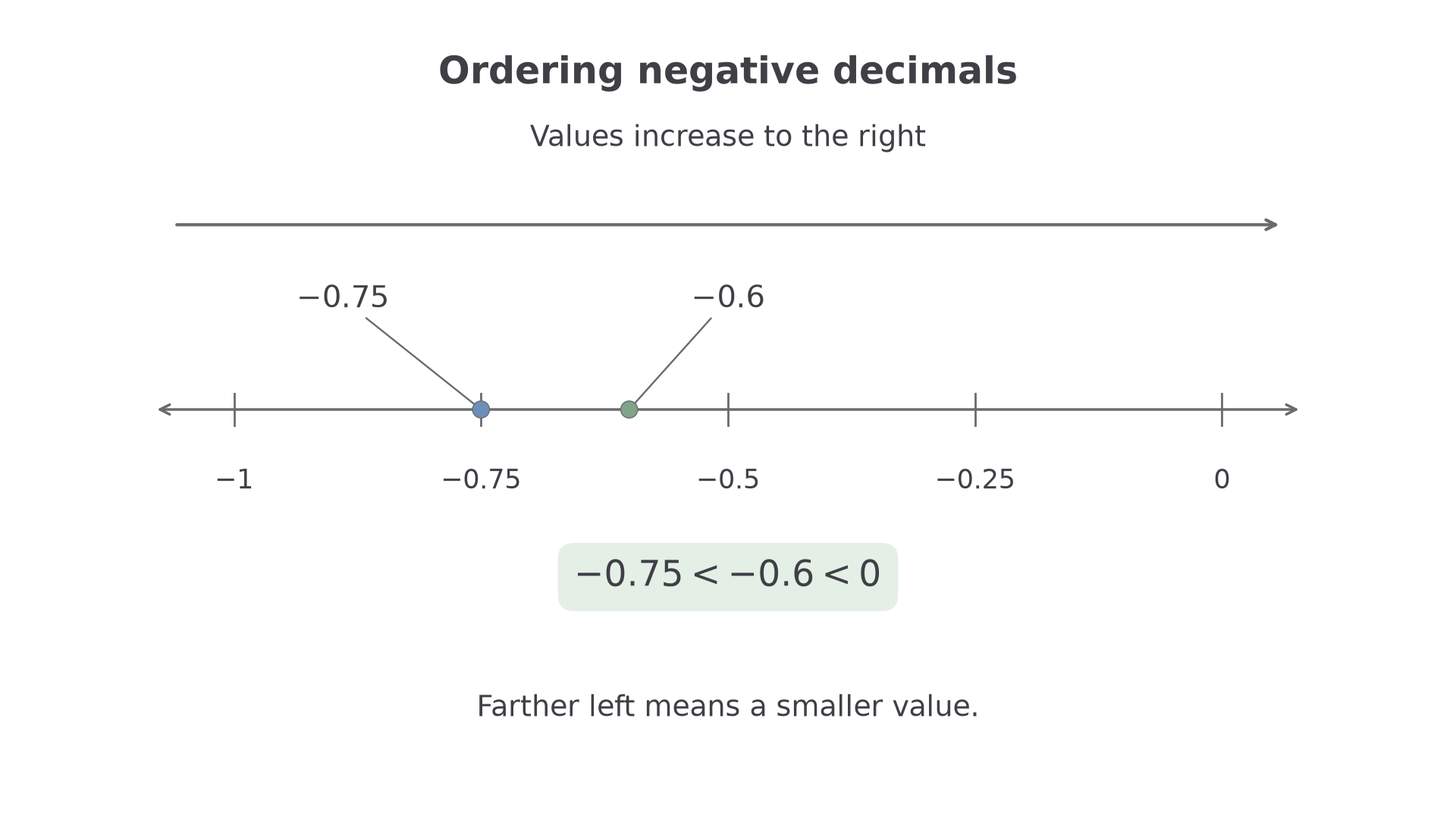
To compare negative fractions and decimals, first convert their positive sizes exactly, then use their positions on the negative side. Any negative number is less than zero, and zero is less than any positive number.
Worked example 5: comparing a negative pair
Question. Insert , or between and .
Plan. Write the fraction as a decimal and locate both relative to zero.
Since is farther left than , it is smaller.
Answer. .
Check. , so the second number exceeds the first by 0.05.
The next list contains equality as well as an inequality. Different-looking negative forms can occupy exactly the same point.
Worked example 6: equality among negative forms
Question. Put , and in ascending order, using or between them.
Plan. Convert to a decimal, then compare positions.
Both are farther left than .
Answer. .
Check. Adding 1 to every value gives , preserving the relationship. The two equal forms must not have between them.
The word “magnitude” can refer to size without sign, but when ordering signed quantities, use their actual values. A debt of \9$6-9<-6$.
Watch out
The positive sizes and the signed values order differently: , but . Use the number line rather than the number of digits or the size after removing the sign.
Allow an equality sign when two forms represent the same value.
Quick Recap
- Convert to a common exact form before ordering mixed representations.
- and are strict; and allow equality; means unequal.
- Negative values farther left are smaller, and equivalent forms can be equal.
In the opening comparison, , since .