E3.4 - Finding a quadratic function (Extended)
Many parabolas have the same lowest point. What extra information picks out just one of them? You will choose a useful quadratic form from a vertex or roots, use another point to find its coefficient, and recognise when a leading coefficient of 1 already fixes the rule.
Vertex and point
A quadratic's vertex is its turning point. The expression is smallest when , because a square cannot be negative. Thus has minimum point . Multiplying the square by a positive number changes the steepness but leaves that vertex fixed; a negative multiplier makes it a maximum instead.
Vertex form of a quadratic
The vertex is and the axis of symmetry is . It is a minimum when , and a maximum when . This form is not in the supplied formula list: learn it.
Use the vertex to write down and . A second point with a different input from the vertex then fixes .
[DIAGRAM: asset_name: A quadratic from its vertex and another point; asset_slug: quadratic_vertex_point; caption: The vertex fixes the brackets and final constant; the second point fixes the multiplier.; description: Exact plot of y equals 2 times x minus 2 squared minus 3, showing vertex 2 comma minus 3, another point 4 comma 5, and dashed symmetry axis x equals 2. The symmetric point zero comma 5 is also marked.]
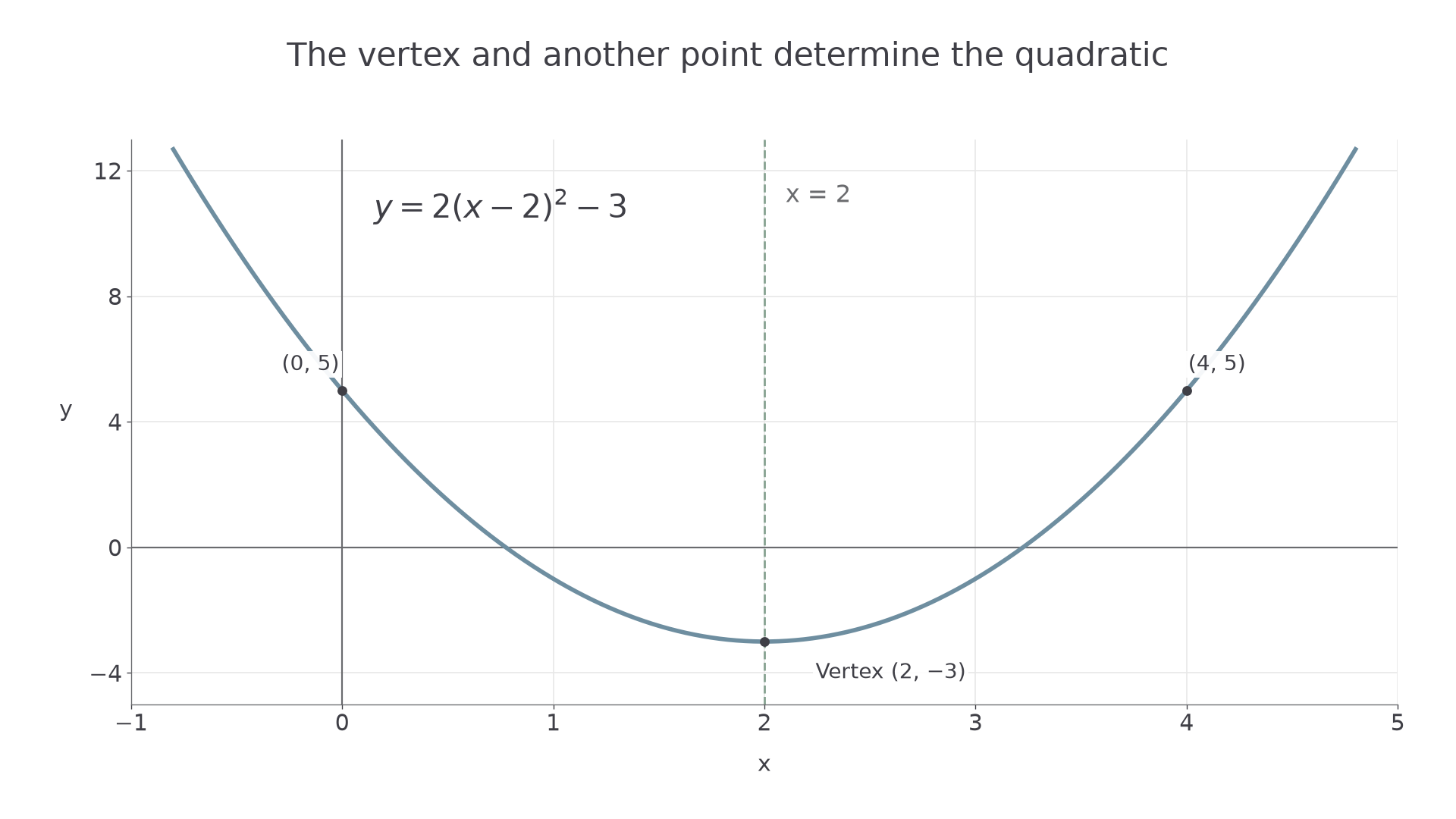
Worked example 1: an upward-opening parabola
Question. A quadratic has vertex and passes through . Find its equation.
Plan. Put the vertex into vertex form, then substitute the other point to find .
Answer. ; expanded form is equivalent.
Check. The square is zero at , giving , and its positive coefficient confirms a minimum. At the mirror point , the equation gives 5, matching the point at by symmetry.
Keep the vertex and the second point's horizontal coordinate fixed, but move that point below the vertex. The coefficient must now be negative.
Worked example 2: a downward-opening parabola
Question. A quadratic has vertex and passes through . Find its equation.
Plan. Use the same vertex form and substitute the changed output.
Answer. .
Check. Since , every output is at most : the stated vertex is a maximum. At , the output is , as required.
Why must the extra point differ from the vertex? Substituting the vertex gives , true for every . It supplies no information about the multiplier. The opening question needs a point away from the turning point.
Watch out
A vertex at gives . The bracket is zero at the vertex: check that input instead of copying its sign.
Use a new vertex and another point.
Roots and point
An -intercept is a point where the output is zero. If those intercepts are and , the factors and build both zeros into the expression. A non-zero multiplier preserves the zeros but changes the other outputs.
Root form of a quadratic
The roots are and , giving intercepts and . If , the repeated factor gives one touching point. This form is not in the supplied formula list: learn it.
A further point that is not an -intercept determines . Multiplying out is optional unless the question asks for expanded form.
Continue this lesson.
You’re previewing NovaLearn without an account. Create a free account to read the rest.
Create free account