C7.2; E7.2 - Trigonometry with bearings
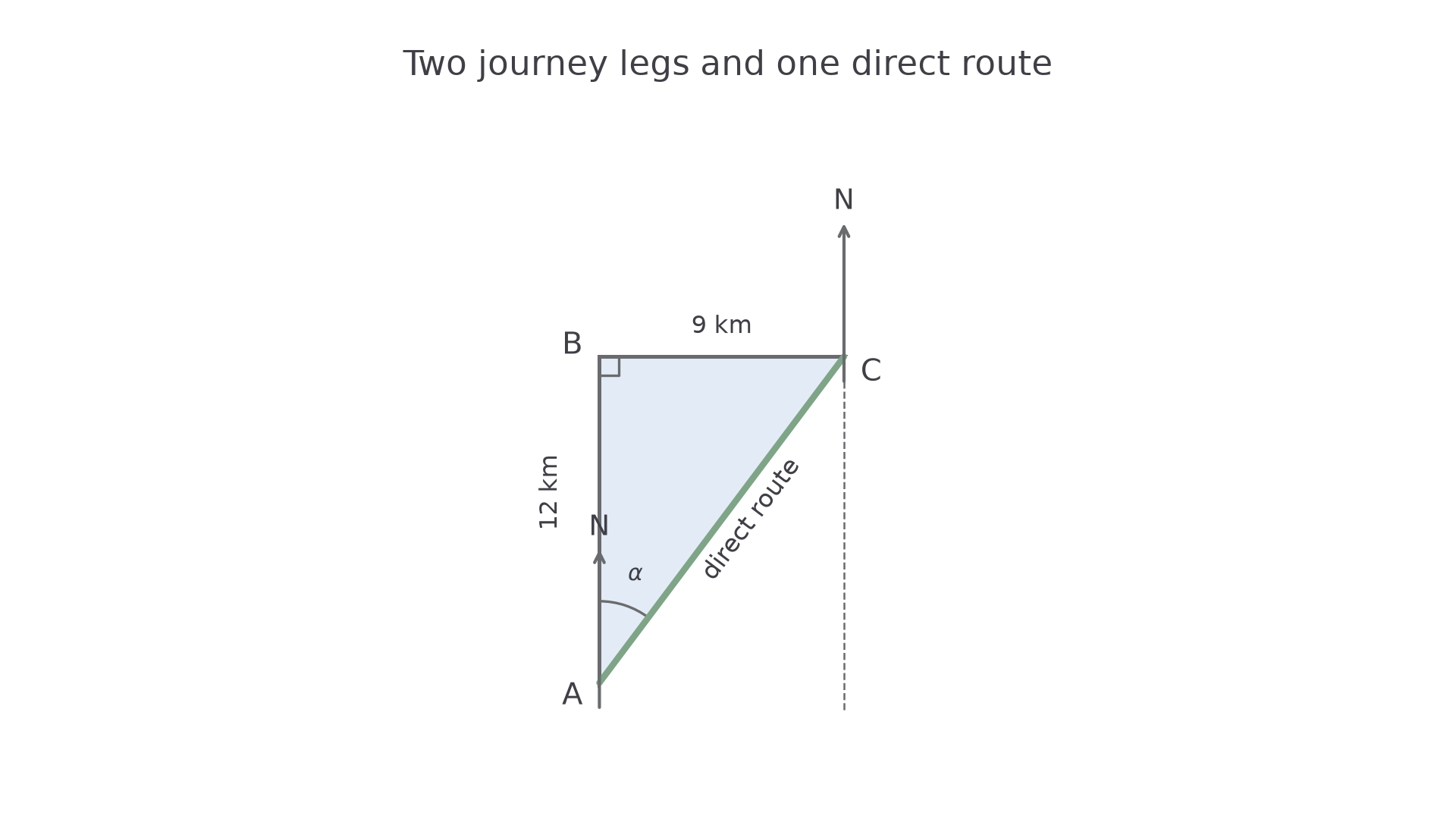
A boat travels 12 km north and then 9 km east. What bearing should it take to return directly to its starting point? C7.2 and E7.2 use right triangles to connect journey lengths, acute angles and the clockwise bearings used on a map.
Bearing diagrams
Start by marking the point named after “from”. Draw north there, with east to the right. A bearing is measured clockwise from north; is east, south and west.
North–south and east–west lines are perpendicular. A journey along one of each makes two legs of a right triangle. Its hypotenuse is the direct connection from the start to the finish, not the total distance travelled.
[DIAGRAM: asset_name: A journey and its direct route; asset_slug: bearing_journey_triangle; caption: The 12 km north and 9 km east legs make a right triangle, with the direct route joining A and C.; description: Exact map with A at the origin, B 12 units north and C 9 units east of B. North arrows at A and C are parallel. AB is labelled 12 km, BC 9 km, angle ABC is marked right, and AC is highlighted. The acute angle between north at A and AC is labelled alpha. A dashed north–south line through C supports the return-bearing interpretation.]
Worked example 1: identifying the direct route
Question. A traveller goes 8 km east from to , then 6 km north to . Identify the hypotenuse of the journey triangle and write a ratio for the acute angle between north at and .
Plan. Sketch the perpendicular legs and compare with a north line through .
The right angle is at , so is the hypotenuse. To use an angle from north at , draw an auxiliary point due north of and due west of . In right triangle , and . Relative to , the horizontal change 8 km is opposite and the vertical change 6 km is adjacent.
Answer. Hypotenuse , with .
Check. The route is north-east, so lies between and . Its eastward change exceeds its northward change, so it lies closer to east than north.
Now reflect only the eastward leg to the west. The length triangle is unchanged, but the clockwise bearing is different.
Worked example 2: moving west instead
Question. A traveller goes 8 km west from to , then 6 km north to . Identify the hypotenuse and write a ratio for the small angle west of north from to .
Plan. Use the same perpendicular changes, keeping their directions on the sketch.
Draw due north of and due east of . The auxiliary right triangle has and , so its angle at is the small angle west of north.
Answer. Hypotenuse , with . The bearing is .
Check. is north-west of , so its bearing must lie between and , unlike the first route.
A route on a stated bearing can also make a right triangle: draw a perpendicular east–west or north–south connection from its endpoint. This supplies the relevant horizontal or vertical component.
Watch out
The sum km is the two-leg journey length, not the direct distance. The direct route is the triangle's hypotenuse.
Identify the triangle before doing any trigonometry.
Lengths and bearings
When a direct route and its bearing are known, its north–south and east–west components are the two shorter sides. Use an acute angle inside the triangle. Mark the compass directions separately so positive distances do not lose their meaning.
Worked example 3: a north-east route
Question. A boat travels 24 km from to on a bearing of . Calculate how far east and how far north lies from .
Plan. Treat 24 km as the hypotenuse and use the angle from north.
Sine gives the side opposite the north-based angle; cosine gives the adjacent side.
Answer. lies 19.7 km east and 13.8 km north, to three significant figures.
Check. Using unrounded components, their squared sum is . The bearing is closer to east than north, matching the larger eastward component.
Continue this lesson.
You’re previewing NovaLearn without an account. Create a free account to read the rest.
Create free account