E8.1 - Combining and reversing transformations (Extended)
Reflecting a shape and then turning it can give a different result from turning it first. E8.1 develops combinations and reverse transformations. You will keep track of intermediate images, undo a sequence in the correct order and decide when the final effect has one complete transformation description.
Order of transformations
Does reflecting in the -axis and then rotating anticlockwise give the same image as doing those operations in reverse? Try one point first: its intermediate position determines where the second transformation starts.
Combined transformation
A combination of transformations applies each instruction to the image produced by the previous instruction. “First A, then B” means apply A to the object, then apply B to A's image.
Keep any stated mirror line or centre in its original position on the grid. Moving the shape does not move that line or centre. Label an intermediate image with one prime and the final image with two primes to keep the stages separate.
[DIAGRAM: asset_name: The same two transformations in different orders; asset_slug: transformation_order; caption: The intermediate and final triangles change when the order changes.; description: Two accurate equal-scale grids use A one comma one, B three comma one and C one comma two. Left first reflects in the x axis to one comma minus one, three comma minus one, one comma minus two, then rotates ninety degrees anticlockwise about the origin to one comma one, one comma three, two comma one. Right first rotates anticlockwise to minus one comma one, minus one comma three, minus two comma one, then reflects in the x axis to minus one comma minus one, minus one comma minus three, minus two comma minus one. Three pale colours distinguish object, intermediate and final image consistently.]
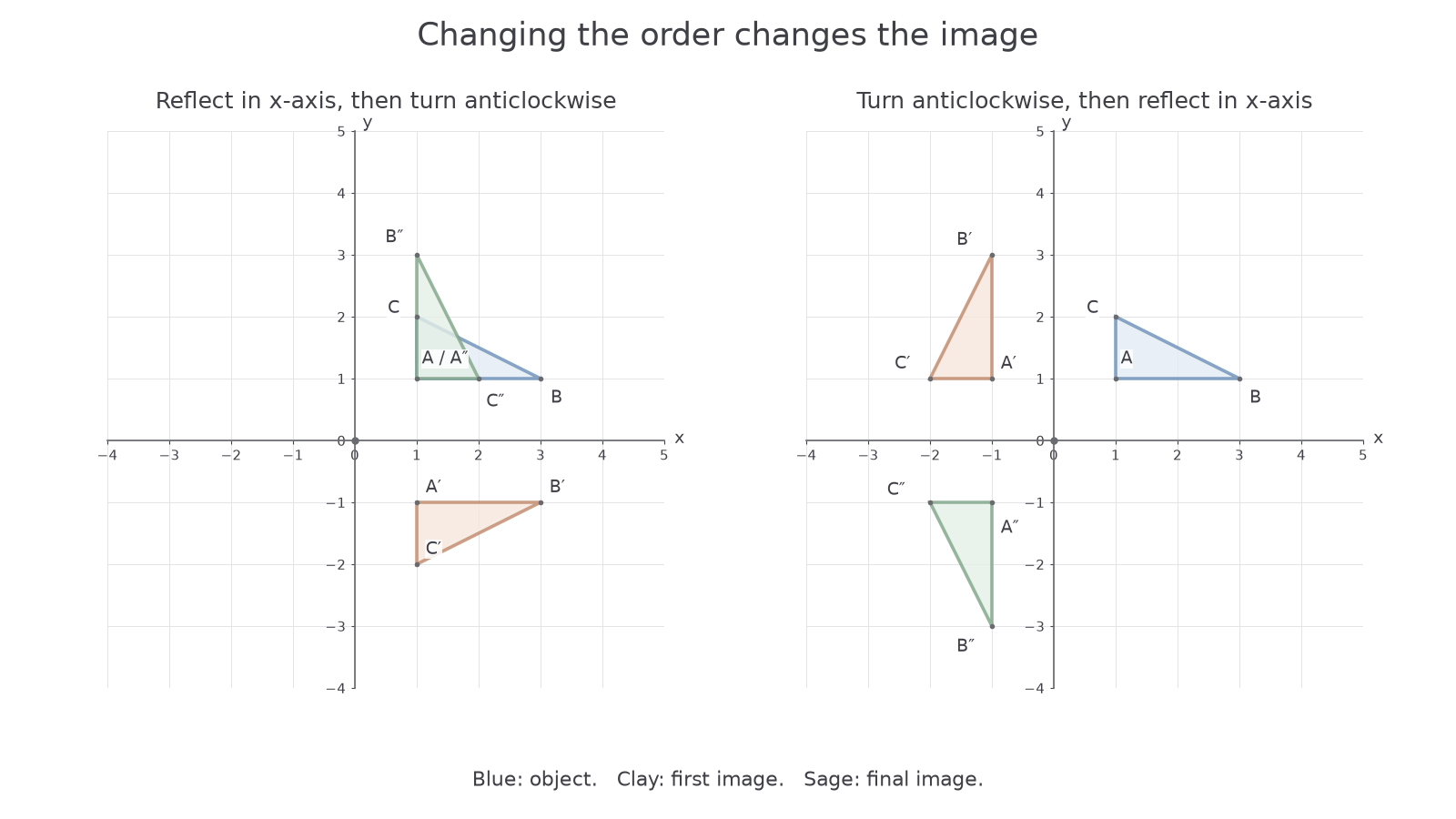
Worked example 1: reflection followed by rotation
Question. Triangle is reflected in the -axis, then rotated anticlockwise about the origin. Find the final image.
Plan. Reflect each vertex first, record that triangle, then rotate those new coordinates.
The reflection changes 's sign. The anticlockwise turn then sends each intermediate to .
Answer. Plot and join , as on the left grid.
Check. The final perpendicular sides have lengths 2 and 1, matching the original. Undo the turn clockwise: returns to ; reflect again to recover B at .
Only the order changes in the second example. Apply the same two instructions to the same original triangle.
Worked example 2: rotation followed by reflection
Question. Rotate triangle through anticlockwise about the origin, then reflect it in the -axis. Find the final image.
Plan. Record the rotated triangle before reflecting its vertical coordinates.
Answer. Join , as on the right grid. This differs from the first order.
Check. Reflecting the final B'' gives , then turning clockwise gives . These reverse steps recover the original point.
Some pairs do give the same result in either order, such as two translations. That does not make order interchangeable for every combination. Calculate or construct each stated stage.
Watch out
Applying both transformations separately to the original object produces two first images, not the requested final image. The second transformation acts on the first image.
Track both stages for a new triangle.
Reverse transformations
To undo a journey, undo its last step first. A reverse transformation must take the image back to the original, including its position, size and orientation.
Inverse transformation
The inverse reverses a transformation. For an enlargement, the scale factor must be non-zero so that a reverse enlargement exists.
| Forward transformation | Reverse transformation |
|---|---|
| Translation by | Translation by |
| Reflection in a line | Reflection in the same line |
| Rotation about a centre | Opposite turn about the same centre |
| Enlargement with factor , centre S | Enlargement with factor , same centre S |
A half-turn is its own inverse. For enlargement, multiplying a displacement by , then by , restores it because . The reciprocal retains a negative sign when is negative.
Worked example 3: reversing one enlargement
Question. An enlargement of factor , centre , maps P to . Describe the reverse enlargement and find P.
Plan. Use reciprocal factor about the same centre, measuring from S.
Here the paired entries represent horizontal and vertical moves; both are multiplied by the same factor.
Answer. Reverse enlargement: factor , centre . The original point is .
Check. From S to P is . The forward factor gives , reaching .
Now an extra transformation follows the enlargement. Its inverse must come first when working back.
Worked example 4: undoing a two-stage mapping
Question. P is enlarged by factor , centre , then translated by . Its final image is . Find P and describe the reverse sequence.
Plan. Undo the translation first, then apply the reverse enlargement from the previous example.
Answer. Reverse sequence: translation by , then enlargement of factor , centre . The original point is .
Check. Forward from , enlargement gives and the translation gives , the stated final image.
Continue this lesson.
You’re previewing NovaLearn without an account. Create a free account to read the rest.
Create free account