C8.1; E8.1, E8.2 - Translations and column vectors
How can one instruction move every corner of a shape without turning or resizing it? C8.1 and E8.1 describe a translation using a column vector; E8.2 uses the same displacement idea in vector notation. You will read the movement, draw an image and describe a complete translation with the signs in the correct order.
Column vectors
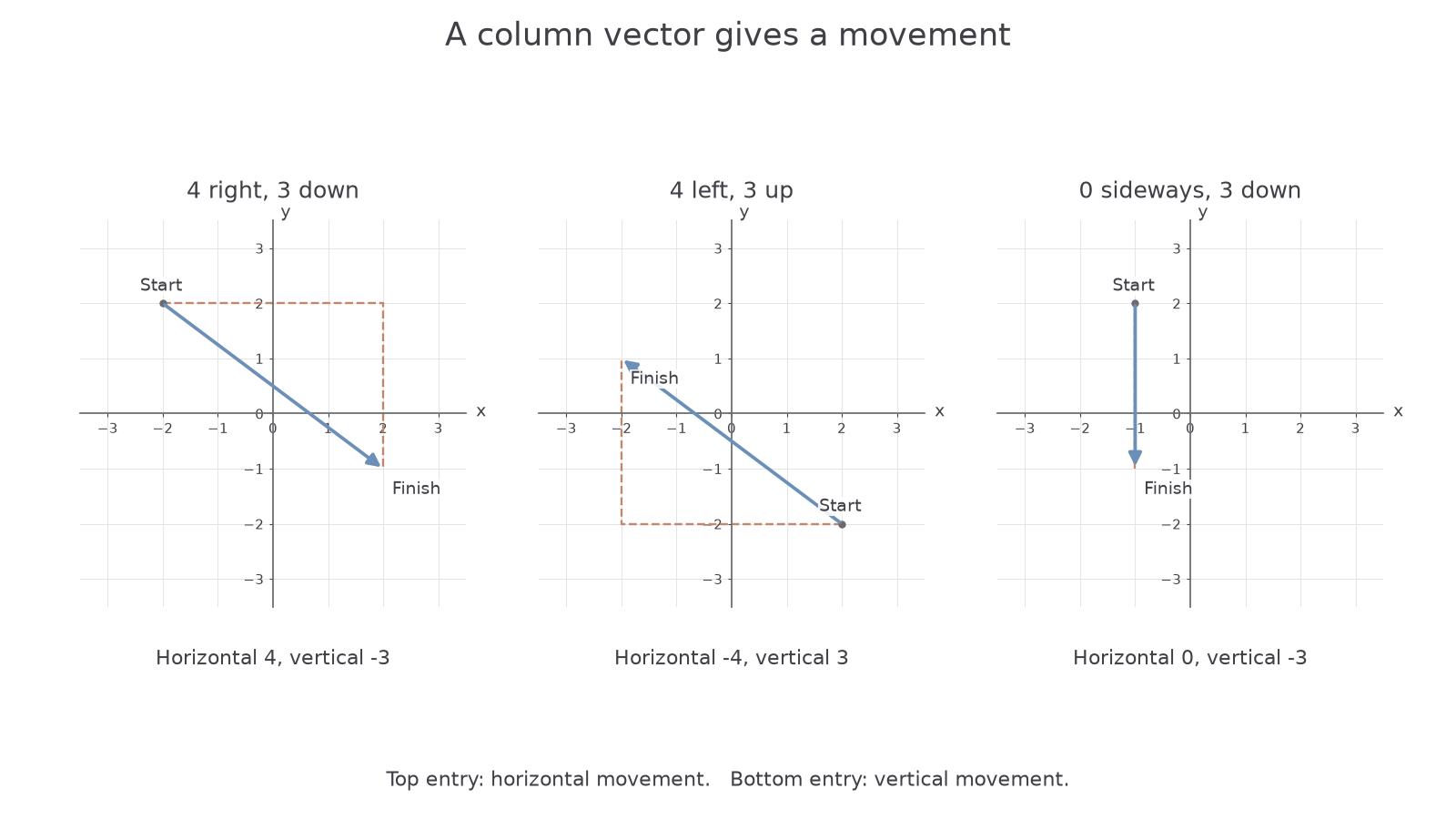
A move of 4 units right and 3 units down can start anywhere on a grid. Its displacement is the same wherever you draw the arrow: the endpoint is always 4 right and 3 down from its starting point.
Column vector
A column vector records a displacement as two entries in a column:
The top entry is the horizontal movement: positive right, negative left. The bottom entry is the vertical movement: positive up, negative down. A zero entry means no movement in that direction.
Thus means 4 right and 3 down. It is an instruction for movement, whereas the coordinate pair gives one point's position relative to the origin. Keep their notation distinct.
[DIAGRAM: asset_name: Reading displacement arrows; asset_slug: translation_displacements; caption: Read the horizontal movement first, including a zero when there is no horizontal movement.; description: Three equal-scale grids show arrows from a starting point to an endpoint. The first moves four right and three down, the second four left and three up, and the third zero horizontally and three down. Dashed horizontal and vertical routes show the component movements and the signed component values are printed beneath each grid.]
Worked example 1: reading signed entries
Question. Describe the movement given by .
Plan. Read the top entry horizontally and the bottom entry vertically.
Answer. Move 4 units right and 3 units down.
Check. Starting at , this reaches . The horizontal coordinate increases by 4 and the vertical coordinate decreases by 3, matching both entries.
Now reverse both signs. The displacement has the same component sizes but points in the opposite direction.
Worked example 2: opposite movement
Question. Describe the movement given by .
Plan. Attach a direction to each signed entry, keeping their order.
Answer. Move 4 units left and 3 units up.
Check. From this returns to , undoing the first example's move.
For a vertical move, keep a zero in the top position. For example, moves 3 down, with no sideways movement. Similarly, moves 6 right. The vector leaves every point where it is.
Watch out
The entries are not a fraction: does not mean . Nor may you swap them: 4 down and 3 right would be .
Interpret a new vector using both entries.
Translating a shape
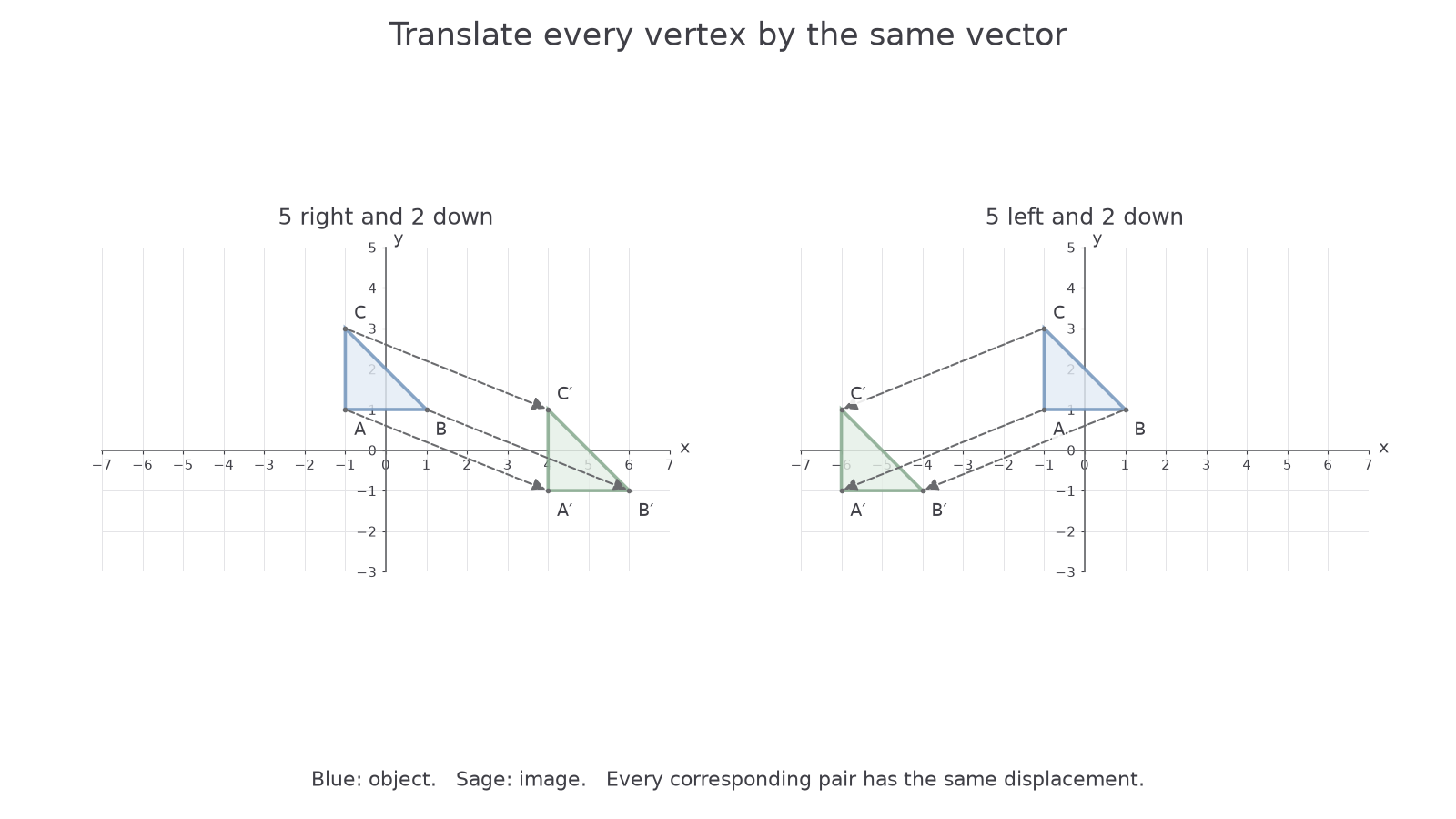
A translation moves every point by one constant displacement. Move each vertex by the same horizontal and vertical amounts, label its image, then join the image vertices in the original order using a ruler.
Translation
A translation moves every point the same distance in the same direction. The shape's size and orientation remain unchanged: there is no turning, reflecting or resizing.
On coordinates, add the horizontal entry to each -coordinate and the vertical entry to each -coordinate. This is just a compact way to count the same grid movement at every vertex.
[DIAGRAM: asset_name: Moving every vertex by the same displacement; asset_slug: translated_triangles; caption: Changing the horizontal sign moves the image to the other side, while the downward movement stays the same.; description: Two accurate equal-scale coordinate grids show object A minus one comma one, B one comma one and C minus one comma three. Left translates by five right and two down to A prime four comma minus one, B prime six comma minus one, C prime four comma one. Right translates by five left and two down to A prime minus six comma minus one, B prime minus four comma minus one, C prime minus six comma one. Object and image use consistent pale fills and arrows link corresponding vertices.]
Continue this lesson.
You’re previewing NovaLearn without an account. Create a free account to read the rest.
Create free account