C1.12; E1.12 - Percentage multipliers
A shop raises a price by 10% and later reduces it by 10%. Does the price return to its starting point? C1.12 and E1.12 turn percentage changes into multipliers, apply them to purchases and earnings, and combine successive changes without losing track of the changing base.
Increase and decrease
After an 8% increase, you have the original 100% plus another 8%: 108% altogether. After an 8% decrease, 92% remains. These totals give a direct route to the new amount.
Percentage multipliers
Multiply the original amount by the appropriate multiplier. For a decrease leaving a non-negative amount, . An increase may exceed 100%.
Not in the supplied formula list: learn the relationships.
Why include 1? It stands for the original whole. Multiplying only by finds the change, rather than the amount after the change.
Worked example 1: an increase in one multiplication
Question. A table costs $240. Its price increases by 8%. Calculate the new price.
Plan. Multiply by , because 108% of the original price is required.
Answer. $259.20.
Check. of 240 is 19.20. Adding this to 240 also gives 259.20.
Change only the direction of the percentage change. The multiplier is now below 1.
Worked example 2: a decrease in one multiplication
Question. A table costs $240. Its price decreases by 8%. Calculate the new price.
Plan. Multiply by , because 92% remains.
Answer. $220.80.
Check. , the same 8% change in the opposite direction.
Both calculations include what remains of the original whole. That is why their multipliers are close to 1 rather than close to zero.
Watch out
Multiplying 0.0819.20 change. It does not give either new price. For an increase of 120%, the total multiplier is , since the original 100% is retained.
Identify the percentage remaining in the next purchase.
Practical percentage changes
The word attached to a percentage tells you its base. A discount reduces a listed price; a deposit is part of the agreed purchase price; commission is a percentage of the sales value stated in the question.
Profit and loss
The cost price is what a trader pays for an item. The selling price is what the trader receives. Profit is selling price minus cost price; loss is cost price minus selling price. Percentage profit or loss uses the cost price as its base, unless another base is explicitly stated.
For a deposit, the amount still to pay is purchase price minus deposit; a deposit is not an extra discount. For earnings, add fixed pay and any commission. Read what the commission applies to: it may be sales rather than profit.
Worked example 3: following one sale
Question. A shop buys a desk for 300. A customer receives a 10% discount, then pays a 20% deposit on the discounted price. A salesperson receives $40 fixed pay plus 5% commission on this sale's discounted price. Calculate the selling price, deposit, shop's profit as an amount and percentage, and salesperson's earnings.
Plan. Find the actual selling price first; use it for the deposit and commission, but use the cost price for percentage profit.
Answer. Selling price 54; profit 53.50.
Check. The deposit and remaining 270. Also, , confirming the profit percentage. The fixed pay plus one twentieth of 53.50.
Only the discount changes in the next sale. This is enough to turn profit into loss, while the definitions of deposit and commission stay the same.
Worked example 4: a discount that creates a loss
Question. A shop buys another desk for 300, but gives a 40% discount. The customer pays a 20% deposit on the discounted price. The salesperson receives $40 fixed pay plus 5% commission on the discounted price. Calculate the selling price, deposit, shop's loss as an amount and percentage, and salesperson's earnings.
Plan. Follow the same bases, then compare the selling price with the $200 cost.
Answer. Selling price 36; loss 49.00.
Check. A 40% discount removes 300. The selling price is 90% of the 180 is $9.
One sale can therefore generate several percentages with different reference amounts. Label the base beside each calculation to keep the customer's payment, the shop's trading result and the employee's earnings distinct.
Watch out
The discount percentage and the loss percentage have different bases. A 40% discount above produces a 10% loss. Using for percentage loss would use the selling price instead of the cost price. The profit/loss here compares buying and selling prices; subtract other expenses only if the question includes them.
Set out the next calculation in the order in which the transaction happens.
Repeated percentage change
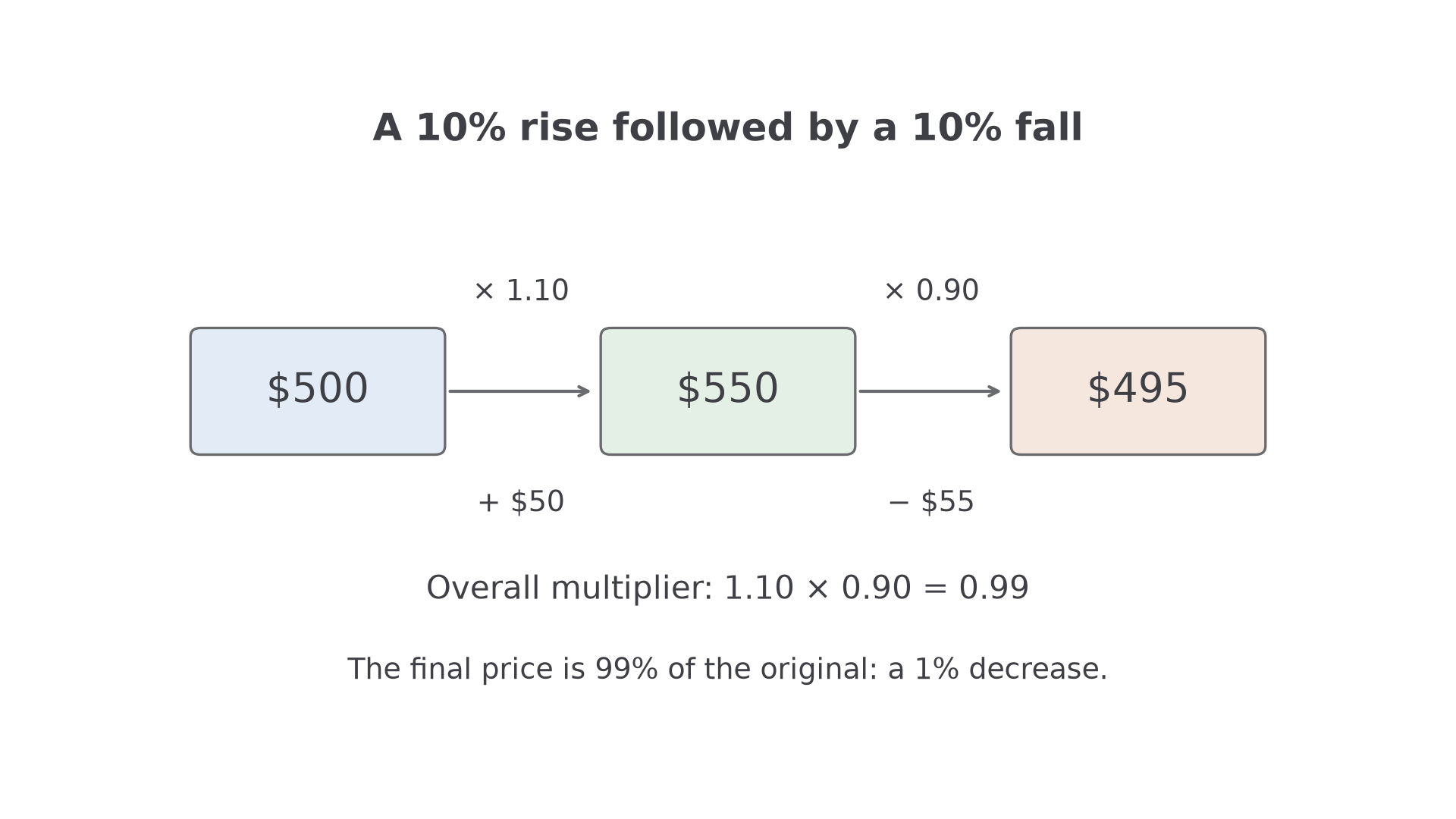
A second percentage change acts on the updated amount. If 550; a later 10% reduction therefore removes 50.
Overall multiplier
For successive percentage changes, multiply the individual multipliers. An overall multiplier above 1 represents an increase; one between 0 and 1 represents a decrease. Compare it with 1 to find the total percentage change.
This repeated multiplication is also the arithmetic behind compound interest. Each step starts from the result of the previous step.
[DIAGRAM: asset_name: Equal percentage rise and fall; asset_slug: successive_ten_percent; caption: A ten percent fall after a ten percent rise removes more than the original rise added.; description: A numerical flow shows five hundred dollars multiplied by one point one to become five hundred and fifty dollars, then multiplied by zero point nine to become four hundred and ninety-five dollars. The first change is plus fifty dollars and the second is minus fifty-five dollars. The overall multiplier is zero point nine nine.]
Worked example 5: equal percentages do not cancel
Question. A $500 price increases by 10%, then decreases by 10%. Calculate the final price and the overall percentage change.
Plan. Apply both multipliers, then compare the result with the original $500.
Answer. $495.00, an overall decrease of 1%.
Check. The separate cash changes are and dollars, giving a net loss of 5/500=1%$.
The second change is now 20% rather than 10%. Keeping the steps separate prevents an incorrect subtraction of the stated percentages.
Worked example 6: unequal successive changes
Question. A $500 price increases by 10%, then decreases by 20%. Calculate the final price and overall percentage change.
Plan. Multiply by and , then interpret their product.
Answer. $440.00, an overall decrease of 12%.
Check. After the rise the price is 110, leaving 60 overall decrease is 12% of $500.
The overall multiplier records the complete journey from the first amount to the last. An overall value of means 88% remains, so the missing 12% is the decrease.
Watch out
does not describe these successive changes: their bases differ. Keep intermediate values unrounded and combine the multipliers instead.
The opening 10% rise and 10% fall leave 99% of the starting price. Their failure to cancel follows from the changing base.
Quick Recap
- An increase uses ; a decrease uses .
- Choose the base from the meaning: price, cost price, sales or agreed purchase price.
- Add fixed pay to commission to obtain total earnings.
- Multiply successive multipliers; compare their product with 1 for total change.
A 10% rise followed by a 10% fall gives a 1% decrease.