E1.16 - Exponential growth and decay (Extended)
A population grows by 5% each year. Does three years of growth mean a total increase of 15%? E1.16 builds exponential growth and decay models from repeated multipliers, uses them for populations and depreciation, and interprets predictions over sensible time periods.
Exponential models
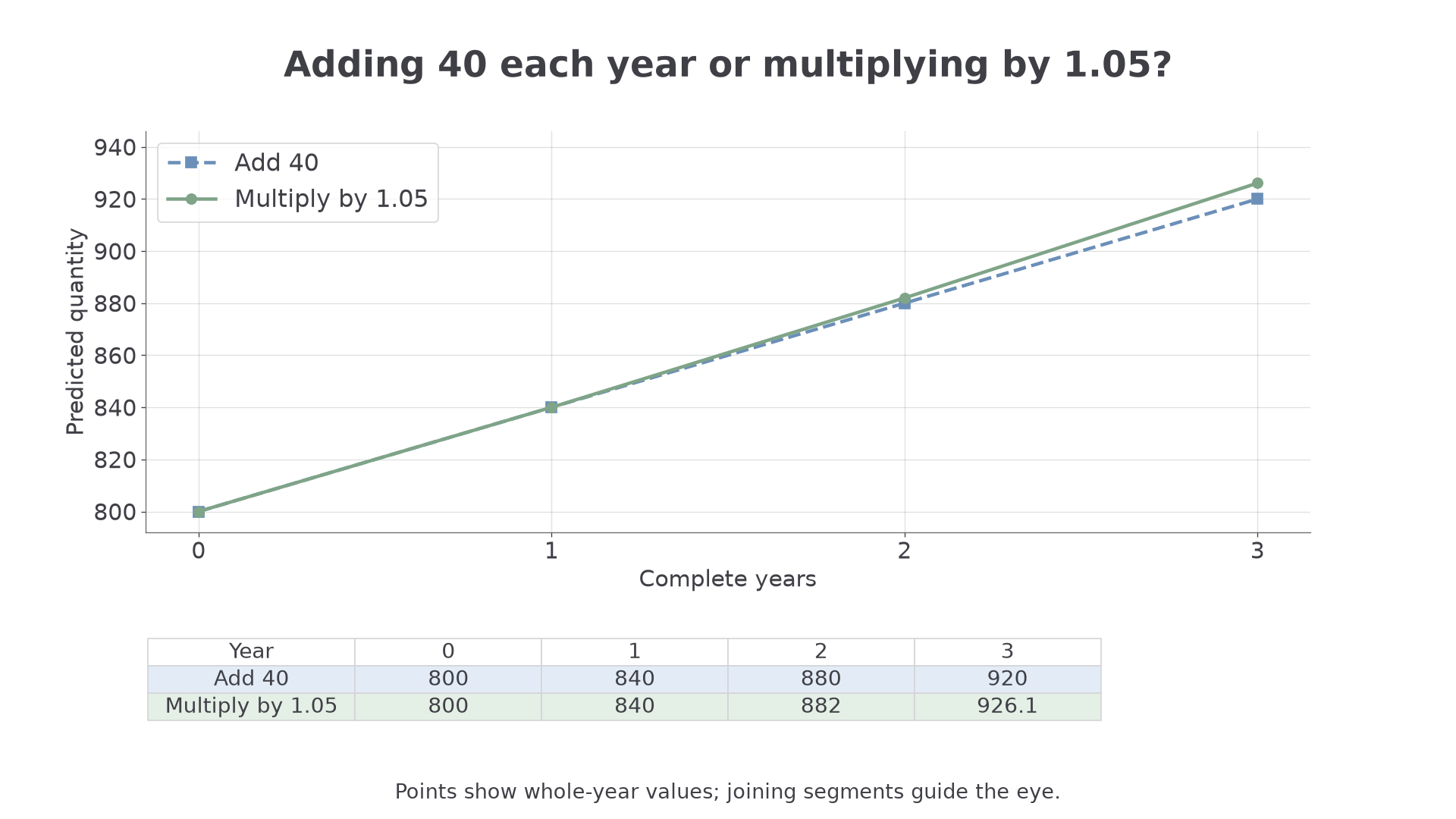
Starting from 800, annual 5% growth gives after one year. The next increase is 5% of 840, so the next value is 882. The amounts added differ, while the multiplier stays constant.
Exponential growth
An exponential model multiplies a quantity by the same positive factor over each equal time interval. If the multiplier is greater than 1, the model describes growth. Equal intervals have equal ratios, rather than equal differences.
Repeated multiplication gives , which is . The same structure extends the compound-interest idea to other quantities.
Repeated proportional change
Here is the initial quantity, is the multiplier per interval and counts the intervals. Growth of per interval has . For whole-interval predictions from the start, .
Not in the supplied formula list: learn the relationship.
The subscript labels the time: is the quantity at the start and is the quantity after three intervals. A fixed multiplier assumes that the stated percentage rate continues unchanged.
[DIAGRAM: asset_name: Fixed additions and fixed multipliers; asset_slug: growth_addition_multiplier; caption: Adding forty each year and growing by five percent agree after one year, then separate.; description: A numerical table and plot show years zero to three. Starting from eight hundred, the fixed-addition values are eight hundred, eight hundred and forty, eight hundred and eighty and nine hundred and twenty. The five percent growth values are eight hundred, eight hundred and forty, eight hundred and eighty-two and nine hundred and twenty-six point one. Points are predictions at whole years.]
Worked example 1: predicting a population
Question. A population is 800 at the start of 2027 and is modelled to grow by 5% per year. Calculate its predicted population at the start of 2030, to the nearest whole number.
Plan. Count three yearly intervals and apply the growth multiplier three times.
Answer. Approximately 926 people.
Check. Successive values are 840, 882 and 926.1. The increases are 40, 42 and 44.1, each 5% of that year's starting value.
The next model gives the initial and final values but leaves the constant rate unknown. Undo a power with the corresponding root; dividing the overall percentage rise by three would ignore compounding.
Worked example 2: recovering a constant growth rate
Question. A model starts with a population of 800 and predicts 1064.8 after 3 years. Its percentage growth rate is constant. Calculate the annual percentage growth rate.
Plan. Find the overall multiplier, take its cube root to find one year's multiplier, then subtract 1.
Answer. 10% per year.
Check. , then 968, then 1064.8. The same 10% multiplier produces every step.
To find a rate from equal periods, the root of order finds the repeated multiplier. To find the later quantity from a known rate, a power applies that multiplier repeatedly.
Watch out
Three years of 5% growth gives , an increase of 15.7625%, rather than 15%. Apply the model to the unrounded quantity and round a population only at the final answer.
Count elapsed intervals rather than counting the named calendar years inclusively.
Decay models
An item losing 15% of its current value each year retains 85% each year. The same proportion is lost each time, but the cash loss becomes smaller as the value falls. Depreciation means a decrease in an asset's value.
Exponential decay
Exponential decay has a constant multiplier with over equal intervals. A decrease of per interval gives , where .
The model is still . It predicts positive values approaching zero, rather than subtracting a fixed amount until the value becomes negative. No special exponential constant is needed: the multiplier comes directly from the stated percentage.
Worked example 3: depreciation from a known rate
Question. A vehicle costs $24 000 when new. It depreciates by 15% of its current value each year. Calculate its value after 3 years.
Plan. Retain 85% each year and apply this multiplier three times.
Answer. $14 739.
Check. Yearly values are 17 340 and 3600, 2601, decreasing as the current value decreases.
Now the rate is unknown. As with growth, a root recovers the single-period multiplier, but the decay percentage is the amount below 1.
Worked example 4: recovering a depreciation rate
Question. A vehicle costs 17 496 under a constant annual percentage depreciation model. Calculate the annual percentage depreciation.
Plan. Take the cube root of the retained fraction to recover the yearly multiplier.
Answer. 10% per year.
Check. , then 19 440, then 17 496. Each value retains 90% of the previous one.
The multiplier describes what is retained, while the percentage depreciation describes what is lost. They add to one whole: retaining 90% means losing 10%.
Watch out
Losing 15% each year is not losing 45% of the original over three years. For the first vehicle, the retained fraction is , so the total loss is 38.5875%. A fixed cash loss would be a different model.
Use the retained percentage as the multiplier in the next model.
Interpreting predictions
A model prediction needs a time and a meaning. “After three complete years” asks for the value at . “The first complete year above a threshold” asks for the earliest whole-number time satisfying the condition, so check the neighbouring years.
Problem-solving
Use repeated calculations or a calculator table to find where a threshold is crossed. Show one whole-period value on each side, then interpret the first qualifying period. A graph's crossing between years does not by itself answer a complete-years question.
For a yearly model beginning now, use . A negative value refers to a time before the model starts; a fractional year requires an assumption about what happens within each year. Neither is automatically part of a whole-year question.
Worked example 5: the first year above a threshold
Question. A population of 1200 grows by 8% per year under a model. Find the first number of complete years after which the predicted population exceeds 1500.
Plan. Calculate successive whole-year values and locate the first above 1500.
Answer. 3 complete years.
Check. At year 2 the prediction is below 1500 and at year 3 it is above. The model increases every year because , so no earlier year qualifies.
For a decay model, the target is first reached from above. The neighbouring-value check works in the same way, with the inequality reversed.
Worked example 6: the first year below a threshold
Question. Equipment is worth 3000.
Plan. Use multiplier and calculate until the value first falls below $3000.
Each line multiplies the previous value by .
Answer. 5 complete years.
Check. , while . The values decrease each year, so year 5 is the first qualifying year.
The numerical answer belongs to the model. A real population's rate can change as housing, resources or migration change; an item's resale value can depend on condition and demand. A constant percentage over a few years is a stated assumption, rather than evidence that the same rate will continue indefinitely.
Watch out
Check the exact inequality before rounding. “Exceeds” means strictly greater than; a value exactly on the threshold does not qualify. Report people as whole numbers when requested, but use unrounded model values to locate a crossing.
The opening 800 population would become 926.1 after three years at 5%, a 15.7625% increase. That prediction uses three changing bases and assumes a constant annual rate.
Quick Recap
- Exponential change uses a constant multiplier over equal intervals.
- Growth uses ; decay uses .
- A root recovers a constant multiplier from a known overall change.
- Check neighbouring whole periods for a threshold, and state the model's time domain and assumptions.
Three successive 5% increases give more than 15% overall because each new increase acts on the updated quantity.