E2.6 - Solving inequalities with graphs (Extended)
An inequality usually has an interval of solutions rather than a few isolated answers. Use permitted GDC graph features to find equality boundaries, decide which graph is higher, and include or exclude endpoints correctly. Check restrictions carefully when a graph has separate branches.
Intersection boundaries
For which inputs is ? Finding where the graphs meet is only the beginning: a forbidden input can split the solution into separate intervals.
Equality boundary
For , the equality identifies possible boundaries between intervals where one graph is higher. Locate these using intersections, or zeros of . Any input where an expression is undefined must also be considered separately.
First enter each complete expression and note any restrictions, such as a zero denominator. Choose a suitable window, find each equality point with the graph tools, and retain the unrounded input values. The inequality sign determines what you do with these boundaries in the next step.
Worked example 1: two equality points
Question. Find the equality boundaries needed to solve .
Plan. Find zeros of the expression on the left.
- Enter , using , .
- Use the zero feature between and , then between 2 and 4.
- The zeros are and 3, so they split the line into three intervals.
Answer. The equality boundaries are and .
Check. and . These are boundary inputs, not yet the full inequality solution.
You can use the same method even when the function is unfamiliar. Here means 2 raised to the input power.
Worked example 2: an unfamiliar increasing function
Question. Find the equality boundary for on .
Plan. Intersect the function graph with the horizontal line of height 6.
- Enter , , using , .
- The intersection feature between 1 and 3 gives .
- The graph rises throughout this interval, so there is only one equality point.
Answer. The equality boundary is .
Check. . Outputs at 1 and 3 are 3 and 11, on opposite sides of 6. Both and increase, so their sum cannot return to 6 later in the interval.
Finding equality alone is not the same as solving an inequality.
Watch out
The answer or describes the equality in the first example. The strict inequality excludes those inputs and needs intervals selected from either side.
Locate every relevant boundary before choosing intervals.
Selecting intervals
For , choose the inputs where the graph of is above the graph of . For , choose where it is below. A test input in each interval checks the direction.
Strict and inclusive endpoints
The signs and exclude equality boundaries. The signs and include them, provided the original expressions are defined there. On a number line use open circles for excluded endpoints and closed circles for included endpoints.
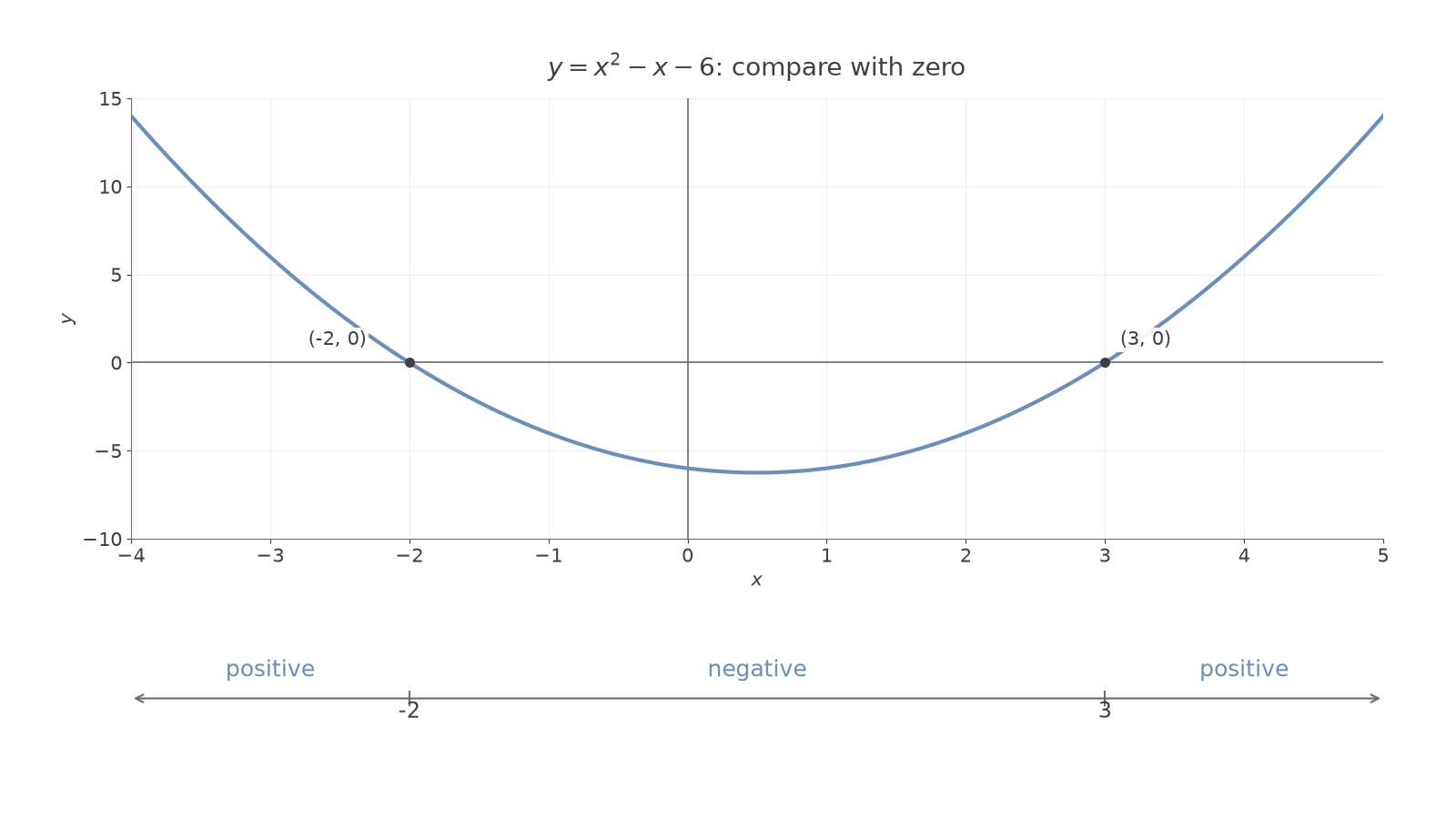
The graph below shows the same quadratic used in the first part. Read positions relative to the horizontal axis: above means a positive output, below a negative output.
[DIAGRAM: asset_name: Quadratic intervals above and below zero; asset_slug: quadratic_inequality_intervals; caption: The zeros split the input line into intervals with positive, negative and positive outputs.; description: Exact numbered-axis graph of y equals x squared minus x minus six, with zeros minus two and three labelled. A lower number line marks these boundaries and shows output signs plus, minus and plus in the three intervals. It presents signs of outputs rather than shading a solution region.]
Worked example 3: a strict inequality
Question. Solve graphically.
Plan. Use the zeros and 3, then select where the graph is above zero.
Test one input in each interval:
| Interval | Test input | Output | Positive? |
|---|---|---|---|
| Yes | |||
| No | |||
| Yes |
The upward parabola stays above the axis outside its two crossings. The strict sign excludes the zeros.
Answer. or .
Check. The test inputs and 4 satisfy the original inequality; the interior input 0 does not. At either boundary the output is zero, which fails .
Changing to “less than or equal to” changes both the selected side and endpoint inclusion.
Continue this lesson.
You’re previewing NovaLearn without an account. Create a free account to read the rest.
Create free account