C7.2; E7.2 - Finding sides with trigonometry
A 10 m cable makes an angle of with a straight baseline in a right-angled triangle. How far does it reach across that baseline? C7.2 and E7.2 connect acute angles to side ratios, so one known side and an angle can determine another side.
Trigonometric ratios
Two right-angled triangles with the same acute angle have the same shape. Enlarging one multiplies every side by the same factor, so ratios of matching sides stay unchanged. Trigonometry names three of these ratios.
Take a right triangle with legs 3 and 4 and hypotenuse 5. Choose the acute angle facing the side of length 3. Its opposite-to-hypotenuse ratio is . Enlarging to legs 6 and 8 and hypotenuse 10 gives , the same ratio.
Opposite, adjacent and hypotenuse
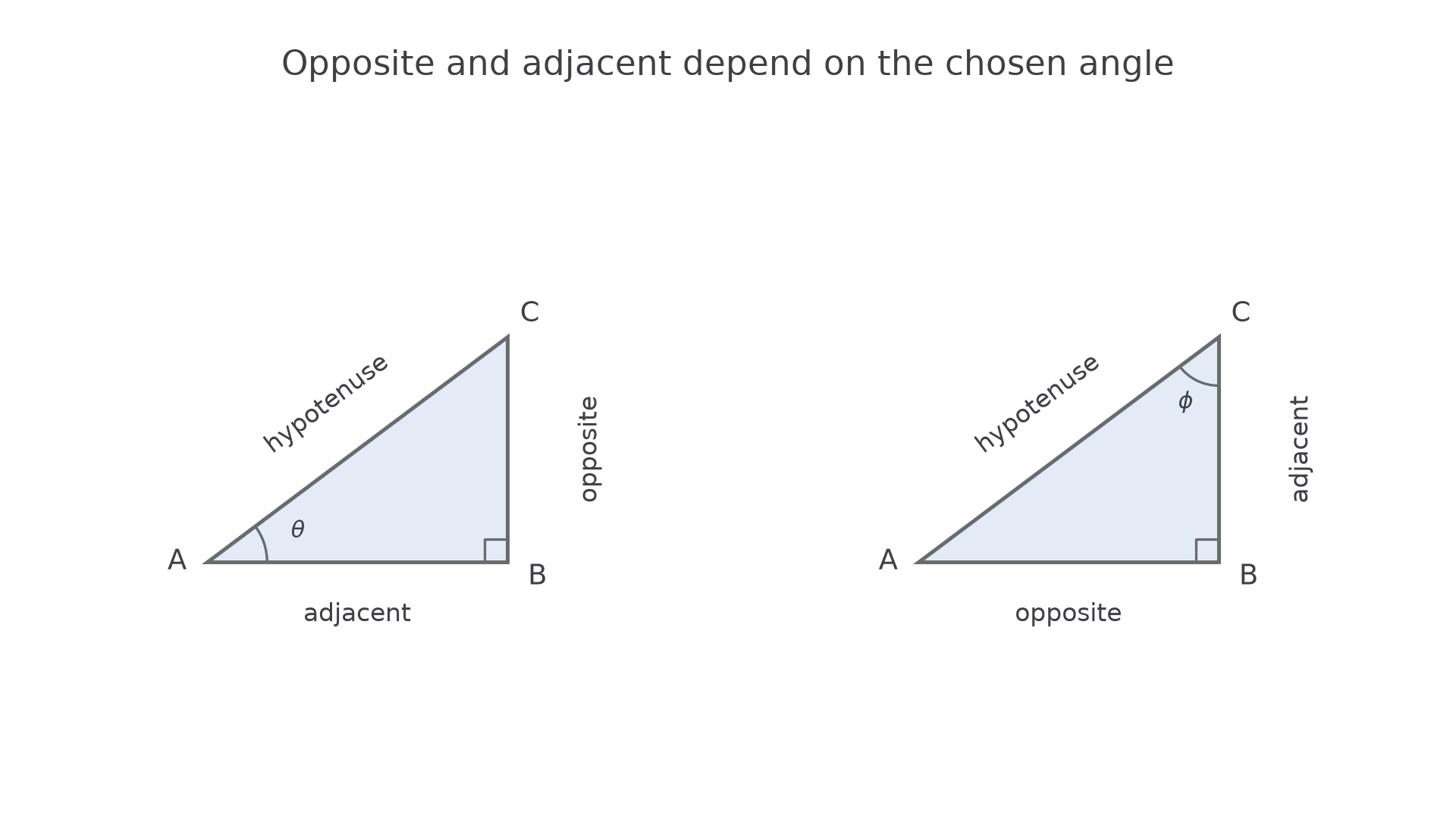
For a chosen acute angle , the opposite side faces . The adjacent side is the shorter side touching . The hypotenuse faces the right angle and is always the longest side.
The adjacent side excludes the hypotenuse, even though both touch the acute angle. Mark the angle first, because changing the chosen acute angle exchanges opposite and adjacent.
[DIAGRAM: asset_name: Sides relative to an acute angle; asset_slug: trig_relative_sides; caption: Changing the chosen acute angle swaps opposite and adjacent, while the hypotenuse stays the same.; description: Two equal 3 by 4 by 5 right triangles ABC with right angle at B. The left highlights angle A and labels BC opposite, AB adjacent and AC hypotenuse. The right highlights angle C and labels AB opposite, BC adjacent and AC hypotenuse. Labels are placed outside the triangles.]
Right-triangle trigonometric ratios
For an acute angle in a right-angled triangle,
Not on the supplied formula list for Papers 1–4: learn these ratios. “SOH CAH TOA” records their side pairs.
For the chosen angle in the 3–4–5 triangle, , and . These are numbers, not side lengths. Sine and cosine lie between 0 and 1 for acute angles, because their numerators are shorter than the hypotenuse. Tangent can exceed 1 when opposite is longer than adjacent.
Key idea
The angle chooses the ratio; the triangle's scale chooses its actual side lengths. Two same-shaped triangles can have different lengths but identical trigonometric ratios.
Choose the ratio that uses the named pair of sides.
Choosing a ratio
Use the known side and the side you need. A ratio containing a third, unknown side adds unnecessary work. Label the three sides relative to the marked angle, then choose the formula containing exactly the required pair.
| Sides involved | Ratio |
|---|---|
| Opposite and hypotenuse | Sine |
| Adjacent and hypotenuse | Cosine |
| Opposite and adjacent | Tangent |
Worked example 1: the opposite side is unknown
Question. Triangle is right-angled at . , , and . Write an equation to find .
Plan. Label the known side and the unknown relative to angle .
Answer. , or .
Check. The fraction compares a shorter side to the hypotenuse, so it should lie between 0 and 1. Sine uses precisely those two sides.
Now choose the other acute angle in the same triangle. The side becomes adjacent, while the hypotenuse remains .
Continue this lesson.
You’re previewing NovaLearn without an account. Create a free account to read the rest.
Create free account