E5.4 - Symmetry of solids (Extended)
A cylinder can be reflected in a flat slice or turned about a line. Which slices and lines really leave the whole solid unchanged? E5.4 extends symmetry into three dimensions, distinguishing planes of reflection from axes of rotation in prisms, cylinders, pyramids and cones.
Planes of symmetry
For a solid, a mirror needs a flat plane rather than a line drawn on its surface. Imagine reflecting every point of the solid through that plane: the complete three-dimensional shape must occupy exactly the same space afterwards.
Plane of symmetry
A plane of symmetry divides a solid into two parts that are mirror images. Corresponding points are equal perpendicular distances from the plane. The plane extends beyond the solid; a shaded slice in a drawing shows only its intersection with the solid.
Use ideal, unmarked solids here. A painted design or an off-centre hole can remove a symmetry. A right prism has its length perpendicular to its parallel end faces. For such a prism, each mirror line of the end shape gives a plane extending along the length, and the plane halfway between the ends is another symmetry plane.
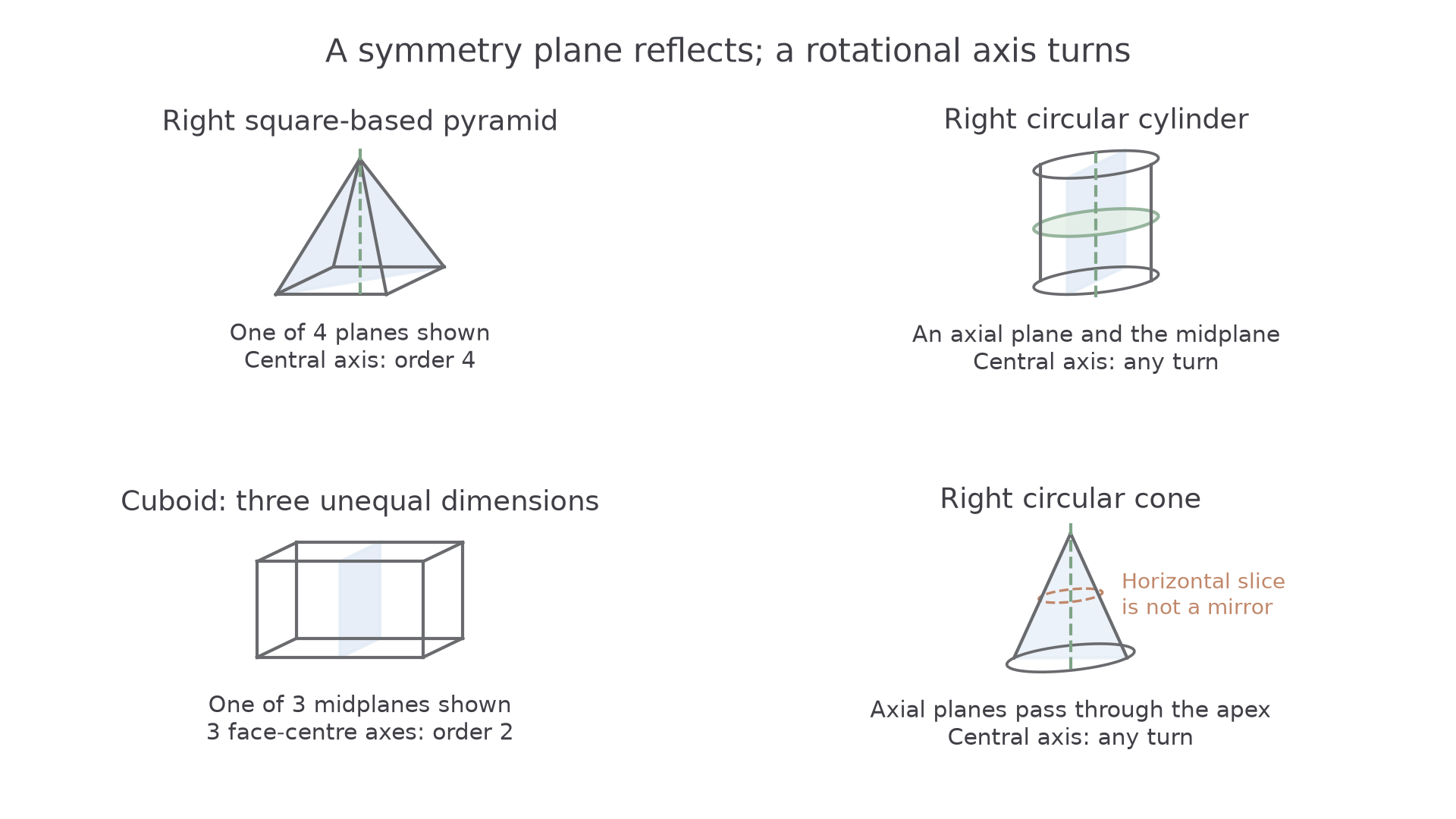
[DIAGRAM: asset_name: Planes and axes of solid symmetry; asset_slug: solid_planes_and_axes; caption: A plane reflects the solid; an axis is a line about which the solid turns.; description: Exact projected right square-based pyramid, right circular cylinder and rectangular cuboid. Pale sheets show one vertical symmetry plane in the pyramid, one axial plane and the horizontal midplane in the cylinder, and one midplane in the cuboid. A distinct dashed central line shows a rotational axis. The cone comparison shows an axial plane through its apex and explains why a horizontal cut is not a mirror plane.]
Worked example 1: a rectangular prism
Question. A cuboid has dimensions , and . How many planes of symmetry does it have? Describe them.
Plan. Test planes halfway between pairs of opposite faces.
- A plane halfway along the direction exchanges its equal end faces.
- The corresponding halfway planes along the and directions also work.
- Diagonal planes would exchange unequal dimensions, so they fail.
Answer. Three planes, each parallel to a pair of opposite faces and halfway between them.
Check. Reflecting a vertex in any stated plane gives another vertex with only one position reversed. A diagonal reflection would try to exchange an edge with a or edge.
Change the rectangular cross-section to an equilateral triangle. The longitudinal planes now come from the triangle's three mirror lines.
Worked example 2: an equilateral triangular prism
Question. A right prism has equilateral triangular ends and length . Describe all its planes of symmetry.
Plan. Extend each end triangle's mirror line along the prism, then test the plane between its ends.
- The equilateral triangle has three mirror lines, each through a vertex and the opposite side midpoint.
- Extending each along the prism gives three longitudinal symmetry planes.
- A plane parallel to the ends, from each, exchanges the two halves along its length.
Answer. Four planes: three longitudinal planes and the midplane parallel to the triangular ends.
Check. A longitudinal reflection exchanges matching rectangular faces. The midplane exchanges the two triangular ends without changing their orientation or size.
A right circular cylinder has infinitely many planes containing its central axis, plus one plane perpendicular to that axis halfway between its ends. A right circular cone has infinitely many planes containing its apex and the centre of its base, but no horizontal symmetry plane: reflection would exchange its pointed end with a circular base.
A right pyramid with a regular base has its apex directly above the base centre. Each base mirror line extends upwards through the apex to form a symmetry plane. A right square-based pyramid therefore has four; a regular triangular pyramid has extra symmetry only in the special regular tetrahedron case, so always use the given solid's properties. A cube likewise has nine planes rather than the three of a cuboid with all dimensions different: three face-parallel midplanes and six diagonal planes.
Watch out
A slice that makes equal volumes need not make mirror-image solids. Test the faces, edges and apex as well as the volume.
Compare a straight-sided cylinder with a pointed cone.
Axes of symmetry
Turning a solid fixes a whole line, its axis. A useful rotational symmetry turns it through less than and brings every point into a matching position.
Rotational axis
An axis of rotational symmetry is a line about which a non-zero turn smaller than maps the solid onto itself. Its order counts matching positions in one complete turn. A circular solid can match under every turn about its main axis.
Continue this lesson.
You’re previewing NovaLearn without an account. Create a free account to read the rest.
Create free account