C6.1; E6.1 - Metric units and conversions
A metre contains 100 centimetres. Does a square metre contain just 100 square centimetres? This lesson develops the length, mass, area, volume and capacity conversions in C6.1 and E6.1, so that you can compare measurements without changing the quantity they describe.
Length and mass
A measuring tape marked in centimetres and a ruler marked in millimetres can describe the same length. A smaller unit needs a larger numerical count: one centimetre fills ten millimetre intervals.
Metric conversion
A conversion changes the unit and numerical value together while preserving the quantity. The basic relationships are
Multiply when changing to smaller units; divide for larger units. Write the relationship first if the direction is uncertain. These relationships are knowledge to learn, rather than supplied formulas.
When measuring with a ruler, line up one endpoint with zero, rather than with the ruler's physical edge. Read the other endpoint against the scale and record the unit. If zero cannot be used, subtract the starting reading from the finishing reading. A ruler with millimetre divisions supports readings to the nearest millimetre; do not invent finer detail.
Worked example 1: converting to smaller units
Question. A walking route is long. Write its length in metres. A parcel has mass . Write its mass in grams.
Plan. Each kilometre contains 1000 metres and each kilogram contains 1000 grams, so multiply each numerical value by 1000.
Answer. and .
Check. metres make kilometres; grams make kilograms.
Now reverse the conversion. The count falls because the new unit is larger; a smaller numerical value does not mean a shorter object.
Worked example 2: converting to larger units
Question. A strip is long. Write its length in centimetres and metres. A bag has mass . Write its mass in kilograms.
Plan. Divide by the number of original units in one target unit.
Answer. , and .
Check. The strip is shorter than one metre, so its metre value should be below 1. Also, , recovering the original mass.
A conversion can pass through an intermediate unit: kilometres to centimetres uses metres first, giving centimetres per kilometre.
Watch out
Changing to reverses the direction. Centimetres are smaller, so the count increases: .
Use the unit relationship to check each direction.
Area units
A square metre is a square with side length one metre. Written in centimetres, both its length and width become 100. It therefore contains squares of area one square centimetre, answering the opening question.
[DIAGRAM: asset_name: Square units change in two directions; asset_slug: squared_unit_scale; caption: Ten small lengths along each edge give one hundred small squares.; description: A square is partitioned into an exact ten by ten grid. Each side is labelled one centimetre equals ten millimetres. A single cell is highlighted and labelled one square millimetre. The full square is labelled one square centimetre equals one hundred square millimetres. A second statement shows one square metre equals one hundred times one hundred square centimetres.]
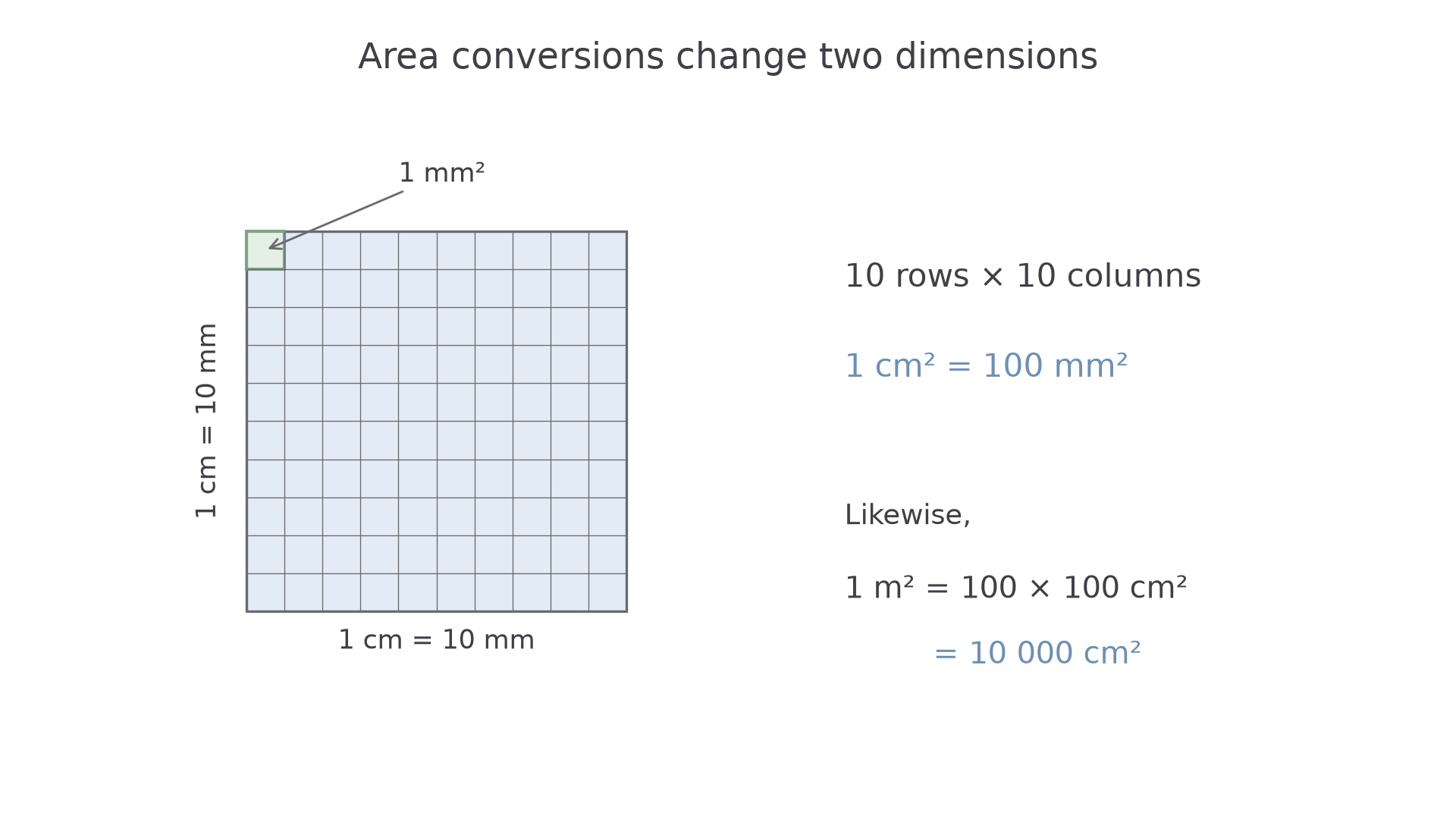
Squared conversion factors
If one larger length unit contains smaller length units, one corresponding square unit contains smaller square units.
Not separately supplied on the formula lists: learn the relationships and their reason.
The exponent belongs to the unit: means three square centimetres, not a square of side three centimetres, whose area would be nine square centimetres.
Continue this lesson.
You’re previewing NovaLearn without an account. Create a free account to read the rest.
Create free account