E5.1 - Planes and further solids (Extended)
A line can cross a segment at right angles without being its perpendicular bisector. E5.1 extends your geometrical vocabulary to planes, further solids and major and minor parts of circles, so each name states the full set of conditions.
Planes and bisectors
Suppose a line meets a segment at a right angle but cuts it into lengths and . It is perpendicular to the segment, but what is missing from the name “perpendicular bisector”?
Plane and perpendicular bisector
A plane is a flat two-dimensional surface extending indefinitely. A perpendicular bisector of a line segment is a line in the same plane that meets the segment at its midpoint and at .
A tabletop suggests part of a plane, but a mathematical plane has no edge. In a sketch, a sloping parallelogram often represents a finite portion of a plane. The perspective does not mean that the surface is curved or thick.
The word bisect means divide into two equal parts. If is the midpoint of , then . A perpendicular bisector must satisfy two separate conditions: pass through , and meet at a right angle.
[DIAGRAM: asset_name: A plane and two perpendicular lines; asset_slug: plane_perpendicular_bisector; caption: Both crossing lines are perpendicular to AB, but only the one through the midpoint bisects it.; description: A pale parallelogram represents part of a plane containing segment AB. Midpoint M has matching ticks on AM and MB, and a perpendicular line through M has a right-angle square. A second perpendicular line crosses AB away from M, labelled perpendicular only.]
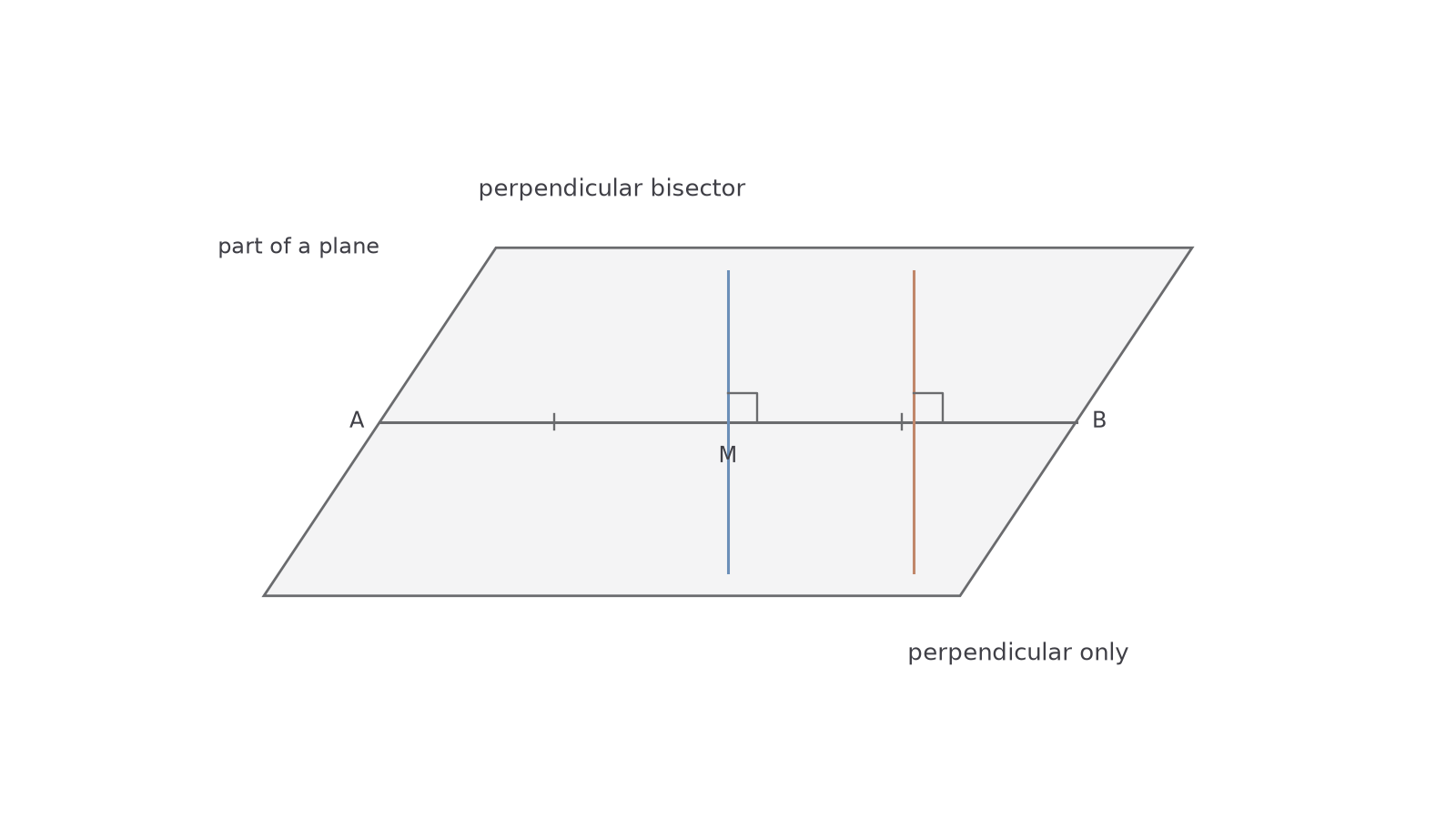
For example, a segment has midpoint from each end. A line through that midpoint meeting the segment at is its perpendicular bisector. A sloping line through the midpoint bisects the segment but is not perpendicular to it.
Two lines that look separated in a three-dimensional sketch need not be parallel: they may lie in different planes. Parallel lines must lie in the same plane and never meet when extended.
Watch out
“Perpendicular” alone does not mean “perpendicular bisector”. Check the right angle and the equal halves separately.
Apply both conditions to the next description.
Further solids
A solid's name can describe its faces or explain how it was formed. These three solids extend the cube, prism, pyramid, cone and sphere you already know.
Tetrahedron, hemisphere and frustum
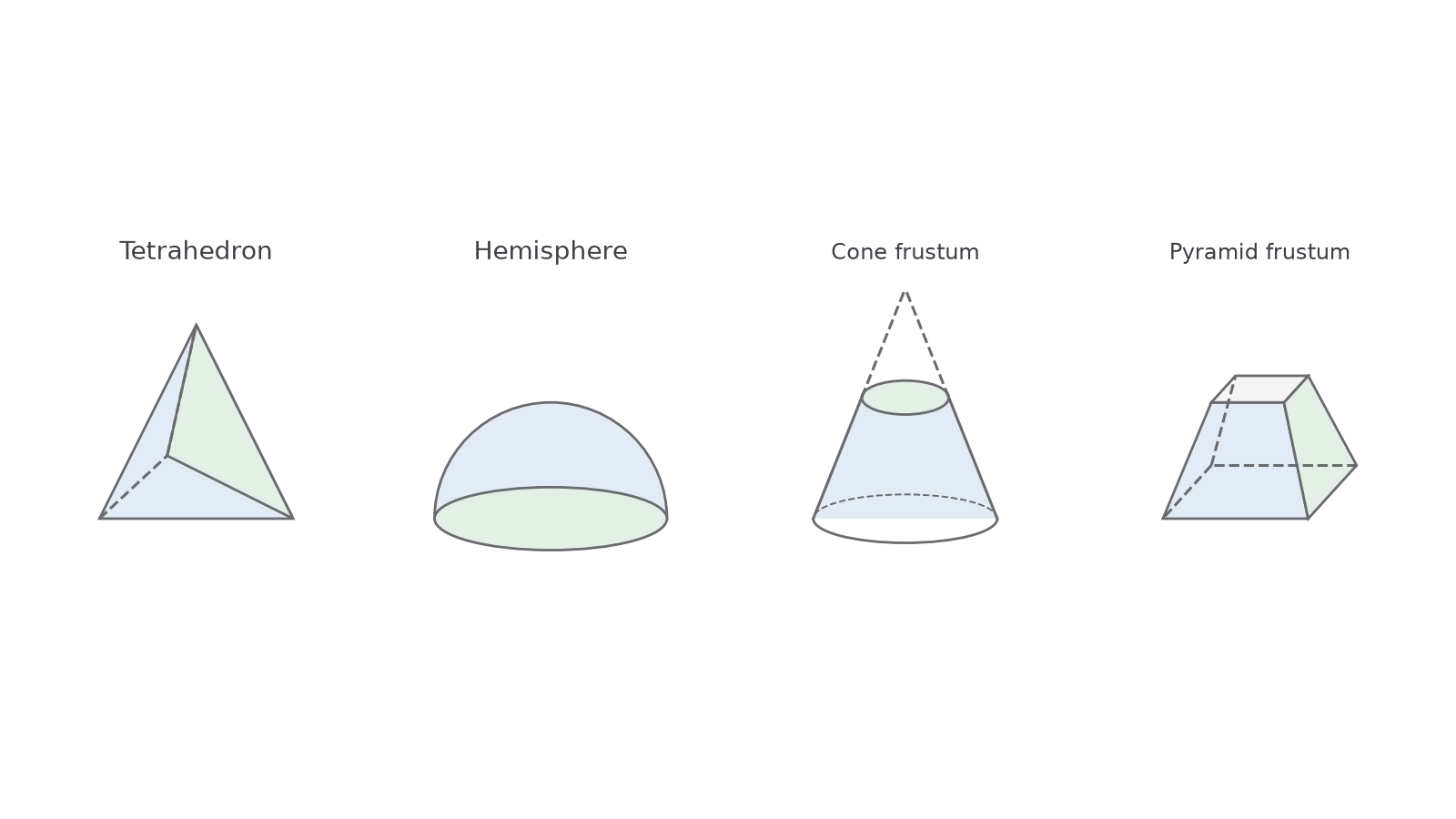
A tetrahedron is a pyramid with four triangular faces. A hemisphere is half a sphere cut by a plane through its centre. A frustum is the part of a cone or pyramid between its base and a cut parallel to that base, after the smaller top cone or pyramid is removed.
A tetrahedron has a triangular base and three triangular side faces, four vertices and six edges. It need not have equilateral faces. A regular tetrahedron is the special case with four equal equilateral faces.
A hemisphere has one flat circular face and one curved surface. The cutting circle has the same radius as the original sphere because the cutting plane passes through its centre. Cutting a sphere away from its centre makes a smaller cap, not a hemisphere.
[DIAGRAM: asset_name: Further solids; asset_slug: tetrahedron_hemisphere_frustum; caption: A tetrahedron has four triangular faces; a hemisphere is half a sphere; a frustum retains parallel bases.; description: Exact projections of a tetrahedron, a hemisphere with its flat circular face, a cone with the removed top shown dashed above its frustum, and a square-pyramid frustum. The two frustums have parallel top and bottom faces of different sizes.]
Continue this lesson.
You’re previewing NovaLearn without an account. Create a free account to read the rest.
Create free account