E8.4 - Conditional probability
New information can change which outcomes are still possible. This Extended lesson uses E8.4 to calculate conditional probabilities from lists, tables, Venn diagrams and trees. You will interpret “given that”, keep only the relevant outcomes and choose the denominator for that restricted group.
Restricting the possible outcomes
A card is chosen with equal chance from cards numbered to . Is “even, given that it is a multiple of three” the same question as “a multiple of three, given that it is even”? Both mention the same two properties, but they start from different information.
“Given that” tells you information known to be true. Discard outcomes that contradict it before finding the required probability. You are not asking for the chance that the information becomes true; you are accepting it as the starting condition.
Conditional probability
A conditional probability is a probability calculated using stated information to restrict the possible outcomes. When the remaining individual outcomes are equally likely, divide the number satisfying the target by the total number satisfying the given condition.
The given condition must be possible. A condition containing no available outcomes cannot supply a probability denominator.
For the numbered cards, the original outcomes all have the same chance. Restricting the list preserves that equal chance within the surviving group. Keep two questions separate: “What do I already know?” and “What am I now trying to find?”
Worked example 1: a known multiple of three
Question. One card is chosen with equal chance from cards numbered to . Given that its number is a multiple of three, find the probability that it is even.
Plan. List the multiples of three, then count the even numbers within that list.
Answer. .
Check. The other two surviving cards, and , are odd. Even and odd therefore each occupy half of this four-card group.
Reverse only which property is given and which is sought. The favourable cards are the same, but the available group changes.
Worked example 2: a known even number
Question. For the same equally likely choice, given that the card's number is even, find the probability that it is a multiple of three.
Plan. Retain the even numbers first, then find which are also multiples of three.
Answer. .
Check. The other four even cards are not multiples of three, with probability . Together the two alternatives total one.
The numerator happened to stay two, but the denominator changed from four to six. Conditional probabilities in opposite directions need not match. New information also need not change a numerical chance: in the first example, half the original cards and half the retained cards are even.
If the condition is certain, no outcomes are removed, so the original probability remains. If the condition is impossible, such as “the number is thirteen” for these cards, there is no surviving group; do not write a fraction with denominator zero.
Watch out
is the probability that the original card is both even and a multiple of three. It is not either conditional answer: “given that” has already restricted the denominator.
Retain the condition before counting the target in this new list.
Conditional probability from a table or Venn diagram
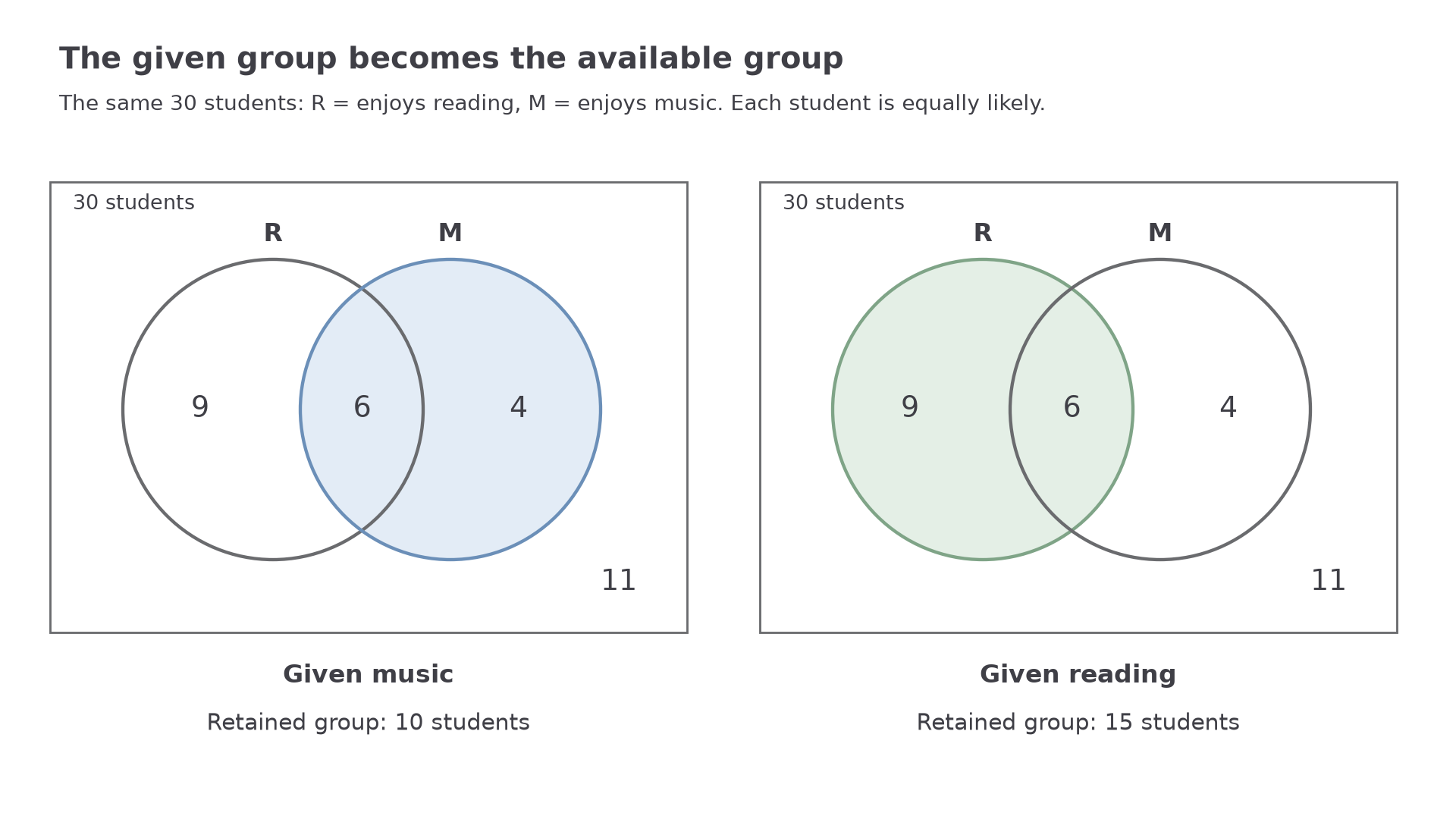
A table and a Venn diagram can organise the same restricted group. In a table, keep the row or column named by the condition. In a Venn diagram, keep the regions satisfying the condition, then count the target within them.
The table describes students. means that a student enjoys reading and that they enjoy music. Each student appears in exactly one cell and is equally likely to be chosen.
| Music | Not music | Total | |
|---|---|---|---|
| Reading | |||
| Not reading | |||
| Total |
The corresponding Venn diagram puts the same four cell counts into separate regions. A condition may keep a whole circle, its complement, or several regions. It need not be a single cell.
[DIAGRAM: asset_name: Restricting a Venn diagram to the given group; asset_slug: conditional_venn_groups; caption: The same overlap is six, but music gives a group of ten and reading gives a group of fifteen.; description: Two panels show the same universal set of 30 students with overlapping circles R for reading and M for music. Region counts are R only 9, both 6, M only 4 and neither 11. In the left panel the entire M circle is shaded pale blue and labelled given music, group total 10. In the right panel the entire R circle is shaded pale sage and labelled given reading, group total 15.]
Worked example 3: the music group is given
Question. One of these students is chosen with equal chance. Given that the student enjoys music, find the probability that they enjoy reading.
Plan. Use the music column, which contains ten students, and count its six readers.
Answer. .
Check. Within the music circle, the four non-readers are the complementary group. Their probability leaves for reading.
Reverse only the given and target properties. You can read the changed denominator from the reading row or from circle .
Worked example 4: the reading group is given
Question. For the same selection, given that the student enjoys reading, find the probability that they enjoy music.
Plan. Keep all fifteen readers; only the six in the overlap enjoy music too.
Answer. .
Check. The reading row contains nine students not enjoying music. They form of the retained group, leaving who enjoy music.
Continue this lesson.
You’re previewing NovaLearn without an account. Create a free account to read the rest.
Create free account