C5.4; E5.4 - Prisms and cylinders
The amount a container holds and the material needed to make it are different measurements. In C5.4 and E5.4, you will calculate volumes using uniform cross-sections, build surface areas from nets, and distinguish a cylinder's curved area from its whole surface.
Cross-sections and prism volumes
Can a quarter-cylinder use the same volume rule as a rectangular box? Yes: what matters is that its cross-section stays the same all the way along. Imagine stacking identical thin slices with no gaps.
You already know
A rectangle has area length times width; a triangle has area half its base times its perpendicular height. A sector is a fraction of a circular region. Use one length unit throughout a calculation.
A box with a by end contains six unit cubes in each -thick layer. Four such layers contain . The same reasoning works when the end is not rectangular.
Uniform cross-section
A uniform cross-section has the same shape and size at every cut parallel to the ends. The length used with it is the perpendicular distance between the end planes.
Earlier, you identified polygonal prisms by their flat faces. For volume calculations, the term prism also includes any solid with a uniform cross-section, including a cylinder or a cylindrical sector. The cross-section need not be a polygon.
[DIAGRAM: asset_name: Uniform triangular and sector cross-sections; asset_slug: uniform_cross_sections; caption: Multiply the unchanged end area by the perpendicular distance between ends.; description: A right triangular prism has a three-four-five end and length eight centimetres. A separate quarter-cylinder has radius four centimetres and length seven centimetres, with a right angle marked at the sector centre. Corresponding front and back cross-sections match.]
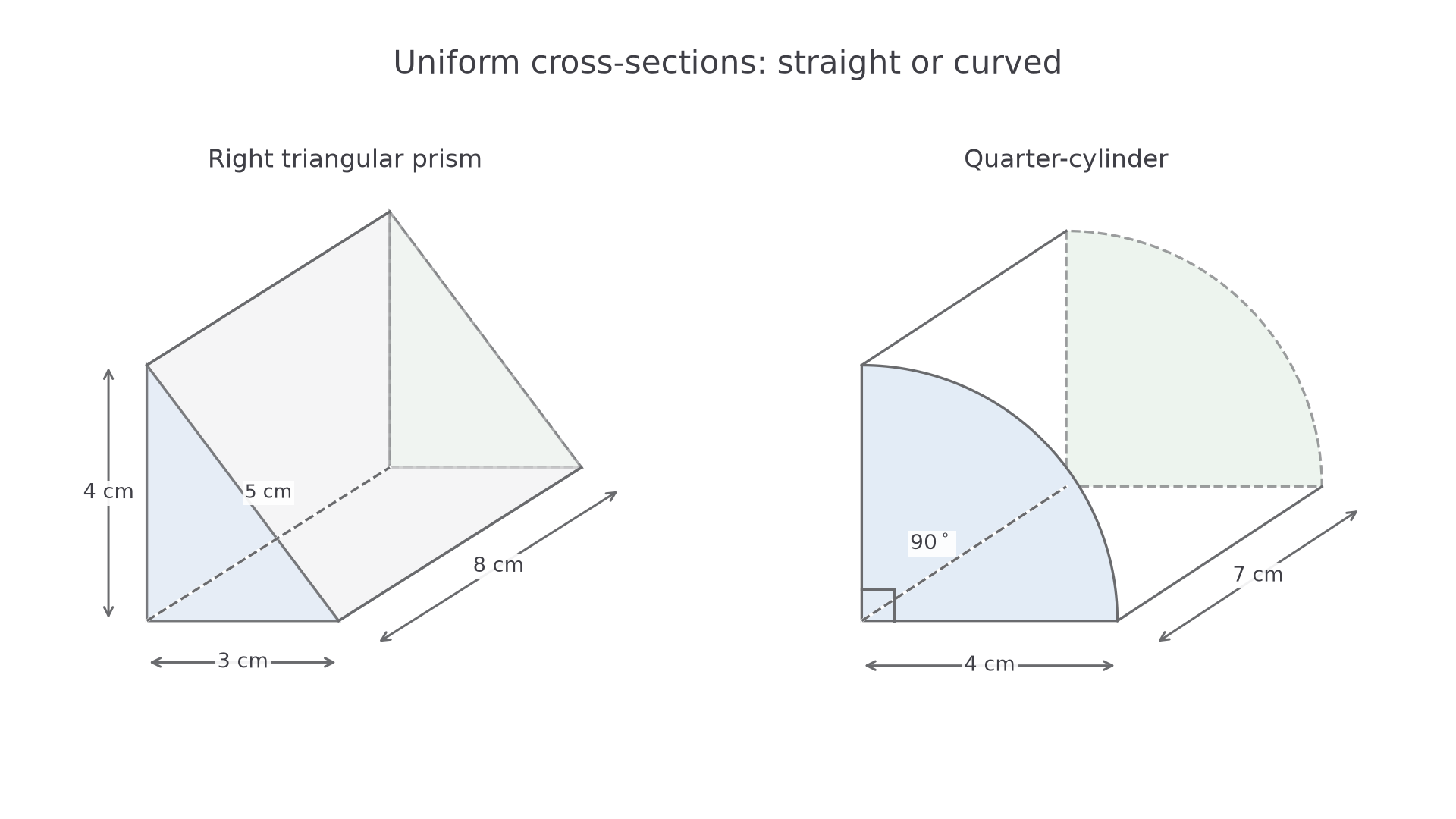
The area tells you the amount in each unit of length. Multiplying by the length counts all the slices.
Volume from a cross-section
For a solid with uniform cross-sectional area and perpendicular length ,
Square units times length units give cubic units. For a cuboid, this becomes .
The prism volume formula is given in the List of formulas on page 2 of each paper.
Choose the end shape before multiplying by the distance between the ends.
Worked example 1: a triangular cross-section
Question. A right prism has a right-angled triangular end with perpendicular sides and , and prism length . Find its volume.
Plan. Calculate the triangular end area, then multiply by the prism length.
Answer. .
Check. A by by cuboid has volume . The diagonal triangular prism is half that cuboid, agreeing with .
Change only the prism length. The end area stays fixed, so there is no need to recalculate it differently.
Worked example 2: a longer prism
Question. The same triangular cross-section now extends through . Find the volume.
Plan. Keep the end area and replace only the distance between ends.
Answer. .
Check. Split the prism into lengths and : their volumes are and , totalling .
For the quarter-cylinder in the diagram, the end is one quarter of a circle, so . Its volume is . A curved boundary does not stop the slice rule working. Here is one quarter of a full turn.
Watch out
“Triangle height prism length” mixes up two perpendicular measurements. The triangle height belongs inside the end-area calculation; the prism length is the distance to the other end.
Use all three supplied measurements for their correct purposes.
Surface area from a net
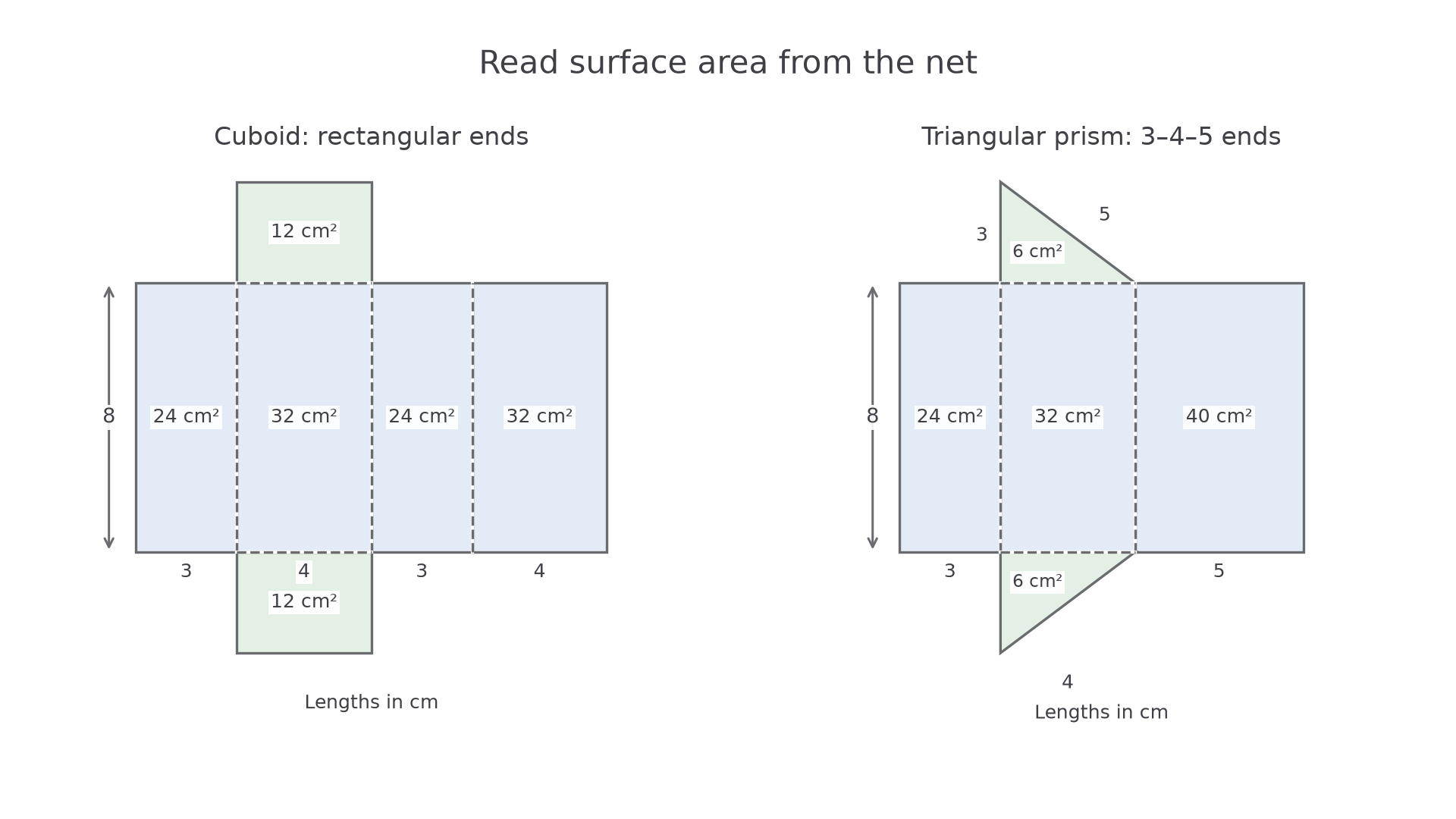
Surface area counts the boundary covering the solid once. A net makes the bookkeeping visible: calculate each face's area, then add. Volume counts the space inside instead, so the same dimensions enter a different calculation.
For a closed cuboid, there are two faces of each rectangular size. For a right prism, each side face is a rectangle whose dimensions are a cross-section side and the prism length. Adding those rectangles gives cross-section perimeter times length.
[DIAGRAM: asset_name: Comparing cuboid and triangular-prism nets; asset_slug: prism_surface_nets; caption: The two ends and every side rectangle contribute to a closed surface.; description: A valid cuboid net has two three-by-four ends and a side strip of height eight with widths three four three four. A valid triangular-prism net has two three-four-five triangular ends and a side strip of height eight with widths three four five. All lengths are in centimetres, fold lines are dashed and each face area is labelled.]
Closed right-prism surface area
If the end area is , its perimeter is , and the prism length is ,
For a closed cuboid, . These expressions come from counting faces in a net; they are not given in the List of formulas. They assume both ends and all side faces are present.
The perimeter in this formula goes around the end, not around an arbitrary rectangle in the net.
Continue this lesson.
You’re previewing NovaLearn without an account. Create a free account to read the rest.
Create free account