C1.1, C1.3; E1.1, E1.3 - Squares, cubes and roots
Powers count repeated equal factors; roots reverse that process. You will recognise square and cube numbers, recall the key values, and work out other whole-number powers and exact roots. The same methods apply to Core and Extended.
Squares and square roots
A square floor contains equal square tiles. How many tiles lie along one edge: or ? Halving the total does not find an edge: each row has the same number of tiles as there are rows.
For a smaller floor, seven rows of seven tiles contain tiles. The short notation is , read “seven squared”. The raised counts the two equal factors; it does not mean multiply by .
[DIAGRAM: asset_name: A square and its root; asset_slug: square_and_root; caption: Seven rows of seven unit squares give 49. The square root recovers the side length, 7.; description: An exact seven-by-seven pale blue square grid with side lengths 7 labelled below and to the left. Text to the right states seven squared equals forty-nine and square root of forty-nine equals seven.]
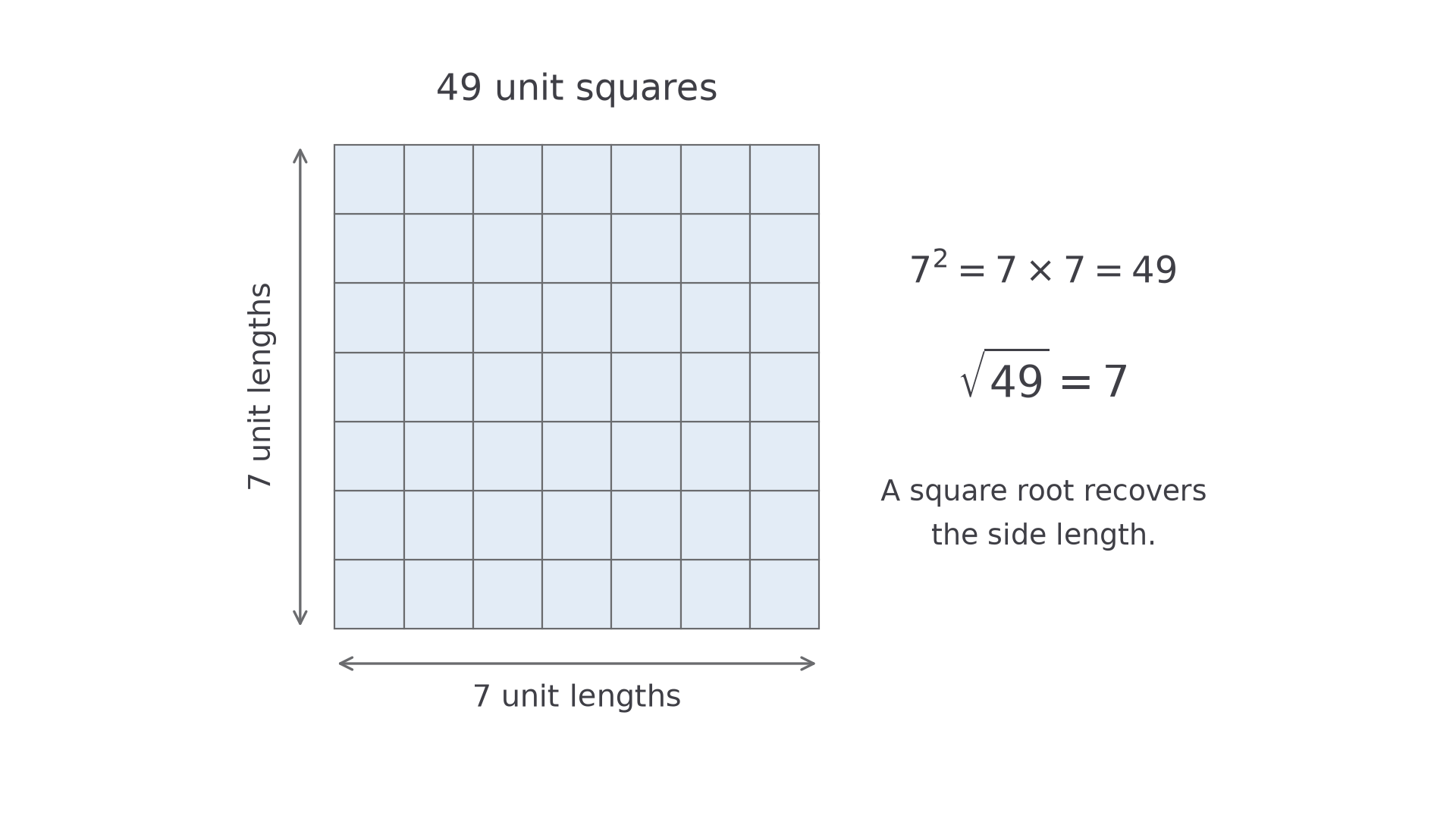
Square and square root
The square of a number is that number multiplied by itself. A square number is the square of an integer: .
For a non-negative number, the principal square root is the non-negative number whose square gives it. The symbol means , not .
Learn these squares and read the table backwards for their roots. For instance, the entry means both and .
| Number | Square | Number | Square | Number | Square |
|---|---|---|---|---|---|
Worked example 1: finding a square
Question. Work out .
Plan. Multiply by itself, using ten twelves and two twelves.
Answer. .
Check. : twelve rows of twelve use all tiles.
Now reverse the question: you know the total and want the repeated factor.
Worked example 2: undoing a square
Question. Write down .
Plan. Find the non-negative number that multiplies by itself to make .
Answer. .
Check. and ; the square lies between these neighbouring squares, as expected.
A root symbol and a question about all possible numbers have different jobs. In “find all numbers whose square is ”, both and work: a negative multiplied by a negative is positive. If this is written , the letter simply stands for the unknown number, and the answers are and . But is the single principal value . The next lesson explains signed products in detail.
Watch out
confuses squaring with doubling. Squaring gives . Also, ; a negative number has no real square root, because no number on the real number line squares to a negative value.
Cubes and cube roots
A cube made from small unit cubes has equal numbers along its length, width and height. With four along each edge, one layer contains unit cubes, and four layers contain .
Cube and cube root
The cube of a number is the product of three equal factors. For example, . A cube number is the cube of an integer.
The cube root, written , reverses cubing: . The small tells you which root to take; it is not a multiplier.
These cube/root pairs must be recalled. They are not supplied in the List of formulas.
| Number | ||||||
|---|---|---|---|---|---|---|
| Cube |
Worked example 3: counting three equal factors
Question. Work out .
Plan. Multiply twice to combine the three factors.
Answer. .
Check. , and : undoing two multiplications leaves the original factor.
Keep the same cube, but recover its edge instead of its total. A root reverses the operation, just as in the square examples.
Worked example 4: recovering a cube's edge
Question. Write down .
Plan. Look for three equal factors with product .
Answer. .
Check. and , so is between the neighbouring cubes.
The same number can be both a square and a cube: . The root sign tells you which factor to recover, so whereas .
Watch out
is wrong. A cube root asks for three equal factors, not three equal shares. Since , the cube root is .
Other powers and roots
The pattern continues beyond squares and cubes. In , the base is and the index or power is : multiply four copies of . The index counts factors, not multiplication signs.
For any positive whole-number index, write that many equal factors. An index of means just one factor, so . Rules for zero and negative indices come later; repeated factors explain the positive indices used here.
Worked example 5: a fourth power
Question. Work out .
Plan. Write four factors, then multiply them in pairs.
Answer. .
Check. Repeated division reverses the calculation: , , .
Changing from a power to its matching root reverses the same four-factor calculation.
Worked example 6: a fourth root
Question. Work out .
Plan. Find the non-negative number whose fourth power is .
Answer. .
Check. and , so a value between and is sensible.
Even-numbered roots, such as square and fourth roots, use the non-negative principal value when the number inside is non-negative. An odd-numbered root reverses an odd power; for instance, , so . Not every root is a whole number: lies between and , since . Keeping the root sign is an exact answer when an integer root does not exist.
Key idea
A power asks for a product of equal factors. Its matching root asks which factor was repeated. The small number on the root sign must match the power being undone.
Quick Recap
- Squaring uses two equal factors; cubing uses three. Higher positive whole-number indices count factors in the same way.
- Recall squares from to , and cubes of and ; read those facts backwards for roots.
- The square-root symbol gives the non-negative principal value. Finding all numbers with a given positive square also includes the negative number.
- Check a root by raising it to the matching power.
The opening floor has tiles along each edge, because .