C1.15; E1.15 - Time, clocks and timetables
A journey can finish on the next day even when it lasts less than two hours. You will convert time units, read clocks and timetables, calculate durations and compare local times. C1.15 and E1.15 share these skills, including the important difference between decimal hours and hours with minutes.
Units of time
A coach leaves at and arrives at the next day. Is the journey really hours long? We will solve this by treating time as a continuous journey across midnight, rather than subtracting the printed digits.
First, units matter. There are seconds in a minute, minutes in an hour, hours in a day and days in a week. There are months in a year. Use days for a year in these syllabus calculations; if a problem supplies particular calendar dates, read that information carefully. Months have different lengths, so there is no single exact number of days in a month.
To change to a smaller unit, multiply: weeks is days. To change to a larger unit, divide: days is years. Similarly, months is year months. A remainder stays in the smaller unit: seconds is minutes seconds because .
Decimal hours
Decimal hours express the fraction of an hour using a decimal. Because an hour has minutes, hours is minutes. The decimal point does not separate hours from minutes.
Convert just the minutes to a fraction of an hour, then add the whole hours. This gives a number you can use in rate calculations later.
Worked example 1: minutes to decimal hours
Question. Write hours minutes in hours.
Plan. Divide the minutes by , then add .
Answer. hours.
Check. minutes, and minutes.
Change only the minutes. The conversion divisor stays .
Worked example 2: a larger part of an hour
Question. Write hours minutes in hours.
Plan. Convert minutes to hours and add it to .
Answer. hours.
Check. minutes. The answer lies between and hours.
Read the requested unit before writing the answer.
Watch out
hours minutes is not hours. The digits represent forty-eight sixtieths of an hour, rather than forty-eight hundredths.
Use the same conversion in this new case.
Twelve-hour and twenty-four-hour clocks
A clock face shows a time within a twelve-hour cycle. The long minute hand completes one turn in minutes; each numbered step is minutes. The short hour hand moves gradually, so at twenty minutes past three it has moved one third of the way from to .
[DIAGRAM: asset_name: Reading two clock faces; asset_slug: reading_clock_faces; caption: The minute hand changes from twenty past to twenty to four. The hour hand also moves.; description: Two exact analogue clock faces labelled Clock A and Clock B. Clock A has its long blue minute hand at 4 and its short grey hour hand one third of the way from 3 to 4. Clock B has its minute hand at 8 and its hour hand two thirds of the way from 3 to 4. A key identifies the long blue hand as minutes and the shorter grey hand as hours.]
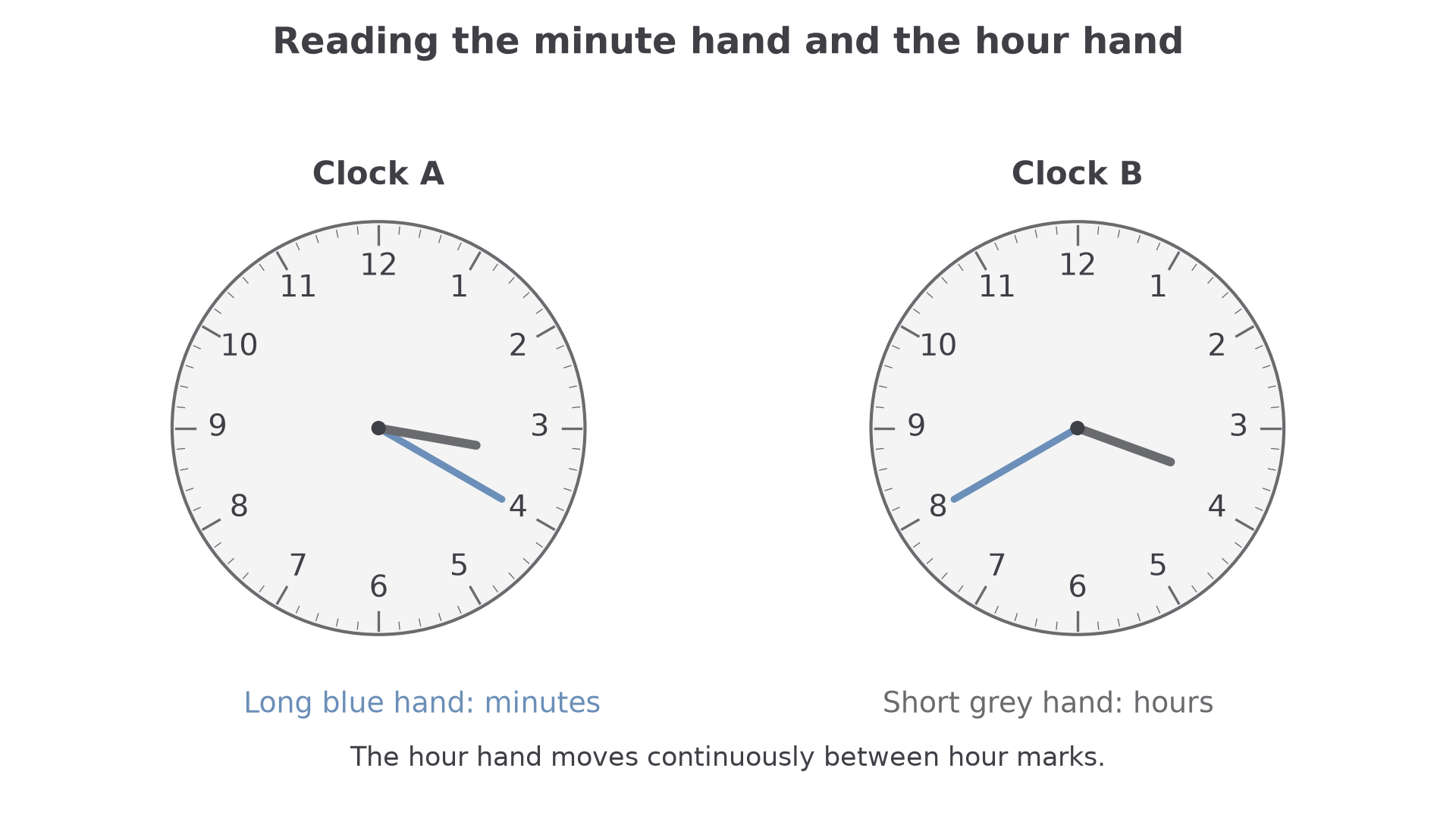
A twelve-hour time needs a.m. for midnight up to before noon, or p.m. for noon up to before midnight. A twenty-four-hour time gives hours since midnight and needs neither. Use two hour digits and two minute digits, as in .
| Time | Twelve-hour notation | Twenty-four-hour notation |
|---|---|---|
| Midnight | a.m. | |
| Half past midnight | a.m. | |
| Noon | p.m. | |
| Half past noon | p.m. |
For afternoon/evening hours to , add to the hour. For twenty-four-hour hours to , subtract and use p.m. Noon and midnight are the exceptions shown above.
Worked example 3: reading Clock A
Question. Clock A shows an afternoon time. Write it in twelve-hour and twenty-four-hour notation.
Plan. Read the long hand in steps of five minutes, then use the short hand for the hour.
Answer. p.m., or .
Check. , and minutes is one third of an hour, matching the short hand's position.
Only the minute-hand position changes in Clock B, but the hour hand must move with it.
Worked example 4: reading Clock B
Question. Clock B also shows an afternoon time. Write it in twelve-hour and twenty-four-hour notation.
Plan. Count the minutes and identify the hour the short hand has already passed.
Answer. p.m., or , also called twenty to four.
Check. There are minutes until . The hour hand is closer to , but has not reached it.
The hour hand tells you which hour has begun, rather than whichever numeral it is nearest.
Watch out
is a.m., not p.m. Also, is already an afternoon time: do not add again.
Now switch between the two written notations.
Durations and timetables
A duration is an elapsed length of time. A timetable gives clock readings at particular events. Read down one service's column to follow that service; do not take a departure from one service and an arrival from another.
For a duration, count forwards through a convenient whole hour or midnight. Hours and minutes do not behave like the digits of a decimal subtraction. A clock reading after midnight belongs to the following day if the service has crossed midnight.
| Stop | Service A | Service B |
|---|---|---|
| Depart Hilltown | ||
| Arrive Lakeside | , same day | , next day |
The two services have the same departure time and arrival minutes. Their arrival hours make a large difference.
Worked example 5: duration within one day
Question. Use the timetable to find the journey time for Service A.
Plan. Count from to , then to .
Answer. minutes.
Check. Adding minutes to reaches .
Now change only the arrival hour, to on the next day. The clock passes through midnight.
Worked example 6: duration across midnight
Question. Use the timetable to find the journey time for Service B.
Plan. Count to midnight first, then add the time after midnight.
Answer. hour minutes, or minutes.
Check. hour gives ; another minutes gives next day. This answers the opening question.
The same forward-counting method also finds an arrival: add the duration to the departure. For connections, compare the next departure with your arrival and allow any stated transfer time.
Watch out
is decimal subtraction, not a duration calculation. In clock notation there are minutes per hour, so the actual gap is minutes.
Try another journey that crosses midnight.
Time zones and local time
Two local clocks can show different times at the same instant. If City B is three hours ahead of City A, add three hours to A's clock to get B's clock. “Ahead” describes the clocks; it does not make a journey three hours longer.
Use the offset supplied in the problem. You do not need to know a city's real time zone or any seasonal clock changes. For a journey, put departure and arrival on the same city's clock before finding elapsed time.
Worked example 7: arrival without a date change
Question. City B is hours ahead of City A. A flight leaves A at local time and lasts hours minutes. Find the local arrival time in B.
Plan. Add the flight time using A's clock, then apply the three-hour offset.
Answer. in B on the same day.
Check. Convert back: hours is in A. The gap from is hours minutes.
Keep the route and flight time, but depart six hours later. This time the date changes.
Worked example 8: arrival on the next day
Question. The same flight instead leaves A at on Monday. Find the local arrival time and day in B.
Plan. Keep track of midnight when adding the duration, then add the offset.
Answer. on Tuesday in B.
Check. At departure it was already Monday in B. Adding hours minutes reaches Tuesday.
To find an unknown time difference instead, calculate the arrival on the departure city's clock first. Compare that with the stated destination time, keeping the dates attached.
Watch out
Subtracting local departure from local arrival can include a clock offset as well as travel time. Convert both readings to one local clock before calculating a journey's duration.
Apply the same idea to a different supplied offset.
Quick Recap
- Convert minutes to hours by dividing by ; decimal hours are not clock notation.
- Twenty-four-hour times distinguish morning and afternoon; is midnight and is noon.
- Follow one timetable service and count forwards to find durations, keeping track of the date.
- Use one local clock for a journey calculation, then apply any supplied time difference.
The coach from to next day travels for hour minutes: midnight resets the clock, not the elapsed time.