C3.5; E3.5 - Equations of straight lines
A line's equation records its gradient and where it crosses an axis. You will interpret these features and find a fully simplified equation from a graph, including horizontal and vertical lines, for C3.5 and E3.5.
Gradient and intercept in an equation
Can two numbers describe an entire sloping line? In , one number tells you how fast the line rises; the other tells you its starting height on the vertical axis. Together they locate every point.
Try two inputs. At , the equation gives . At , it gives . Increasing by one raises by three. The same happens wherever you start, because the added two stays fixed.
Gradient and intercept form
For a non-vertical straight line,
where is the gradient and is the -intercept, the value of where the line meets the -axis. That crossing point is . Not given in the List of formulas: learn it.
The intercept is a value, so “the -intercept is ” and “the line crosses at ” describe the same feature. It is not generally where the line crosses the horizontal axis. Negative gradients and negative intercepts are allowed.
Worked example 1: reading both features
Question. State the gradient and -intercept of .
Plan. Match the coefficient of and the constant to .
Answer. Gradient ; -intercept , at .
Check. Inputs and give outputs and : the crossing is at two and a run of one produces a rise of three.
Change only the constant's sign. The line now crosses below the origin, but its gradient stays the same.
Worked example 2: a negative intercept
Question. State the gradient and -intercept of .
Plan. Keep the minus sign attached to the constant.
Answer. Gradient ; -intercept , at .
Check. At , ; at , . The rise is still three for a run of one.
Simplify the right side before reading the features: becomes . Writing means gradient ; a missing written coefficient does not mean zero.
Watch out
In , the gradient is , not . Substitute to identify the intercept, rather than choosing whichever number looks nearest the equals sign.
Finding an equation from a graph
To turn a graph into an equation, read its -intercept and measure its gradient from a grid triangle. Put those values into . Then check another point on the graph. Reading the intercept alone cannot distinguish lines that cross the same point in different directions.
[DIAGRAM: asset_name: Two lines with the same intercept; asset_slug: graph_equations; caption: Both lines cross at negative three; changing the direction changes the gradient.; description: Two numbered Cartesian grids use one x-unit per horizontal division and two y-units per vertical division. The left line rises through zero comma negative three and two comma one; its run is two and rise four. The right line falls through zero comma negative three and two comma negative seven; its run is two and rise negative four. A third point is marked on each line for checking.]
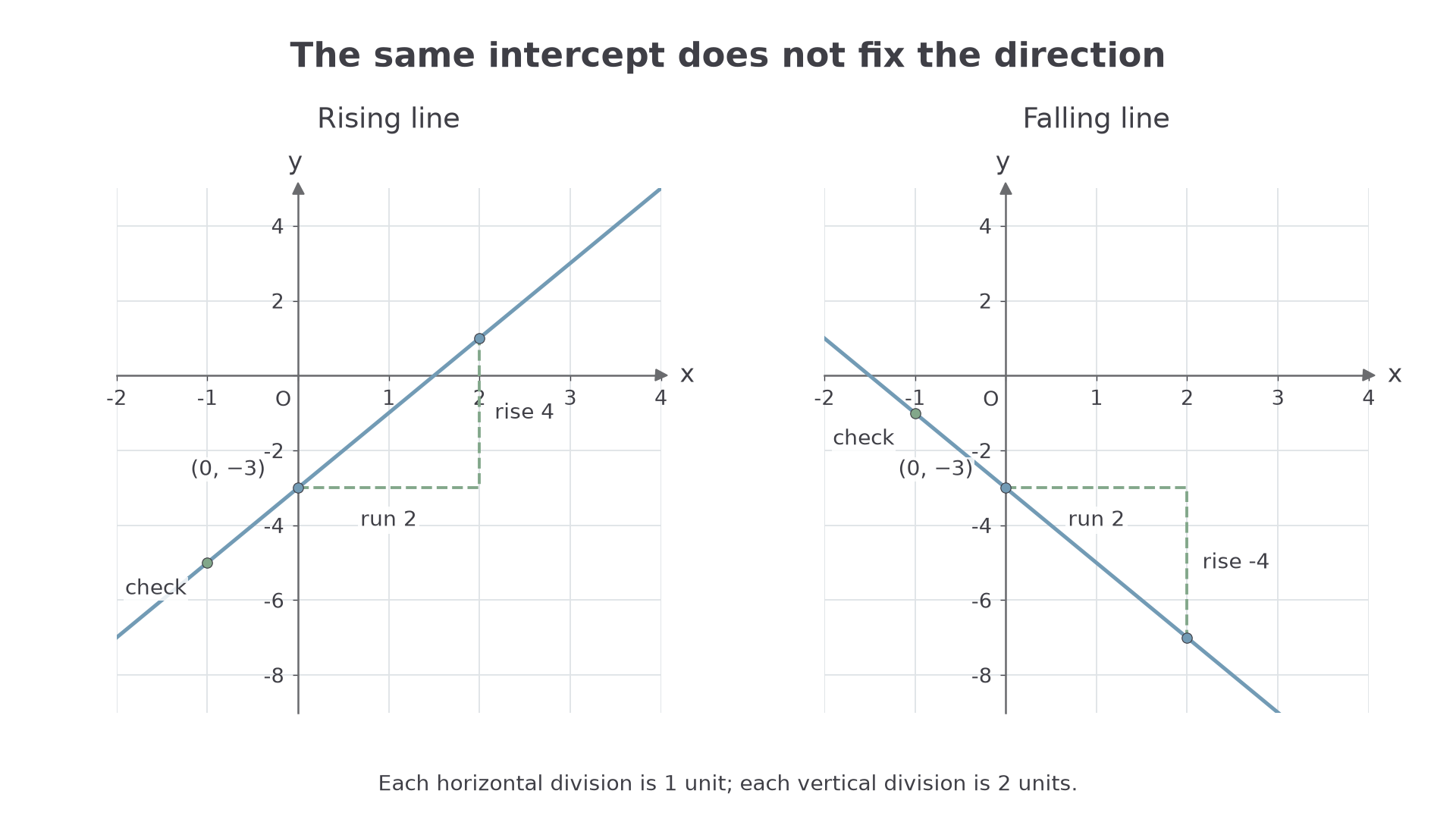
Worked example 3: a rising graph
Question. Find the equation of the line in the left grid.
Plan. Read the crossing value and use the displayed triangle for the gradient.
Answer. .
Check. The separate graph point gives , so the equation agrees with it.
Change only the gradient's sign, keeping the intercept at negative three. The second graph falls to the right.
Worked example 4: a falling graph
Question. Find the equation of the line in the right grid.
Plan. Read the same intercept, but give the downward rise a negative sign.
Answer. .
Check. At the separate marked point , the equation gives , matching the graph.
Continue this lesson.
You’re previewing NovaLearn without an account. Create a free account to read the rest.
Create free account