C2.2; E2.2 - Expanding and taking out common factors
Multiplying a whole sum and multiplying its separate terms give the same result. You will use that fact to expand brackets, handle negative signs, and reverse the process by taking out the highest common factor.
The distributive law
Can and really describe the same quantity for every ? Three bags, each containing counters and four extra counters, contain three lots of and twelve extras. You can count by bags or by types of counter.
This is the distributive law: a multiplier outside brackets multiplies every term inside. In symbols,
It follows from how multiplication distributes over addition. It works for real numbers, including zero, negative numbers and fractions; the bags are just a starting picture for positive whole numbers.
Expand
To expand is to remove brackets by carrying out the multiplication. For example, . An expanded answer may then need like terms collected.
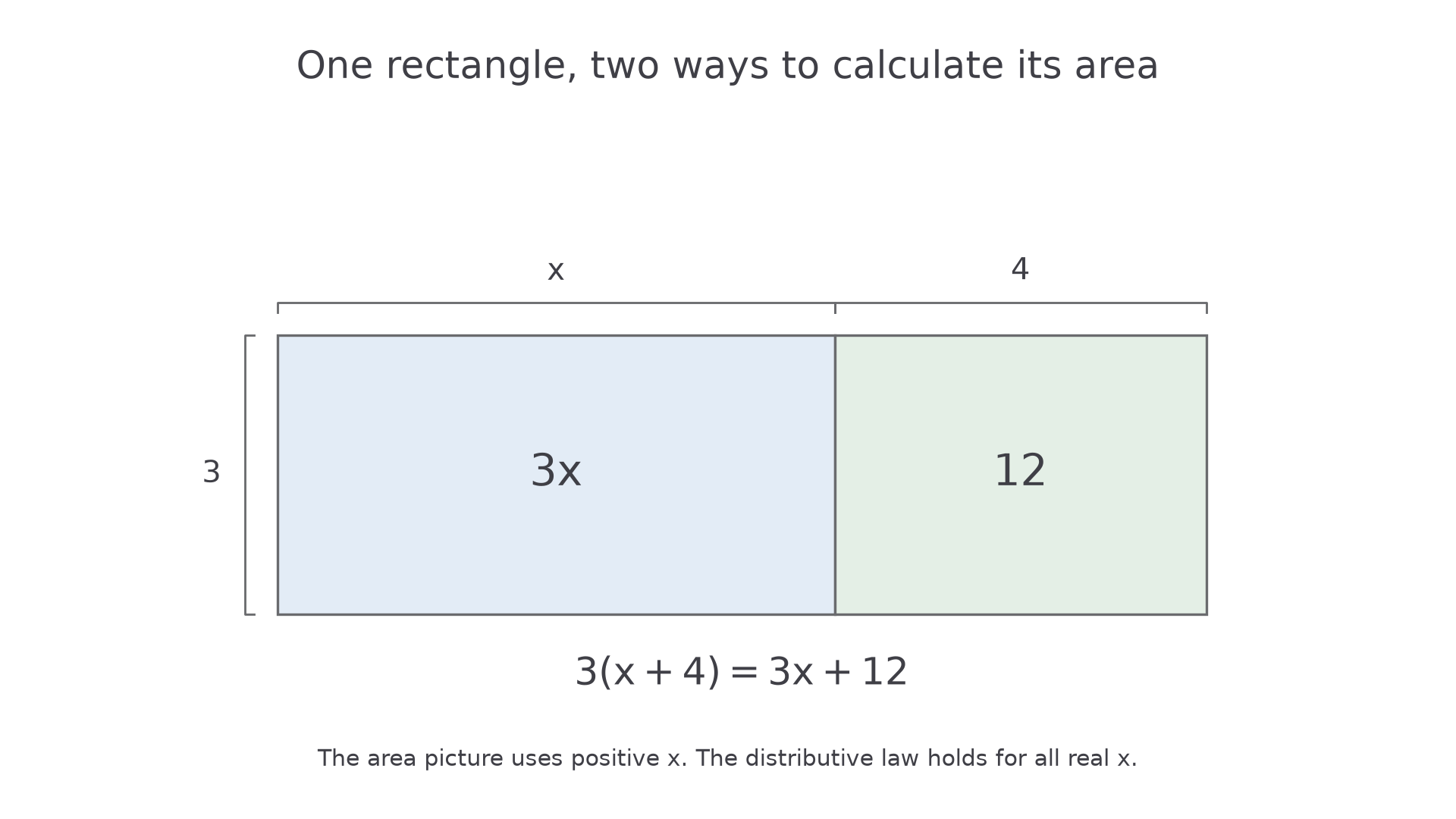
A split rectangle shows the same reasoning. For positive , its total area can be calculated using the whole width or by adding the two smaller areas.
[DIAGRAM: asset_name: One rectangle counted two ways; asset_slug: distributive_area; caption: A rectangle of height three and width x plus four has area three x plus twelve.; description: A rectangle of height three is split into widths x and four. The left pale blue region is labelled three x and the right pale sage region twelve. Height three, widths x and four, and total area three times bracket x plus four equals three x plus twelve are labelled. The picture represents positive x; the algebraic distributive law also holds for other real values.]
Worked example 1: a numerical multiplier
Question. Expand .
Plan. Multiply each term inside the brackets by .
Answer. .
Check. At , the original is ; the answer is . The rectangle explains why the expansion works generally, rather than only at this input.
Now multiply the outside factor by . The same two products are required, but one contains two factors of .
Worked example 2: a letter in the multiplier
Question. Expand .
Plan. Multiply both terms by the complete outside factor .
Answer. .
Check. At , the original is ; the answer is .
The factor can be a number, a letter or a product of both. When multiplying letter powers, count the factors: . When different letters occur, retain them both: .
Watch out
misses the in the second product. The whole multiplier applies to both terms, giving .
Use an intermediate line showing every product whenever there is a risk of missing one.
Expanding with negative terms
Subtraction inside a bracket does not change the rule. Read as , so . A negative outside factor changes the signs of both products, using the signed multiplication rules you already know.
For example, . The positive comes from multiplying two negative numbers; it is not a separate “bracket sign rule”.
Worked example 3: a negative term inside
Question. Expand .
Plan. Treat the second term as , then multiply both terms by .
Answer. .
Check. At , , the original is ; the answer is .
Change only the sign of the outside factor. The whole result must now be the negative of the previous result.
Worked example 4: a negative outside factor
Question. Expand .
Plan. Include the minus sign in each multiplication.
Answer. .
Check. At , , the original is . The answer gives , the opposite of the previous example's value.
A minus sign immediately before brackets means multiplication by . Therefore and . For instance, . Both terms in the subtracted bracket change sign.
Watch out
is wrong: is positive. Write the signed products before simplifying.
The number of different letters does not change a single-bracket expansion. Each product simply retains all its letter factors.
Taking out the highest common factor
You can run expansion backwards. Since , the sum can be written as a product. This is factorisation. In a common-factor question, “factorise” means take out the highest common factor so that no further common factor remains inside.
Common factor
A common factor of the terms divides every term exactly. Their highest common factor, or HCF, includes the greatest common numerical factor and every letter factor shared by all the terms, using its lowest power.
For and , the coefficient HCF is . Both contain an , but only the second contains , so the complete HCF is . Build the remaining bracket by dividing each term by the factor you have removed.
This division is a way to find the factors symbolically; the finished product identity is still valid at . You are not imposing a new condition that .
Worked example 5: a shared letter factor
Question. Factorise fully .
Plan. Take out the numerical HCF and one common factor of .
Answer. .
Check. Expanding gives exactly. The terms and have no common numerical or letter factor other than , so this is fully factorised.
Now multiply both original terms by . That new shared factor must also appear outside.
Worked example 6: an additional shared letter
Question. Factorise fully .
Plan. Take out , leaving the smallest shared power of each letter outside.
Answer. .
Check. Multiplying by gives , and by gives . The remaining terms share no further factor.
For a subtraction, keep the subtraction in the bracket. For example, . If a term equals the factor removed, its remainder is : , not .
Watch out
is equivalent, but it is not fully factorised: and still share . Taking out finishes the common-factor task.
Expanding your answer checks every original term and sign. This check establishes an identity for all values, including zero.
Quick Recap
- Expanding multiplies every term in a bracket by the complete outside factor.
- Negative signs follow the ordinary rules for multiplying signed numbers.
- Factorising reverses expansion; include all shared numerical and letter factors.
- Expand a factorised answer to check its terms and signs.
The opening expressions and agree for every real : they are two forms of the same distributive-law calculation.