C4.1, C4.4; E4.1, E4.4 - Similar shapes and length scale factors
A photograph can change size while keeping its shape. You will recognise similar and congruent shapes, match corresponding sides and angles, and use a length scale factor to find missing lengths.
Similarity and congruence
A photograph is wide and high. You make it wide. Should its height become or to preserve the picture? Adding the same amount to each length feels reasonable, but shape depends on ratios.
The original width-to-height ratio is . A by copy has that same ratio; a by copy does not. The second copy stretches the picture unevenly.
Similar and congruent shapes
Similar shapes have the same shape: corresponding angles are equal and corresponding lengths are in one common ratio. Corresponding means matching the same position or feature in the two shapes.
Congruent shapes have the same shape and size. Their corresponding lengths and angles are equal. Turning, moving or reflecting a shape does not change its size or shape.
[DIAGRAM: asset_name: Keeping a photograph in proportion; asset_slug: similarity_rectangles; caption: Multiplying every length by the same factor preserves shape; adding the same amount need not.; description: Three exact rectangles measure 6 by 4, 9 by 6, and 9 by 7 centimetres. The first two share a width to height ratio of three to two. The third is visibly taller relative to its width. Each side length is labelled.]
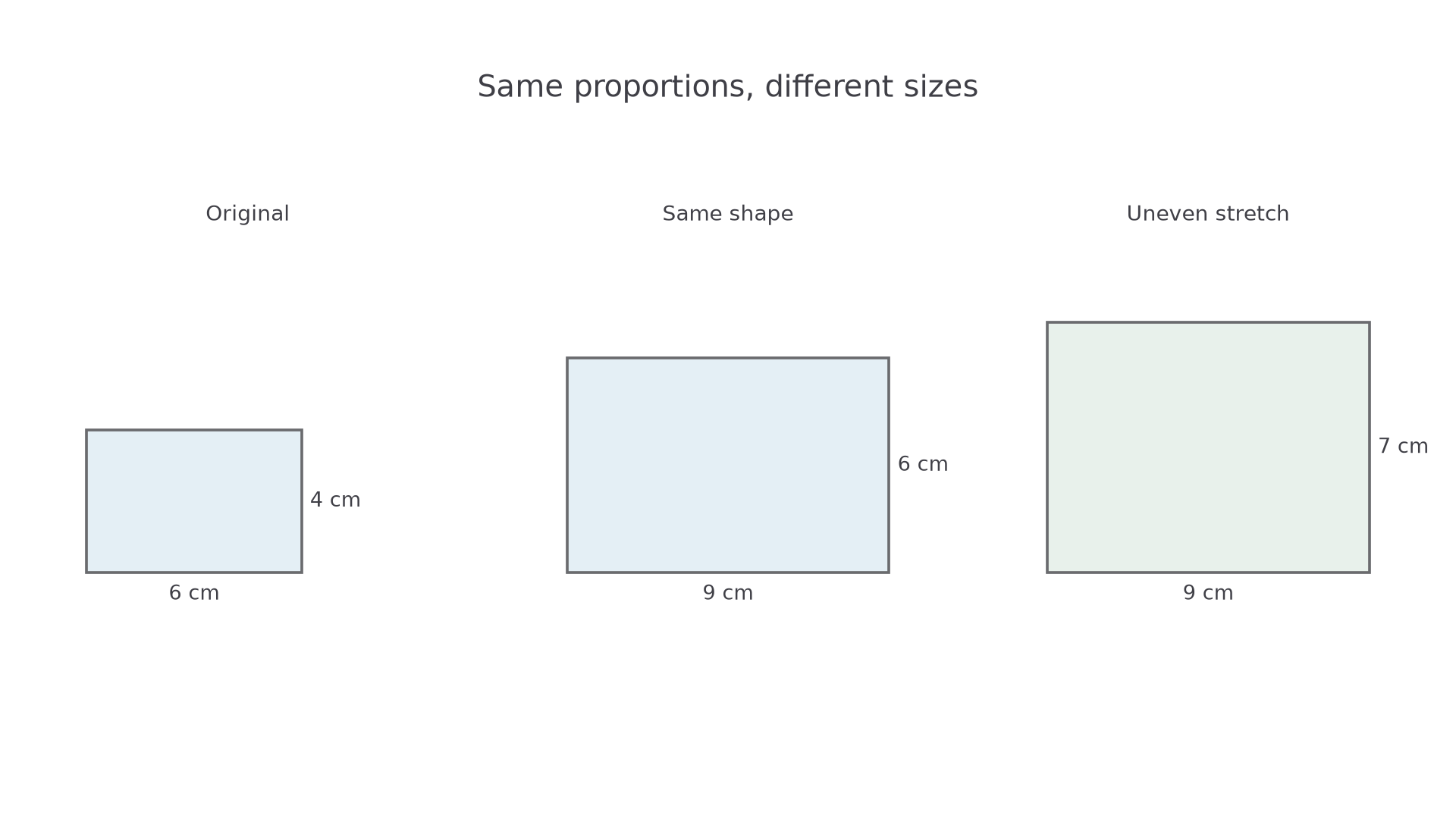
Congruent shapes are also similar: the common length factor is . Similar shapes need not be congruent. A small square and a large square are similar, but only equal-sized squares are congruent. Two rectangles are not automatically similar just because both have four right angles: their length ratios must match too.
Key idea
Similarity preserves angles and proportions; congruence also preserves every length. Match features before comparing measurements, even when a shape has been turned over.
Use the ratios rather than the page orientation.
Corresponding lengths and scale factors
A scale factor needs a direction. The factor taking a small copy to a large copy differs from the factor taking the large copy back to the small one. Choose a known pair of corresponding sides, using the angle labels or the stated vertex order rather than their appearance on the page.
Length scale factor
For similar shapes, the positive length scale factor from shape to shape is
Every length in is times its corresponding length in . A factor greater than enlarges; a factor between and reduces; gives congruent copies.
Not given in the List of formulas: learn this relationship.
[DIAGRAM: asset_name: Direction matters for a scale factor; asset_slug: length_scale_directions; caption: Match the vertices first, then divide target length by starting length.; description: Three separate pairs of similar right triangles have explicitly stated matching vertices in the order ABC and DEF. First AB is 4 and DE is 10 centimetres; second AB is 10 and DE is 4 centimetres; third AB is 9 and DE is 6 centimetres. Matching right angles are marked. The triangle names identify ABC as the start and DEF as the target.]
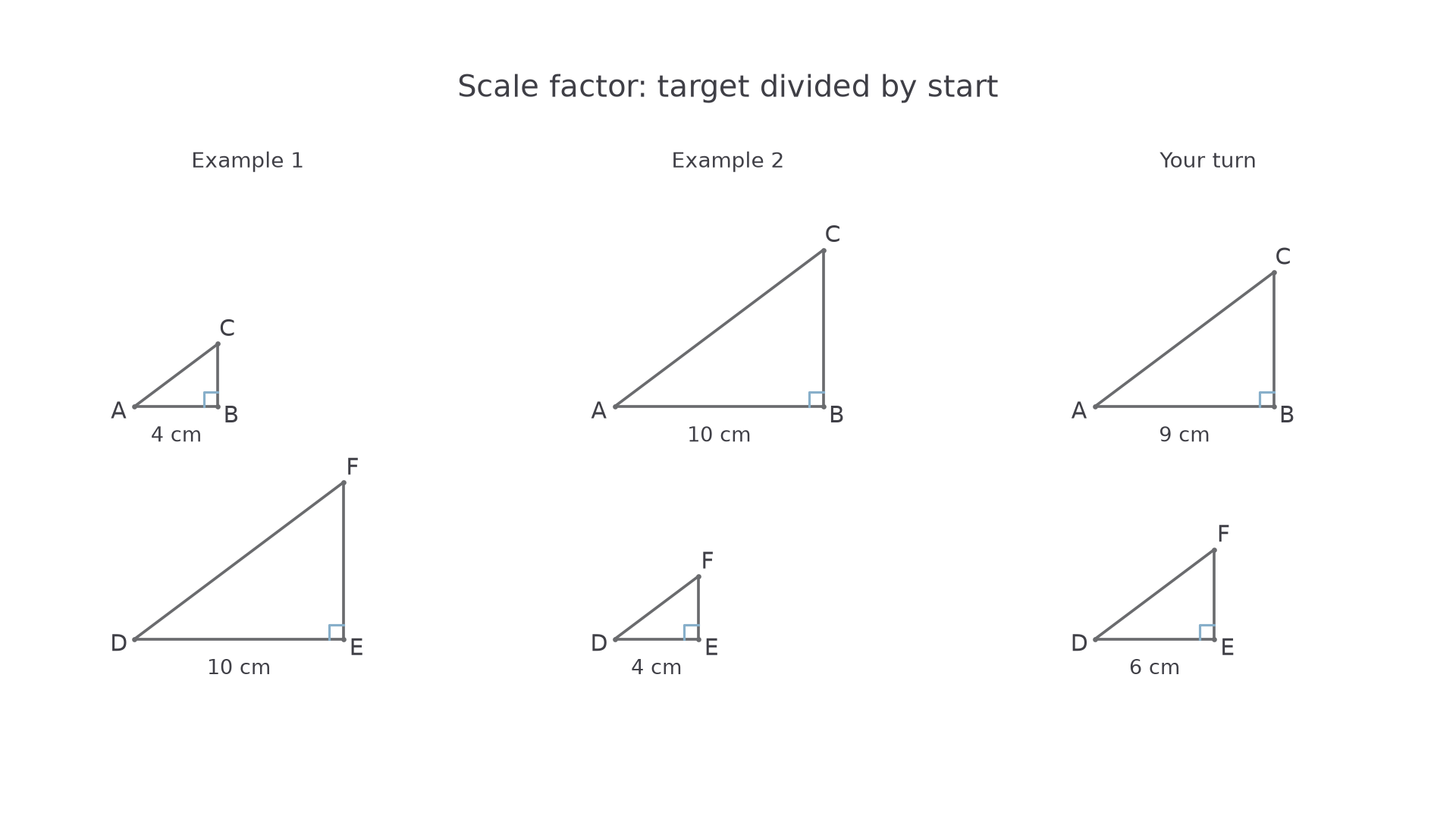
Worked example 1: from small to large
Question. Triangles and are similar, with , , . Given and , find the length scale factor from to .
Plan. Divide the target side by its matching starting side .
Answer. The scale factor is .
Check. . The target side is longer, so a factor greater than makes sense.
Continue this lesson.
You’re previewing NovaLearn without an account. Create a free account to read the rest.
Create free account