C3.6; E3.6 - Parallel line equations
Parallel lines share a direction but occupy different positions. You will recognise equal gradients, find the equation of a parallel line through a stated point and check that it meets both conditions, as required by C3.6 and E3.6.
Parallel lines have equal gradients
Can you change the equation so that its line never meets the first one? Changing the constant to produces . At each input, the second output is four lower. Both lines rise two for every step right, so the gap never closes.
[DIAGRAM: asset_name: Same gradient, different intercepts; asset_slug: parallel_gradients; caption: Equal rises for equal runs keep the lines apart.; description: One numbered Cartesian grid shows the distinct parallel lines y equals two x plus one and y equals two x minus three. Matching triangles on the two lines both have run one and rise two. The y-intercepts one and negative three are highlighted.]
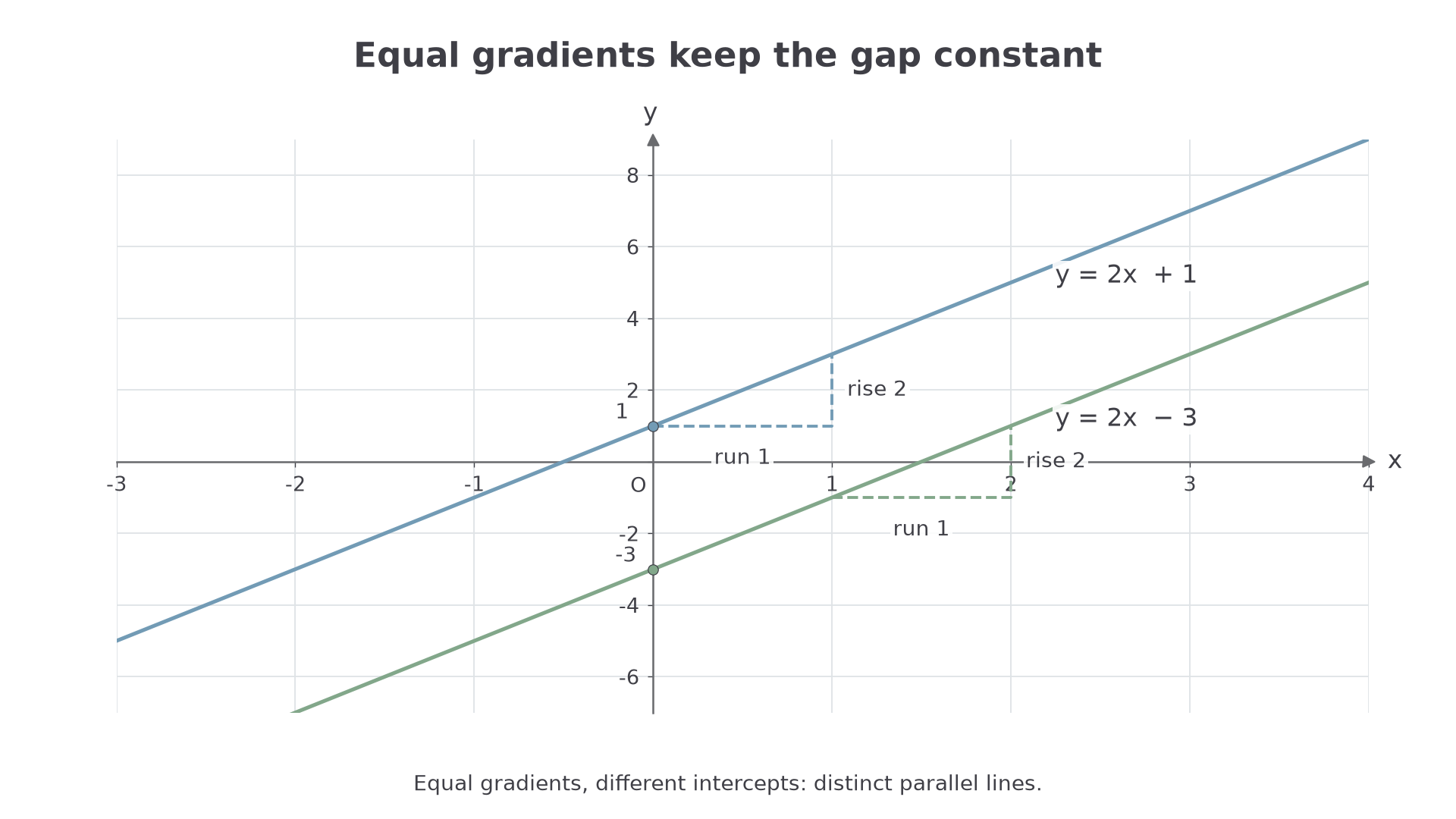
Parallel lines and gradients
Distinct non-vertical straight lines are parallel exactly when their gradients are equal. In , equal and different give distinct parallel lines. Equal and equal give the same line, also called coincident lines.
Why will different intercepts stay separate? For the same input, subtracting the two outputs cancels the identical terms. Only the fixed difference between their constants remains. It cannot become zero at a special input. The conclusion does not depend on where the diagram stops.
Worked example 1: different intercepts
Question. Are and distinct parallel lines?
Plan. Compare gradients, then check that the intercepts differ.
Answer. Yes. Their gradients are equal and their intercepts are different.
Check. Trying to make their outputs equal gives , hence , which is impossible. They have no common point.
Now change only the second intercept from to . Equal gradients alone no longer establish two distinct lines.
Worked example 2: the same line twice
Question. Are and distinct parallel lines?
Plan. Compare the complete equations, including their constants.
Answer. No. They are coincident: both equations describe the same line.
Check. At , both give ; at , both give . Since their expressions are identical, this agreement holds for every input.
Distinct horizontal lines are parallel because each has gradient zero. Distinct vertical lines are also parallel, but their gradients are undefined: compare their equations instead of trying to compare numerical gradients.
Watch out
The gradients of and are not equal. Opposite signs mean different directions, even though both coefficients have size two. Compare signed gradients.
Finding an intercept through a point
Knowing a parallel line's gradient does not fix its position. A stated point supplies the missing information. Keep the known gradient, write , substitute the point's two coordinates and solve for the unknown constant .
You already know
A point lies on a line when its coordinates satisfy the equation. To solve for an unknown constant, use the same balance operations as in a linear equation.
Substitute both coordinates, including their signs. The point gives a value of ; it is not automatically the y-intercept, which occurs only when .
Worked example 3: a point to the right
Question. Find the equation of the line parallel to that passes through .
Plan. Keep gradient three, then use the point to find the intercept.
Answer. .
Check. At , the new equation gives , as required. Its output is always nine below the original line, because , so the lines stay distinct and parallel.
Change only the sign of the point's first coordinate. The gradient stays fixed, but the intercept must move.
Continue this lesson.
You’re previewing NovaLearn without an account. Create a free account to read the rest.
Create free account