C1.1; E1.1 - Highest common factors and lowest common multiples
Sharing objects into equal groups and finding when two repeating events meet use the same number facts in different ways. You will find highest common factors and lowest common multiples by listing and prime factors, then choose the one a problem needs.
Highest common factors
You have red counters and blue counters. What is the greatest number of identical packs you can make using them all? A possible pack count must divide both totals exactly, so this is a question about common factors.
Highest common factor
A common factor of two positive integers is a positive integer that divides both exactly. Their highest common factor, or HCF, is the greatest of those common factors. For example, the common factors of and are , so their HCF is .
For small numbers, list their factors and choose the largest shared entry. Prime factorisation gives a more efficient method for larger numbers. A common factor can use only the prime copies available in both numbers. Take as many shared copies as possible, counting repeated primes carefully.
[DIAGRAM: asset_name: Matching prime copies for a common factor; asset_slug: hcf_prime_copies; caption: The greatest shared product uses two copies of two and one copy of three.; description: Prime factor rows for forty-eight and sixty. Forty-eight is shown as two, two, two, two, three; sixty is shown as two, two, three, five. Pale green highlights two matched copies of two and one matched copy of three in each row. Unmatched factors are pale blue. The shared product is labelled two times two times three equals twelve.]
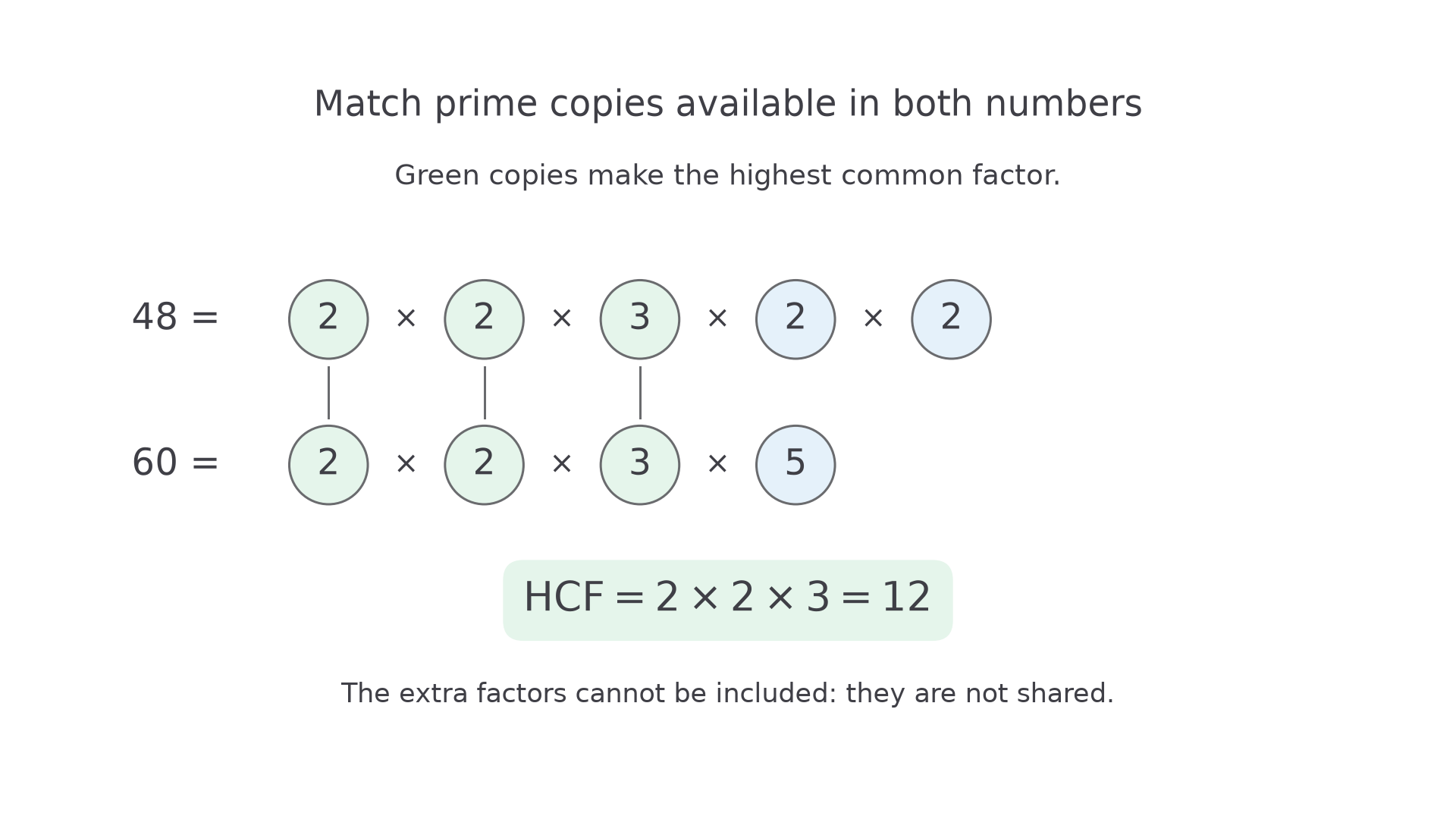
Worked example 1: listing and matching prime copies
Question. Find the HCF of and .
Plan. Identify their common factors, then confirm the largest using prime factors.
The largest shared entry is . The prime copies explain why:
Answer. .
Check. and , both whole numbers. The remaining factors and have no common factor greater than , so nothing further can be included in the HCF.
Keep , but change to . There are now three copies of available in both numbers instead of two.
Worked example 2: one number has more shared copies
Question. Find the HCF of and .
Plan. Compare factor lists, then select the shared prime copies.
Using primes gives the same result:
Answer. .
Check. and . The remaining factors and share no factor greater than .
If two positive integers have no shared prime factor, their HCF is . The number divides every positive integer. The HCF can also equal one of the given numbers: the HCF of and is .
Watch out
For and , taking every prime copy gives something too large to divide both numbers. The HCF must fit inside both, so each prime uses the smaller available number of copies.
Lowest common multiples
A common multiple must contain enough equal groups to be divisible by each of the given numbers. Unlike a common factor, it need not fit inside either number: both numbers must fit inside it.
Lowest common multiple
A common multiple of two positive integers is a number that is a multiple of both. Their lowest common multiple, or LCM, is their smallest positive common multiple. For example, is the LCM of and . Zero is a common multiple, but is excluded by “positive”.
For small numbers, list positive multiples until the first shared entry appears. With prime factors, include enough copies of each prime to build either original number: use the larger available count of each prime. Once included, the same copy can serve both numbers; do not automatically include it twice.
Worked example 3: the first shared multiple
Question. Find the LCM of and .
Plan. Find their first shared positive multiple, then confirm using prime factors.
The prime method needs two copies of for , and two copies of for :
Answer. .
Check. and . Removing a factor of would leave , not divisible by ; removing a factor of would leave , not divisible by .
Keep , but replace by . This time one given number is already a multiple of the other.
Worked example 4: one number already contains the other
Question. Find the LCM of and .
Plan. Test whether the larger given number is itself a common multiple.
The prime counts agree:
Answer. .
Check. and . No positive multiple of is smaller than , so no smaller common multiple is possible.
Multiplying the two given numbers always gives a common multiple, but it may not be the lowest one. For and , the product includes shared prime copies twice; already contains all the copies needed. If their HCF is , there are no shared prime copies, and their product is the LCM.
Watch out
“Common” does not mean “lowest”. The number is a common multiple of and , but the LCM is . State the smallest positive shared value.
Choosing HCF or LCM in a problem
Decide what the answer must do before calculating. Must it divide both quantities, or must both quantities divide it? That distinction is more reliable than searching for a single word such as “greatest” or “first”.
| Situation | What must be true? | Choice |
|---|---|---|
| Greatest number of identical packs, with nothing left over | Pack count divides each object total | HCF |
| Longest equal pieces cut from two lengths, with no waste | Piece length divides each original length | HCF |
| First positive time two regular events repeat together | Elapsed time is a multiple of each interval | LCM |
| Smallest positive total that can be grouped in either of two sizes | Each group size divides the total | LCM |
In a repeating-event problem, use the same time units and identify a common starting time. The LCM gives the first meeting after that start; the shared starting instant itself is not a positive elapsed time.
Worked example 5: identical packs
Question. There are red counters and blue counters. All the counters are put into identical packs. Find the greatest number of packs, and the number of each colour in one pack.
Plan. Find the largest pack count that divides both totals, then divide to find the contents.
Answer. packs, each containing red counters and blue counters.
Check. Six packs use red and blue counters. A larger pack count could not divide both totals, because is their HCF.
Keep the same two numbers, but change their role: they are now repeating intervals rather than totals to share. This deliberate change reverses which way the divisibility must work.
Worked example 6: repeating events
Question. Two lights flash together at noon. One flashes every minutes and the other every minutes. Find the first time after noon when they flash together again.
Plan. Find the smallest positive elapsed time divisible by both intervals, then add it to noon.
Answer. , or pm.
Check. and , so each light has completed a whole number of intervals. The positive multiples show that neither earlier -minute flash coincides with an -minute flash.
The opening counter problem therefore gives , while a repeating-event problem using the same numbers gives . Choosing the relationship is the mathematical work; the numbers alone do not tell you which operation to use.
Problem-solving
Write a short condition for the answer: “must divide both” leads to common factors; “must be divisible by both” leads to common multiples. Then use the size condition to choose the highest factor or lowest positive multiple.
Quick Recap
- The HCF is the greatest positive divisor shared by both numbers.
- The LCM is the smallest positive multiple shared by both numbers.
- For prime factors, the HCF uses shared copies; the LCM uses enough copies to build either number.
- In a problem, decide whether the answer divides the quantities or is divisible by them.
The opening red and blue counters make at most identical packs, each with red and blue counters.